🧮 Autoregressive Transformer: Encoder + Decoder
This notebook implements the original Transformer (Vaswani et al., 2017, Attention Is All You Need) in pure NumPy — the full encoder–decoder architecture, with every intermediate matrix printed and every formula written out.
The task here is autoregressive next-token prediction:
- the encoder reads a prefix of the sentence (9 tokens);
- the decoder predicts the continuation of that same sentence (6 tokens), one token at a time, each prediction conditioned on the prefix and on everything it has already generated.
This is the "prefix-LM" arrangement: same architecture as translation, different task. Nothing about the encoder, the decoder, or the cross-attention changes — only what the two sequences contain.
The chain is carried all the way to the end:
tokens → IDs → embeddings → positional encoding → encoder (MHA + FFN) → decoder (masked MHA + cross-attention + FFN) → linear projection → logits → softmax → next token
The Autoregressive Factorization
"Autoregressive" means the model factorizes the probability of the whole continuation into a product of next-token probabilities, each conditioned only on what came before:
$$P(y_1, y_2, \dots, y_n \mid x) \;=\; \prod_{t=1}^{n} P(y_t \mid y_1, \dots, y_{t-1},\, x)$$
Two architectural components enforce the "only on what came before" part, and both are implemented below:
- Shift right — at position $t$ the decoder is fed $y_{t-1}$, never $y_t$.
- Causal mask — position $t$ cannot attend to positions $> t$.
The conditioning on $x$ (the prefix) enters through cross-attention, which is the one place the encoder and decoder touch:
$$Q \text{ from the \textbf{decoder}}, \qquad K, V \text{ from the \textbf{encoder}}$$
Honest caveat, stated once: the weights here are random, not trained. Every number is computed correctly, but the predicted token is meaningless. The purpose is the mechanics of the forward pass, not linguistic quality.
NumPy: 2.4.4
Display helpers ready: show_matmul, show_elementwise, show_masked, show_weights_masked, expand.
1. Task & Hyperparameters
The sentence is split into two parts:
| content | length | fed to | |
|---|---|---|---|
| prefix $x$ | the cat sat on the mat and was looking |
9 | encoder |
| continuation $y$ | at a tiny mouse running by |
6 | decoder (autoregressively) |
The decoder must produce at a tiny mouse running by <eos>, one token at a time.
The two lengths are deliberately different (9 vs 6). This matters: it forces the cross-attention matrix to be rectangular ($n_{tgt} \times n_{src}$), which is easy to get wrong when both lengths are equal, and it makes the shapes unambiguous when reading the printouts.
Note that both halves share one vocabulary — they are two parts of the same English sentence. In the translation version of this architecture the two halves would be two different languages; the machinery is identical either way.
| Symbol | Meaning | Value |
|---|---|---|
| $n_{src}$ | prefix length | 9 |
| $n_{tgt}$ | decoder input length | 7 (<sos> + 6 words) |
| $d_{model}$ | embedding / model width | 8 |
| $h$ | number of attention heads | 2 |
| $d_k = d_v = d_{model}/h$ | width of one head | 4 |
| $d_{ff}$ | inner width of the FFN | 32 ($=4 d_{model}$) |
| $V$ | vocabulary size | 500 |
Full sentence (15 tokens): ['the', 'cat', 'sat', 'on', 'the', 'mat', 'and', 'was', 'looking', 'at', 'a', 'tiny', 'mouse', 'running', 'by']

PREFIX       -> encoder (9 tokens): ['the', 'cat', 'sat', 'on', 'the', 'mat', 'and', 'was', 'looking']
CONTINUATION -> decoder (6 tokens): ['at', 'a', 'tiny', 'mouse', 'running', 'by']

d_model=8, h=2, d_k=4, d_ff=32, V=500
2. Vocabulary & Token IDs
As requested, token IDs are random integers in [50, 500) — this mimics a real tokenizer, where the ID is an arbitrary index into a vocabulary, carrying no meaning by itself.
Three IDs are reserved below 50, as is standard:
<pad>= 0 — padding (not used here, sequences are not batched)<sos>= 1 — start of sequence, fed to the decoder at position 0<eos>= 2 — end of sequence, what the decoder must predict last
Prefix and continuation share one vocabulary of size $V = 500$ — they are halves of the same sentence. Note that the repeated word "the" receives the same ID at both of its positions — an embedding table is a lookup by ID, so identical words start from identical vectors. What makes them differ later is positional encoding and context.
Vocabulary: 17 entries used out of V=500

PREFIX token -> ID  (encoder)
  the       -> 83
  cat       -> 168
  sat       -> 458
  on        -> 328
  the       -> 83
  mat       -> 421
  and       -> 185
  was       -> 276
  looking   -> 274

CONTINUATION token -> ID  (decoder)
  at        -> 127
  a         -> 340
  tiny      -> 68
  mouse     -> 57
  running   -> 412
  by        -> 322

Note: 'the' appears at positions 0 and 4, both with ID 83.
3. Weight Initialization
The old notebook drew every weight from np.random.rand, i.e. $\mathcal{U}(0,1)$: all entries positive, mean 0.5.
For $y = xW$ with $W \in \mathbb{R}^{8\times 8}$ and all entries positive, each output is a sum of 8 positive products, so $\mathbb{E}[y] \approx 8 \cdot 0.5 \cdot \mathbb{E}[x] = 4\,\mathbb{E}[x]$. The signal is multiplied by ~4 at every matrix product, and it is never re-centred because there is no LayerNorm. Chaining ≈ 8 such products gives $4^8 \approx 65\,000$ — exactly the order of magnitude seen in the old output (≈ 80 000). Worse, since all rows grow in the same direction, they become nearly parallel and the row-to-row differences vanish: the tokens lose their identity.
Xavier/Glorot initialization fixes the scale:
$$W_{ij} \sim \mathcal{U}(-a, a), \qquad a = \sqrt{\frac{6}{fan_{in} + fan_{out}}}$$
which keeps $\mathrm{Var}(y) \approx \mathrm{Var}(x)$ and $\mathbb{E}[y] = 0$.
After 8 chained matmuls, no LayerNorm:
  U(0,1) init  -> mean |value| =   33138.98   row-to-row std = 9033.2708
  Xavier init  -> mean |value| =     0.2531   row-to-row std = 0.1784

The U(0,1) rows have exploded AND collapsed onto each other.
4. Embeddings
The embedding table is $E \in \mathbb{R}^{V \times d_{model}} = \mathbb{R}^{500 \times 8}$. Looking up token ID $t$ means taking row $t$: this is exactly a one-hot vector times $E$,
$$\mathrm{emb}(t) = \mathbf{e}_t^\top E, \qquad \mathbf{e}_t \in \{0,1\}^{V}$$
but implemented as indexing, since the matrix product would be wasteful.
Scaling by $\sqrt{d_{model}}$. The paper multiplies the embeddings by $\sqrt{d_{model}}$ before adding the positional encoding (Section 3.4). The reason is scale matching: positional encodings are sines and cosines with values in $[-1, 1]$, while embeddings initialized with variance $1/d_{model}$ have entries around $\pm 0.35$. Without the scaling, the positional signal would dominate the semantic signal. Here $\sqrt{8} \approx 2.83$.
Embedding table E shape: (500, 8)

src_emb = E[src_ids] * sqrt(8) = E[src_ids] * 2.8284
Prefix embeddings shape: (9, 8)

  the       (id  83) -> [-0.1   -0.204 -0.878 -0.827 -0.226  0.367  0.914 -0.803]
  cat       (id 168) -> [-0.685  0.791 -1.97   0.893 -1.211  0.731  0.014 -0.954]
  sat       (id 458) -> [ 1.393  0.839  0.873 -0.966 -0.079 -0.3   -1.006  0.36 ]
  on        (id 328) -> [ 1.221 -0.877  1.712 -1.748  0.435  0.475 -0.796  0.424]
  the       (id  83) -> [-0.1   -0.204 -0.878 -0.827 -0.226  0.367  0.914 -0.803]
  mat       (id 421) -> [ 0.234  1.035 -0.836  1.424 -0.092 -0.888  0.998 -0.287]
  and       (id 185) -> [-0.536 -1.707 -1.117  1.236 -0.156 -0.548  0.16   0.502]
  was       (id 276) -> [-0.864  1.279  1.042  0.584 -0.13   0.58  -0.707  0.856]
  looking   (id 274) -> [ 0.234 -0.249  1.201  0.14  -1.967 -1.117 -0.186  0.31 ]

Check that both occurrences of 'the' are identical before PE:
  position 0: [-0.1   -0.204 -0.878 -0.827 -0.226  0.367  0.914 -0.803]
  position 4: [-0.1   -0.204 -0.878 -0.827 -0.226  0.367  0.914 -0.803]
  identical? True
5. Positional Encoding
Self-attention is a set operation: it computes a weighted sum over positions, and the weights depend only on content. Nothing in $QK^\top$ knows that position 3 comes after position 2. Order must therefore be injected into the input itself.
The sinusoidal encoding from the paper, for position $pos$ and dimension index $i$:
$$PE_{(pos,\,2i)} = \sin\!\left(\frac{pos}{10000^{2i/d_{model}}}\right), \qquad PE_{(pos,\,2i+1)} = \cos\!\left(\frac{pos}{10000^{2i/d_{model}}}\right)$$
With $d_{model} = 8$ there are 4 frequency pairs, $i = 0, 1, 2, 3$:
| $i$ | columns | wavelength $2\pi \cdot 10000^{2i/8}$ |
|---|---|---|
| 0 | 0, 1 | $2\pi \approx 6.28$ |
| 1 | 2, 3 | $2\pi \cdot 10 \approx 62.8$ |
| 2 | 4, 5 | $2\pi \cdot 100 \approx 628$ |
| 3 | 6, 7 | $2\pi \cdot 1000 \approx 6283$ |
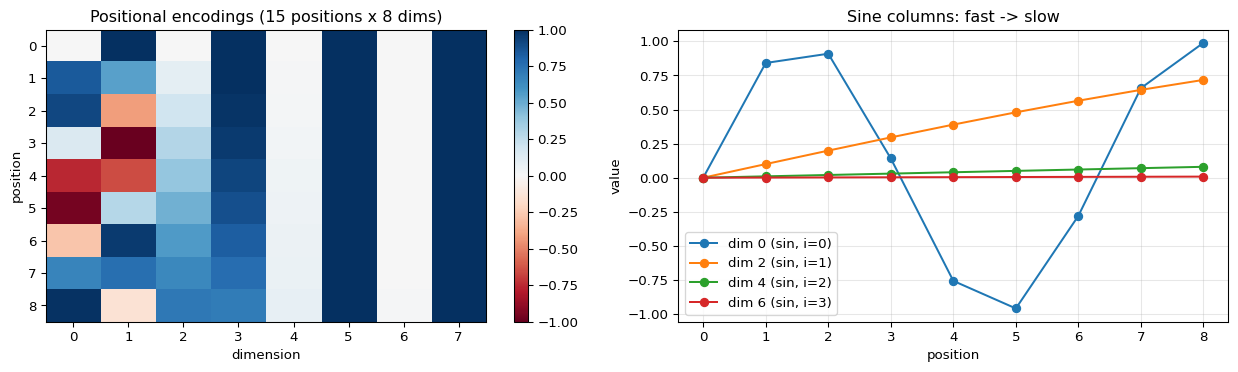
Fast columns encode fine-grained local position; slow columns encode coarse absolute position. The property that makes this choice useful is that $PE_{pos+k}$ is a fixed linear function of $PE_{pos}$ (a 2-D rotation by angle $k\omega_i$ in each frequency pair), so relative offsets are linearly recoverable by the attention weights.
PE_src shape: (9, 8)
[[ 0.     1.     0.     1.     0.     1.     0.     1.   ]
 [ 0.842  0.54   0.1    0.995  0.01   1.     0.001  1.   ]
 [ 0.909 -0.416  0.199  0.98   0.02   1.     0.002  1.   ]
 [ 0.141 -0.99   0.295  0.955  0.03   1.     0.003  1.   ]
 [-0.757 -0.654  0.389  0.921  0.04   0.999  0.004  1.   ]
 [-0.959  0.284  0.479  0.878  0.05   0.999  0.005  1.   ]
 [-0.279  0.96   0.565  0.825  0.06   0.998  0.006  1.   ]
 [ 0.657  0.754  0.644  0.765  0.07   0.998  0.007  1.   ]
 [ 0.989 -0.145  0.717  0.697  0.08   0.997  0.008  1.   ]]

Hand check  PE[3,2] = sin(3 / 10000^(2*1/8)) = sin(3 * 0.100000) = 0.295520
From array  PE[3,2] = 0.295520   ->  match: True
Encoder Input
$$X_{enc} = \mathrm{Embedding}(\text{src\_ids}) \cdot \sqrt{d_{model}} + PE$$
This is the step that was missing in the old notebook. Its effect is visible immediately: the two occurrences of "the" (positions 0 and 4 of the prefix), which had identical embeddings, now have different input vectors.
X_enc shape: (9, 8)

   0 the       [-0.1    0.796 -0.878  0.173 -0.226  1.367  0.914  0.197]
   1 cat       [ 0.157  1.331 -1.87   1.888 -1.201  1.731  0.015  0.046]
   2 sat       [ 2.302  0.423  1.071  0.014 -0.059  0.699 -1.004  1.36 ]
   3 on        [ 1.362 -1.867  2.008 -0.792  0.465  1.475 -0.793  1.424]
   4 the       [-0.857 -0.857 -0.489  0.094 -0.186  1.367  0.918  0.197]
   5 mat       [-0.725  1.319 -0.357  2.302 -0.042  0.111  1.003  0.713]
   6 and       [-0.815 -0.747 -0.552  2.061 -0.096  0.45   0.166  1.502]
   7 was       [-0.207  2.033  1.686  1.348 -0.06   1.577 -0.7    1.856]
   8 looking   [ 1.223 -0.394  1.918  0.837 -1.887 -0.12  -0.178  1.31 ]

'the' at position 0: [-0.1    0.796 -0.878  0.173 -0.226  1.367  0.914  0.197]
'the' at position 4: [-0.857 -0.857 -0.489  0.094 -0.186  1.367  0.918  0.197]
identical now? False  <- order information is now present
Embeddings + Positional Encoding
$X_{enc} = \text{scaled embeddings} + PE$ is element-wise: three matrices of shape $(9, 8)$, nothing mixes across rows or columns. Both operands are printed side by side below.
==============================================================================
  X_enc = emb*sqrt(d) + PE      all three are (9, 8) — element-wise, no mixing
==============================================================================

       the |
      emb*sqrt(d):   -0.100    -0.204    -0.878    -0.827    -0.226    +0.367    +0.914    -0.803
               PE:   +0.000    +1.000    +0.000    +1.000    +0.000    +1.000    +0.000    +1.000
            X_enc:   -0.100    +0.796    -0.878    +0.173    -0.226    +1.367    +0.914    +0.197

       cat |
      emb*sqrt(d):   -0.685    +0.791    -1.970    +0.893    -1.211    +0.731    +0.014    -0.954
               PE:   +0.841    +0.540    +0.100    +0.995    +0.010    +1.000    +0.001    +1.000
            X_enc:   +0.157    +1.331    -1.870    +1.888    -1.201    +1.731    +0.015    +0.046

       sat |
      emb*sqrt(d):   +1.393    +0.839    +0.873    -0.966    -0.079    -0.300    -1.006    +0.360
               PE:   +0.909    -0.416    +0.199    +0.980    +0.020    +1.000    +0.002    +1.000
            X_enc:   +2.302    +0.423    +1.071    +0.014    -0.059    +0.699    -1.004    +1.360

        on |
      emb*sqrt(d):   +1.221    -0.877    +1.712    -1.748    +0.435    +0.475    -0.796    +0.424
               PE:   +0.141    -0.990    +0.296    +0.955    +0.030    +1.000    +0.003    +1.000
            X_enc:   +1.362    -1.867    +2.008    -0.792    +0.465    +1.475    -0.793    +1.424

       the |
      emb*sqrt(d):   -0.100    -0.204    -0.878    -0.827    -0.226    +0.367    +0.914    -0.803
               PE:   -0.757    -0.654    +0.389    +0.921    +0.040    +0.999    +0.004    +1.000
            X_enc:   -0.857    -0.857    -0.489    +0.094    -0.186    +1.367    +0.918    +0.197

       mat |
      emb*sqrt(d):   +0.234    +1.035    -0.836    +1.424    -0.092    -0.888    +0.998    -0.287
               PE:   -0.959    +0.284    +0.479    +0.878    +0.050    +0.999    +0.005    +1.000
            X_enc:   -0.725    +1.319    -0.357    +2.302    -0.042    +0.111    +1.003    +0.713

       and |
      emb*sqrt(d):   -0.536    -1.707    -1.117    +1.236    -0.156    -0.548    +0.160    +0.502
               PE:   -0.279    +0.960    +0.565    +0.825    +0.060    +0.998    +0.006    +1.000
            X_enc:   -0.815    -0.747    -0.552    +2.061    -0.096    +0.450    +0.166    +1.502

       was |
      emb*sqrt(d):   -0.864    +1.279    +1.042    +0.584    -0.130    +0.580    -0.707    +0.856
               PE:   +0.657    +0.754    +0.644    +0.765    +0.070    +0.998    +0.007    +1.000
            X_enc:   -0.207    +2.033    +1.686    +1.348    -0.060    +1.577    -0.700    +1.856

   looking |
      emb*sqrt(d):   +0.234    -0.249    +1.201    +0.140    -1.967    -1.117    -0.186    +0.310
               PE:   +0.989    -0.146    +0.717    +0.697    +0.080    +0.997    +0.008    +1.000
            X_enc:   +1.223    -0.394    +1.918    +0.837    -1.887    -0.120    -0.178    +1.310

  check element [0,0]: -0.100154 + +0.000000 = -0.100154   MATCH: True
6. Layer Normalization
This is the component whose absence caused the 80 000-magnitude output in the old notebook. For each row (each token) independently:
$$\mu = \frac{1}{d}\sum_{j=1}^{d} x_j, \qquad \sigma^2 = \frac{1}{d}\sum_{j=1}^{d}(x_j - \mu)^2, \qquad \mathrm{LN}(x) = \gamma \odot \frac{x - \mu}{\sqrt{\sigma^2 + \epsilon}} + \beta$$
Three points worth being precise about:
- Per row, not per column. Unlike BatchNorm, no statistic is shared across tokens. Token $i$ is normalized using only its own 8 numbers. This is what makes it valid at inference time with a single sequence.
- $\gamma, \beta \in \mathbb{R}^{d_{model}}$ are learned; initialized to $\mathbf{1}$ and $\mathbf{0}$, so LayerNorm starts as pure standardization.
- $\epsilon = 10^{-5}$ guards against division by zero.
The original paper uses post-norm: LayerNorm(x + Sublayer(x)). That is what is implemented below. (Modern implementations often use pre-norm, x + Sublayer(LayerNorm(x)), which trains more stably in deep stacks — but post-norm is the 2017 architecture and this notebook follows it.)
x        = [-0.1    0.796 -0.878  0.173 -0.226  1.367  0.914  0.197]
mean     = 0.2803
variance = 0.4513   (std = 0.6718)
LN(x)    = [-0.566  0.768 -1.724 -0.16  -0.754  1.618  0.943 -0.124]
           mean = -8.33e-17, std = 1.0000
7. Scaled Dot-Product Attention
$$\mathrm{Attention}(Q, K, V) = \mathrm{softmax}\!\left(\frac{QK^\top}{\sqrt{d_k}} + M\right) V$$
Reading it as a sequence of shapes, with $n_q$ queries and $n_{kv}$ keys/values:
| Step | Operation | Shape |
|---|---|---|
| 1 | $Q$, $K$, $V$ | $(n_q, d_k)$, $(n_{kv}, d_k)$, $(n_{kv}, d_v)$ |
| 2 | $S = QK^\top$ | $(n_q, n_{kv})$ — one score per (query, key) pair |
| 3 | $S / \sqrt{d_k}$ | same |
| 4 | $+ M$ (mask, optional) | same |
| 5 | $A = \mathrm{softmax}(\cdot)$ row-wise | same, each row sums to 1 |
| 6 | $AV$ | $(n_q, d_v)$ |
Why divide by $\sqrt{d_k}$? If the components of $q$ and $k$ are independent with mean 0 and variance 1, then $q \cdot k = \sum_{j=1}^{d_k} q_j k_j$ has mean 0 and variance $d_k$, i.e. standard deviation $\sqrt{d_k}$. Feeding scores of that magnitude into a softmax pushes it toward a one-hot distribution, where the gradient is nearly zero. Dividing by $\sqrt{d_k}$ restores unit variance and keeps the softmax in its responsive region. Here $\sqrt{d_k} = \sqrt{4} = 2$.
Softmax, applied to each row $s$ independently:
$$A_{ij} = \frac{\exp(s_{ij})}{\sum_{j'} \exp(s_{ij'})}$$
implemented as exp(s - max(s)) for numerical stability — subtracting the row max changes nothing mathematically (the constant cancels) but prevents exp from overflowing.
Numerical check on a tiny example:
  raw scores q.k    = [[2. 0. 1.]]      (2, 0, 1)
  scaled by sqrt(4) = [[1.  0.  0.5]]
  softmax weights   = [[0.506 0.186 0.307]]  sum = 1.0000
  output = w @ V    = [[5.065 1.863 3.072 0.   ]]
  -> the query matches key 0 most, so V row 0 dominates the output.
8. Multi-Head Attention
The old notebook described "multi-head" but computed a single head and omitted the output projection $W^O$. Both are corrected here.
$$\mathrm{MultiHead}(Q,K,V) = \mathrm{Concat}(\mathrm{head}_1, \dots, \mathrm{head}_h)\,W^O, \qquad \mathrm{head}_i = \mathrm{Attention}(QW_i^Q,\, KW_i^K,\, VW_i^V)$$
Why several heads? A single softmax row is a probability distribution — it can only express one weighting of the context. Averaging cancels competing patterns. With $h$ heads, each head runs the same operation in its own $d_k$-dimensional subspace, so one head can track syntactic agreement while another tracks a co-reference, and $W^O$ recombines them.
Implementation. Rather than $h$ separate small matrices, one uses full $d_{model} \times d_{model}$ matrices $W^Q, W^K, W^V$ and reshapes the result — mathematically identical, since a block of columns of $W^Q$ is exactly $W_i^Q$:
X (n, 8) @ Wq (8, 8) -> Q (n, 8)
             reshape -> (n, 2, 4)
           transpose -> (2, n, 4)      # (heads, tokens, d_k)
Total parameter count is unchanged: $h \cdot d_k = d_{model}$. Multi-head attention costs the same as single-head, but is strictly more expressive.
MHA class defined. Each instance owns Wq, Wk, Wv, Wo of shape (8, 8).
Parameters per attention sub-layer: 4 * 8 * 8 = 256
9. Encoder: Self-Attention
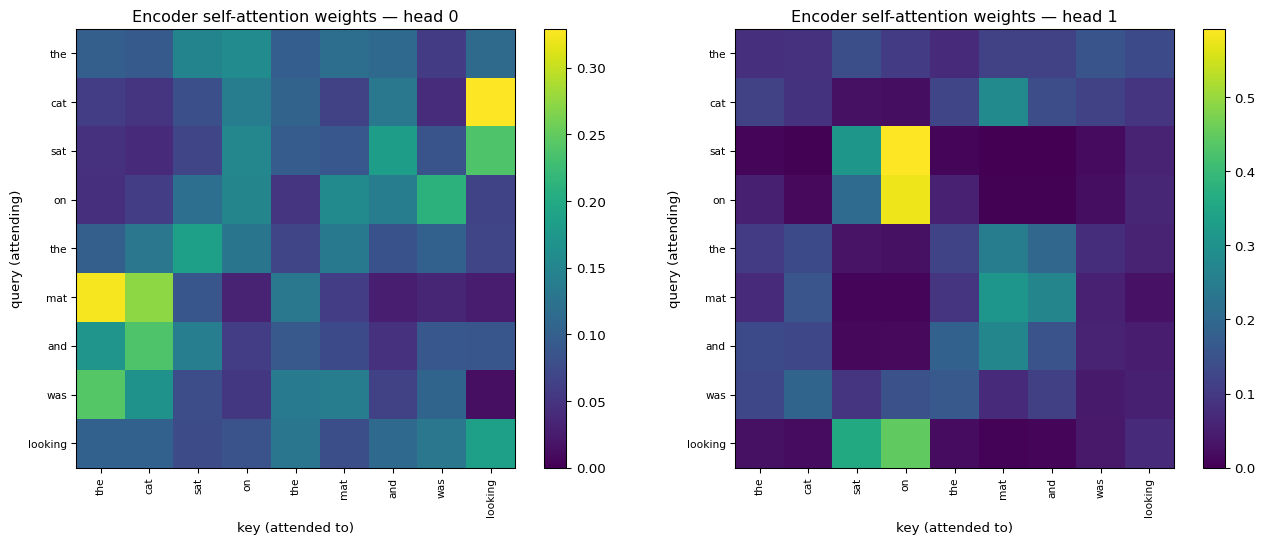
"Self"-attention means $Q$, $K$ and $V$ all come from the same input $X_{enc}$. No causal mask is used here. This is the point that most often causes confusion in an autoregressive setup: the prefix is fully known input, not something being generated, so the encoder is free to be bidirectional — token 2 may look at token 7. The autoregressive constraint applies only to the decoder side, where tokens are produced one at a time.
Below the computation is unrolled, and one score is verified by hand against the definition.
[encoder self-attn] x_q (9, 8) , x_kv (9, 8)
  Q,K,V per head: (2, 9, 4), (2, 9, 4), (2, 9, 4)
  scores/weights: (2, 9, 9)   concat: (9, 8)   out: (9, 8)

--- Head 0: Q, K, V (9 x 4 each) ---
Q[head0]:
[[-0.363  0.43   1.132 -1.267]
 [-1.14  -1.112  0.583 -0.527]
 [-0.04  -0.869  0.345 -0.223]
 [ 1.895  1.278  0.877  0.181]
 [ 0.557  1.335  1.018 -0.361]
 [-1.574  0.05  -0.869 -0.623]
 [-0.513  0.355 -0.385  0.953]
 [ 0.287  0.698 -0.771 -1.189]
 [-0.319 -0.98  -0.91   1.053]]

K[head0]:
[[-0.642  0.947 -0.654 -0.265]
 [-0.815  1.333 -0.331  0.315]
 [-0.212  0.556  1.075  0.39 ]
 [ 0.833 -0.997  1.658 -0.011]
 [ 0.126 -0.482  0.012 -0.353]
 [ 0.888 -0.151  0.471 -0.344]
 [ 1.368 -1.584  1.217 -0.221]
 [ 1.429 -0.377  0.183  0.313]
 [ 0.161 -1.964  2.485  1.113]]

V[head0]:
[[-1.375 -1.282  0.058  1.186]
 [-2.807 -1.31  -0.778  1.31 ]
 [ 0.743  0.139 -0.711 -1.884]
 [ 1.641 -0.434  0.404 -0.671]
 [-1.132 -1.533  0.746  2.018]
 [-3.082 -0.455 -1.491  0.839]
 [-2.619 -1.071 -0.747  1.683]
 [-2.389  0.491 -2.011 -0.774]
 [-1.053 -0.132  0.331 -1.287]]

--- Head 0: raw scores Q K^T / sqrt(d_k), shape (9, 9) ---
[[ 0.117  0.047  0.519  0.579  0.104  0.291  0.24  -0.436  0.25 ]
 [-0.282 -0.457  0.023  0.566  0.292 -0.194  0.514 -0.634  1.432]
 [-0.482 -0.656 -0.095  0.704  0.248  0.167  0.896  0.132  1.156]
 [-0.314 -0.037  0.661  0.878 -0.214  0.921  0.798  1.222  0.087]
 [ 0.168  0.437  0.788  0.412 -0.216  0.449 -0.016  0.183 -0.203]
 [ 0.895  0.72  -0.408 -1.398 -0.007 -0.8   -1.577 -1.311 -1.602]
 [ 0.332  0.66   0.133 -0.715 -0.288 -0.509 -0.972 -0.319 -0.338]
 [ 0.648  0.289 -0.483 -0.862  0.055  0.098 -0.695 -0.183 -2.283]
 [-0.204 -0.207 -0.522 -0.404  0.025 -0.463 -0.112  0.039  0.393]]
q_1 (head 0, token 'cat') = [-1.14  -1.112  0.583 -0.527]
k_8 (head 0, token 'looking') = [ 0.161 -1.964  2.485  1.113]

q . k  = (-1.1400)(0.1606) + (-1.1117)(-1.9641) + (0.5834)(2.4849) + (-0.5266)(1.1127)
       = 2.864096
/ sqrt(d_k) = 2.864096 / 2.0 = 1.432048

From the scores matrix: 1.432048   match: True

Softmax of row 1 (head 0), by hand:
[0.059 0.05  0.08  0.138 0.105 0.065 0.131 0.042 0.329]
sum = 1.000000
matches library row: True
Every row sums to 1: True

Note the full square (no mask): the encoder is bidirectional over the prefix.
The pattern is diffuse because the weights are random, not trained.
Self-Attention, Step by Step
This is the shape question spelled out. Follow the inner dimensions as they cancel:
| # | operation | shapes | result |
|---|---|---|---|
| 1 | $X_{enc} W^Q$ | $(9,8) @ (8,8)$ | $(9,8)$ |
| 2 | split into heads | reshape | $(2,9,4)$ |
| 3 | $Q_0 K_0^\top$ | $(9,4) @ (4,9)$ | $(9,\mathbf{9})$ |
| 4 | softmax | element-wise per row | $(9,9)$ |
| 5 | $A V_0$ | $(9,9) @ (9,4)$ | $(9,\mathbf{4})$ |
| 6 | concat heads | $(9,4) + (9,4)$ side by side | $(9,8)$ |
| 7 | $\cdot\, W^O$ | $(9,8) @ (8,8)$ | $(9,8)$ |
Why step 5 returns $(9,4)$ and not $(9,9)$: the $9 \times 9$ matrix is weights, not content. In $AV$ the shared dimension is the 9 keys, and it cancels — $(9,9)@(9,4) \to (9,4)$. Each output row is a weighted average of the 9 rows of $V$, so it has $V$'s width, which is $d_v = 4$. The count of tokens sets the number of rows, never the number of columns.
The block therefore returns $(9,8)$ — exactly the shape it received. That invariance is what allows 6 blocks to be stacked.
STEP 1 : project X_enc to Q (K and V are identical in form)
==============================================================================
==============================================================================
  X_enc (9, 8)   @   Wq (8, 8)   =   Q_full (9, 8)
  shape rule: (9 x 8) @ (8 x 8) -> (9 x 8)   inner dim 8 cancels
  K uses Wk, V uses Wv — same shapes, same arithmetic
==============================================================================

X_enc =
          the |   -0.100    +0.796    -0.878    +0.173    -0.226    +1.367    +0.914    +0.197
          cat |   +0.157    +1.331    -1.870    +1.888    -1.201    +1.731    +0.015    +0.046
          sat |   +2.302    +0.423    +1.071    +0.014    -0.059    +0.699    -1.004    +1.360
           on |   +1.362    -1.867    +2.008    -0.792    +0.465    +1.475    -0.793    +1.424
          the |   -0.857    -0.857    -0.489    +0.094    -0.186    +1.367    +0.918    +0.197
          mat |   -0.725    +1.319    -0.357    +2.302    -0.042    +0.111    +1.003    +0.713
          and |   -0.815    -0.747    -0.552    +2.061    -0.096    +0.450    +0.166    +1.502
          was |   -0.207    +2.033    +1.686    +1.348    -0.060    +1.577    -0.700    +1.856
      looking |   +1.223    -0.394    +1.918    +0.837    -1.887    -0.120    -0.178    +1.310

Wq =
     -0.356    -0.524    +0.249    -0.119    +0.514    +0.184    -0.502    +0.549
     -0.296    -0.199    -0.120    -0.550    -0.004    -0.461    -0.121    -0.183
     +0.334    +0.371    -0.424    -0.163    -0.155    -0.427    +0.366    +0.254
     -0.379    -0.163    -0.483    +0.157    -0.464    +0.595    +0.344    -0.134
     +0.096    +0.504    +0.066    -0.399    -0.149    +0.420    +0.177    +0.185
     +0.449    +0.483    +0.514    -0.496    +0.054    +0.295    +0.315    +0.131
     -0.408    +0.364    +0.270    -0.507    -0.044    -0.399    -0.199    -0.590
     -0.122    +0.061    +0.146    +0.200    +0.412    -0.348    -0.465    +0.431

Q_full =
          the |   -0.363    +0.430    +1.132    -1.267    +0.149    -0.034    -0.191    -0.764
          cat |   -1.140    -1.112    +0.583    -0.527    -0.220    +1.320    +0.033    -0.870
          sat |   -0.040    -0.869    +0.345    -0.223    +1.661    -0.113    -1.033    +2.714
           on |   +1.895    +1.278    +0.877    +0.181    +1.397    +0.233    +0.047    +3.064
          the |   +0.557    +1.335    +1.018    -0.361    -0.263    +0.392    +0.511    -0.763
          mat |   -1.574    +0.050    -0.869    -0.623    -1.129    +0.147    +0.361    -1.317
          and |   -0.513    +0.355    -0.385    +0.953    -0.637    +1.160    +0.400    -0.138
          was |   +0.287    +0.698    -0.771    -1.189    -0.113    -0.821    +0.700    +1.169
      looking |   -0.319    -0.980    -0.910    +1.053    +0.767    -1.128    -0.522    +1.422

  worked element  Q_full[0,0]  =  row 0 of X_enc  .  column 0 of Wq
      row  0 of X_enc = [-0.1    0.796 -0.878  0.173 -0.227  1.367  0.914  0.197]
      col  0 of Wq = [-0.356 -0.296  0.334 -0.379  0.096  0.449 -0.408 -0.122]
      (-0.1002)*(-0.3560) + (+0.7963)*(-0.2957) + (-0.8780)*(+0.3342) + (+0.1731)*(-0.3792) +
      (-0.2265)*(+0.0962) + (+1.3674)*(+0.4493) + (+0.9136)*(-0.4081) + (+0.1968)*(-0.1221)
      = -0.363201   |  from array: -0.363201   |  MATCH: True

K_full = X_enc @ Wk -> (9, 8)
V_full = X_enc @ Wv -> (9, 8)
STEP 2 : split the 8 columns into 2 heads of 4
==============================================================================
Q_full (9, 8)  ->  reshape(9, 2, 4)  ->  transpose  ->  (2, 9, 4)

head 0 takes columns 0..3, head 1 takes columns 4..7

Q head 0 (9, 4):
[[-0.363  0.43   1.132 -1.267]
 [-1.14  -1.112  0.583 -0.527]
 [-0.04  -0.869  0.345 -0.223]
 [ 1.895  1.278  0.877  0.181]
 [ 0.557  1.335  1.018 -0.361]
 [-1.574  0.05  -0.869 -0.623]
 [-0.513  0.355 -0.385  0.953]
 [ 0.287  0.698 -0.771 -1.189]
 [-0.319 -0.98  -0.91   1.053]]

Q head 1 (9, 4):
[[ 0.149 -0.034 -0.191 -0.764]
 [-0.22   1.32   0.033 -0.87 ]
 [ 1.661 -0.113 -1.033  2.714]
 [ 1.397  0.233  0.047  3.064]
 [-0.263  0.392  0.511 -0.763]
 [-1.129  0.147  0.361 -1.317]
 [-0.637  1.16   0.4   -0.138]
 [-0.113 -0.821  0.7    1.169]
 [ 0.767 -1.128 -0.522  1.422]]

matches the column slices of Q_full: True
STEP 3 : scores = Q0 @ K0^T, THEN divide by sqrt(d_k)
==============================================================================
==============================================================================
  Q_head0 (9, 4)   @   K_head0^T (4, 9)   =   raw_scores (9, 9)
  shape rule: (9 x 4) @ (4 x 9) -> (9 x 9)   inner dim 4 cancels
  K is TRANSPOSED: (9,4) becomes (4,9) so the inner dim 4 can cancel
==============================================================================

Q_head0 =
          the |   -0.363    +0.430    +1.132    -1.267
          cat |   -1.140    -1.112    +0.583    -0.527
          sat |   -0.040    -0.869    +0.345    -0.223
           on |   +1.895    +1.278    +0.877    +0.181
          the |   +0.557    +1.335    +1.018    -0.361
          mat |   -1.574    +0.050    -0.869    -0.623
          and |   -0.513    +0.355    -0.385    +0.953
          was |   +0.287    +0.698    -0.771    -1.189
      looking |   -0.319    -0.980    -0.910    +1.053

K_head0^T =
     -0.642    -0.815    -0.212    +0.833    +0.126    +0.888    +1.368    +1.429    +0.161
     +0.947    +1.333    +0.556    -0.997    -0.482    -0.151    -1.584    -0.377    -1.964
     -0.654    -0.331    +1.075    +1.658    +0.012    +0.471    +1.217    +0.183    +2.485
     -0.265    +0.315    +0.390    -0.011    -0.353    -0.344    -0.221    +0.313    +1.113

raw_scores =
          the |   +0.235    +0.094    +1.038    +1.159    +0.208    +0.582    +0.480    -0.871    +0.500
          cat |   -0.563    -0.913    +0.046    +1.132    +0.584    -0.388    +1.027    -1.269    +2.864
          sat |   -0.964    -1.311    -0.190    +1.408    +0.496    +0.335    +1.791    +0.264    +2.311
           on |   -0.628    -0.073    +1.321    +1.757    -0.429    +1.841    +1.597    +2.444    +0.174
          the |   +0.336    +0.874    +1.576    +0.824    -0.432    +0.897    -0.033    +0.366    -0.405
          mat |   +1.791    +1.441    -0.816    -2.796    -0.014    -1.601    -3.154    -2.623    -3.204
          and |   +0.665    +1.320    +0.265    -1.430    -0.577    -1.019    -1.944    -0.639    -0.675
          was |   +1.297    +0.578    -0.966    -1.724    +0.110    +0.195    -1.390    -0.367    -4.566
      looking |   -0.407    -0.414    -1.043    -0.807    +0.049    -0.926    -0.223    +0.078    +0.785

  worked element  raw_scores[0,0]  =  row 0 of Q_head0  .  column 0 of K_head0^T
      row  0 of Q_head0 = [-0.363  0.43   1.132 -1.267]
      col  0 of K_head0^T = [-0.642  0.947 -0.654 -0.265]
      (-0.3632)*(-0.6416) + (+0.4299)*(+0.9465) + (+1.1320)*(-0.6542) + (-1.2669)*(-0.2648)
      = +0.234868   |  from array: +0.234868   |  MATCH: True

then divide every entry by sqrt(d_k) = sqrt(4) = 2:
[[ 0.117  0.047  0.519  0.579  0.104  0.291  0.24  -0.436  0.25 ]
 [-0.282 -0.457  0.023  0.566  0.292 -0.194  0.514 -0.634  1.432]
 [-0.482 -0.656 -0.095  0.704  0.248  0.167  0.896  0.132  1.156]
 [-0.314 -0.037  0.661  0.878 -0.214  0.921  0.798  1.222  0.087]
 [ 0.168  0.437  0.788  0.412 -0.216  0.449 -0.016  0.183 -0.203]
 [ 0.895  0.72  -0.408 -1.398 -0.007 -0.8   -1.577 -1.311 -1.602]
 [ 0.332  0.66   0.133 -0.715 -0.288 -0.509 -0.972 -0.319 -0.338]
 [ 0.648  0.289 -0.483 -0.862  0.055  0.098 -0.695 -0.183 -2.283]
 [-0.204 -0.207 -0.522 -0.404  0.025 -0.463 -0.112  0.039  0.393]]

matches enc_scores[0]: True

>>> this (9, 9) matrix is WEIGHTS, not output. 9 queries x 9 keys.
STEP 5 : the multiplication that answers the shape question
==============================================================================
==============================================================================
  A (weights) (9, 9)   @   V_head0 (9, 4)   =   head0_out (9, 4)
  shape rule: (9 x 9) @ (9 x 4) -> (9 x 4)   inner dim 9 cancels
  the 9 KEYS are the shared dimension and cancel: (9,9)@(9,4) -> (9,4)
==============================================================================

A (weights) =
          the |   +0.100    +0.093    +0.149    +0.158    +0.098    +0.119    +0.113    +0.057    +0.114
          cat |   +0.059    +0.050    +0.080    +0.138    +0.105    +0.065    +0.131    +0.042    +0.329
          sat |   +0.046    +0.039    +0.068    +0.152    +0.096    +0.089    +0.184    +0.086    +0.239
           on |   +0.045    +0.060    +0.121    +0.150    +0.050    +0.156    +0.138    +0.211    +0.068
          the |   +0.100    +0.131    +0.186    +0.128    +0.068    +0.133    +0.083    +0.102    +0.069
          mat |   +0.325    +0.273    +0.088    +0.033    +0.132    +0.060    +0.027    +0.036    +0.027
          and |   +0.172    +0.238    +0.140    +0.060    +0.092    +0.074    +0.047    +0.089    +0.088
          was |   +0.243    +0.169    +0.078    +0.054    +0.134    +0.140    +0.063    +0.106    +0.013
      looking |   +0.103    +0.102    +0.075    +0.084    +0.129    +0.079    +0.112    +0.131    +0.186

V_head0 =
     -1.375    -1.282    +0.058    +1.186
     -2.807    -1.310    -0.778    +1.310
     +0.743    +0.139    -0.711    -1.884
     +1.641    -0.434    +0.404    -0.671
     -1.132    -1.533    +0.746    +2.018
     -3.082    -0.455    -1.491    +0.839
     -2.619    -1.071    -0.747    +1.683
     -2.389    +0.491    -2.011    -0.774
     -1.053    -0.132    +0.331    -1.287

head0_out =
          the |   -1.056    -0.609    -0.373    +0.150
          cat |   -1.043    -0.545    -0.128    -0.077
          sat |   -1.195    -0.542    -0.307    +0.081
           on |   -1.373    -0.387    -0.771    +0.019
          the |   -1.177    -0.543    -0.567    +0.075
          mat |   -1.611    -1.020    -0.317    +0.854
          and |   -1.461    -0.731    -0.478    +0.355
          was |   -1.678    -0.833    -0.516    +0.723
      looking |   -1.426    -0.606    -0.399    +0.233

  worked element  head0_out[0,0]  =  row 0 of A (weights)  .  column 0 of V_head0
      row  0 of A (weights) = [0.1   0.093 0.149 0.158 0.098 0.118 0.113 0.057 0.114]
      col  0 of V_head0 = [-1.375 -2.807  0.743  1.641 -1.132 -3.082 -2.619 -2.389 -1.053]
      (+0.0996)*(-1.3749) + (+0.0929)*(-2.8072) + (+0.1489)*(+0.7433) + (+0.1581)*(+1.6414) +
      (+0.0983)*(-1.1323) + (+0.1185)*(-3.0817) + (+0.1126)*(-2.6194) + (+0.0573)*(-2.3888) +
      (+0.1138)*(-1.0528)
      = -1.055683   |  from array: -1.055683   |  MATCH: True

>>> (9, 9) @ (9, 4) = (9, 4).  The 9x9 collapsed back to width 4.
>>> Row i of the result is a weighted average of the 9 rows of V,
>>> so it must have V's width (d_v = 4), not the token count.
STEPS 6 and 7 : concatenate the heads, then project with W_O
==============================================================================
head0_out (9, 4)   +   head1_out (9, 4)   side by side   ->   concat (9, 8)

     token |      ---- head 0 (dims 0-3) ----       |      ---- head 1 (dims 4-7) ----
--------------------------------------------------------------------------------------------
       the |   -1.056    -0.609    -0.373    +0.150 |   +0.444    +0.965    +0.219    +0.641
       cat |   -1.043    -0.545    -0.128    -0.077 |   +1.377    +0.827    +0.138    +0.455
       sat |   -1.195    -0.542    -0.307    +0.081 |   -1.675    +1.218    +0.676    +0.960
        on |   -1.373    -0.387    -0.771    +0.019 |   -1.276    +1.107    +0.730    +0.920
       the |   -1.177    -0.543    -0.567    +0.075 |   +1.481    +0.723    +0.177    +0.401
       mat |   -1.611    -1.020    -0.317    +0.854 |   +1.799    +0.757    +0.101    +0.299
       and |   -1.461    -0.731    -0.478    +0.355 |   +1.617    +0.604    +0.223    +0.383
       was |   -1.678    -0.833    -0.516    +0.723 |   +0.761    +0.511    +0.451    +0.556
   looking |   -1.426    -0.606    -0.399    +0.233 |   -1.386    +1.132    +0.539    +0.899

matches concat_e: True

==============================================================================
  concat (9, 8)   @   W_O (8, 8)   =   attn_out (9, 8)
  shape rule: (9 x 8) @ (8 x 8) -> (9 x 8)   inner dim 8 cancels
  W_O is what MIXES the two heads — without it they stay separate
==============================================================================

concat =
          the |   -1.056    -0.609    -0.373    +0.150    +0.444    +0.965    +0.219    +0.641
          cat |   -1.043    -0.545    -0.128    -0.077    +1.377    +0.827    +0.138    +0.455
          sat |   -1.195    -0.542    -0.307    +0.081    -1.675    +1.218    +0.676    +0.960
           on |   -1.373    -0.387    -0.771    +0.019    -1.276    +1.107    +0.730    +0.920
          the |   -1.177    -0.543    -0.567    +0.075    +1.481    +0.723    +0.177    +0.401
          mat |   -1.611    -1.020    -0.317    +0.854    +1.799    +0.757    +0.101    +0.299
          and |   -1.461    -0.731    -0.478    +0.355    +1.617    +0.604    +0.223    +0.383
          was |   -1.678    -0.833    -0.516    +0.723    +0.761    +0.511    +0.451    +0.556
      looking |   -1.426    -0.606    -0.399    +0.233    -1.386    +1.132    +0.539    +0.899

W_O =
     -0.504    -0.106    +0.306    +0.237    +0.601    -0.272    -0.002    -0.209
     -0.073    +0.437    +0.226    +0.468    -0.363    +0.457    -0.539    +0.476
     -0.209    -0.227    +0.015    +0.540    -0.554    -0.181    +0.437    -0.127
     -0.368    -0.092    -0.140    +0.509    +0.321    +0.006    +0.598    -0.043
     -0.541    -0.291    -0.078    -0.420    +0.548    +0.327    -0.284    +0.111
     +0.271    +0.540    +0.467    +0.019    +0.336    +0.076    +0.065    -0.472
     -0.458    +0.036    -0.283    -0.587    +0.273    -0.573    +0.117    +0.048
     +0.574    -0.019    -0.534    +0.063    +0.418    +0.609    -0.085    -0.220

attn_out =
          the |   +0.889    +0.304    -0.476    -0.917    +0.737    +0.560    +0.165    -0.565
          cat |   +0.298    -0.049    -0.437    -1.226    +0.878    +0.768    -0.166    -0.353
          sat |   +2.155    +1.103    -0.508    -0.271    -0.249    -0.125    +0.760    -0.912
           on |   +2.059    +1.127    -0.603    -0.726    +0.005    +0.145    +0.327    -0.632
          the |   +0.268    -0.033    -0.544    -1.488    +1.099    +0.857    -0.295    -0.200
          mat |   -0.004    -0.399    -0.824    -1.378    +1.245    +0.804    +0.451    -0.363
          and |   +0.166    -0.233    -0.781    -1.540    +1.076    +0.832    -0.026    -0.176
          was |   +0.589    -0.076    -1.056    -1.237    +0.755    +0.541    +0.482    -0.268
      looking |   +2.087    +0.973    -0.608    -0.374    -0.197    +0.056    +0.747    -0.810

  worked element  attn_out[0,0]  =  row 0 of concat  .  column 0 of W_O
      row  0 of concat = [-1.056 -0.61  -0.373  0.15   0.444  0.965  0.219  0.641]
      col  0 of W_O = [-0.504 -0.073 -0.209 -0.368 -0.541  0.271 -0.458  0.574]
      (-1.0557)*(-0.5044) + (-0.6095)*(-0.0727) + (-0.3735)*(-0.2093) + (+0.1498)*(-0.3685) +
      (+0.4438)*(-0.5410) + (+0.9654)*(+0.2712) + (+0.2191)*(-0.4579) + (+0.6409)*(+0.5742)
      = +0.889213   |  from array: +0.889213   |  MATCH: True
Encoder Add & Norm (1)
$$X' = \mathrm{LayerNorm}\big(X_{enc} + \mathrm{MultiHead}(X_{enc})\big)$$
The residual + is what lets the original token identity survive an arbitrary number of layers; the LayerNorm is what keeps the magnitude from drifting. Watch the mean and standard deviation before and after.
attention output   : mean=+0.0581  std=0.8073
after residual add : mean=+0.4630  std=1.2245
after LayerNorm    : mean=+0.0000  std=1.0000   <- rescaled

Encoder Add&Norm 1 output (shape (9, 8)):
[[ 0.411  0.715 -1.678 -1.084  0.14   1.521  0.693 -0.718]
 [ 0.175  0.808 -1.938  0.333 -0.421  1.739 -0.288 -0.408]
 [ 2.439  0.46  -0.19  -0.744 -0.779 -0.183 -0.735 -0.268]
 [ 1.913 -0.932  0.534 -1.464 -0.105  0.682 -0.745  0.116]
 [-0.502 -0.768 -0.893 -1.211  0.82   1.975  0.565  0.014]
 [-1.366  0.494 -1.875  0.498  0.814  0.489  1.096 -0.149]
 [-0.831 -1.17  -1.532  0.369  0.84   1.15  -0.021  1.195]
 [-0.644  1.286 -0.341 -0.976 -0.26   1.483 -1.379  0.832]
 [ 1.965  0.004  0.529 -0.079 -1.908 -0.457 -0.002 -0.052]]
Add & Norm Operands
==============================================================================
  residual = X_enc + attn_out      all three are (9, 8) — element-wise, no mixing
==============================================================================

       the |
            X_enc:   -0.100    +0.796    -0.878    +0.173    -0.226    +1.367    +0.914    +0.197
         attn_out:   +0.889    +0.304    -0.476    -0.917    +0.737    +0.560    +0.165    -0.565
         residual:   +0.789    +1.101    -1.354    -0.744    +0.511    +1.927    +1.078    -0.368

       cat |
            X_enc:   +0.157    +1.331    -1.870    +1.888    -1.201    +1.731    +0.015    +0.046
         attn_out:   +0.298    -0.049    -0.437    -1.226    +0.878    +0.768    -0.166    -0.353
         residual:   +0.455    +1.282    -2.307    +0.662    -0.324    +2.499    -0.150    -0.307

       sat |
            X_enc:   +2.302    +0.423    +1.071    +0.014    -0.059    +0.699    -1.004    +1.360
         attn_out:   +2.155    +1.103    -0.508    -0.271    -0.249    -0.125    +0.760    -0.912
         residual:   +4.457    +1.526    +0.563    -0.257    -0.308    +0.575    -0.243    +0.448

        on |
            X_enc:   +1.362    -1.867    +2.008    -0.792    +0.465    +1.475    -0.793    +1.424
         attn_out:   +2.059    +1.127    -0.603    -0.726    +0.005    +0.145    +0.327    -0.632
         residual:   +3.421    -0.739    +1.404    -1.518    +0.470    +1.620    -0.466    +0.793

       the |
            X_enc:   -0.857    -0.857    -0.489    +0.094    -0.186    +1.367    +0.918    +0.197
         attn_out:   +0.268    -0.033    -0.544    -1.488    +1.099    +0.857    -0.295    -0.200
         residual:   -0.589    -0.890    -1.033    -1.394    +0.912    +2.223    +0.623    -0.003

       mat |
            X_enc:   -0.725    +1.319    -0.357    +2.302    -0.042    +0.111    +1.003    +0.713
         attn_out:   -0.004    -0.399    -0.824    -1.378    +1.245    +0.804    +0.451    -0.363
         residual:   -0.729    +0.920    -1.180    +0.924    +1.204    +0.915    +1.454    +0.350

       and |
            X_enc:   -0.815    -0.747    -0.552    +2.061    -0.096    +0.450    +0.166    +1.502
         attn_out:   +0.166    -0.233    -0.781    -1.540    +1.076    +0.832    -0.026    -0.176
         residual:   -0.649    -0.980    -1.333    +0.521    +0.980    +1.282    +0.140    +1.326

       was |
            X_enc:   -0.207    +2.033    +1.686    +1.348    -0.060    +1.577    -0.700    +1.856
         attn_out:   +0.589    -0.076    -1.056    -1.237    +0.755    +0.541    +0.482    -0.268
         residual:   +0.382    +1.958    +0.630    +0.111    +0.696    +2.119    -0.218    +1.587

   looking |
            X_enc:   +1.223    -0.394    +1.918    +0.837    -1.887    -0.120    -0.178    +1.310
         attn_out:   +2.087    +0.973    -0.608    -0.374    -0.197    +0.056    +0.747    -0.810
         residual:   +3.311    +0.579    +1.310    +0.463    -2.084    -0.064    +0.569    +0.500

  check element [0,0]: -0.100154 + +0.889213 = +0.789059   MATCH: True


Then LayerNorm, row by row (each token uses only its own 8 numbers):

     token |      mean       std | before -> after (dim 0..7)
--------------------------------------------------------------------------------------------
       the |   +0.3675    1.0255 |  +0.79   +1.10   -1.35   -0.74   +0.51   +1.93   +1.08   -0.37
           |                     |  +0.41   +0.71   -1.68   -1.08   +0.14   +1.52   +0.69   -0.72   <- normalized
       cat |   +0.2262    1.3070 |  +0.46   +1.28   -2.31   +0.66   -0.32   +2.50   -0.15   -0.31
           |                     |  +0.18   +0.81   -1.94   +0.33   -0.42   +1.74   -0.29   -0.41   <- normalized
       sat |   +0.8451    1.4812 |  +4.46   +1.53   +0.56   -0.26   -0.31   +0.57   -0.24   +0.45
           |                     |  +2.44   +0.46   -0.19   -0.74   -0.78   -0.18   -0.73   -0.27   <- normalized
        on |   +0.6231    1.4626 |  +3.42   -0.74   +1.40   -1.52   +0.47   +1.62   -0.47   +0.79
           |                     |  +1.91   -0.93   +0.53   -1.46   -0.10   +0.68   -0.74   +0.12   <- normalized
       the |   -0.0187    1.1352 |  -0.59   -0.89   -1.03   -1.39   +0.91   +2.22   +0.62   -0.00
           |                     |  -0.50   -0.77   -0.89   -1.21   +0.82   +1.98   +0.57   +0.01   <- normalized
       mat |   +0.4821    0.8865 |  -0.73   +0.92   -1.18   +0.92   +1.20   +0.92   +1.45   +0.35
           |                     |  -1.37   +0.49   -1.88   +0.50   +0.81   +0.49   +1.10   -0.15   <- normalized
       and |   +0.1609    0.9748 |  -0.65   -0.98   -1.33   +0.52   +0.98   +1.28   +0.14   +1.33
           |                     |  -0.83   -1.17   -1.53   +0.37   +0.84   +1.15   -0.02   +1.20   <- normalized
       was |   +0.9080    0.8164 |  +0.38   +1.96   +0.63   +0.11   +0.70   +2.12   -0.22   +1.59
           |                     |  -0.64   +1.29   -0.34   -0.98   -0.26   +1.48   -1.38   +0.83   <- normalized
   looking |   +0.5729    1.3930 |  +3.31   +0.58   +1.31   +0.46   -2.08   -0.06   +0.57   +0.50
           |                     |  +1.97   +0.00   +0.53   -0.08   -1.91   -0.46   -0.00   -0.05   <- normalized
10. Encoder: Feed-Forward Network
$$\mathrm{FFN}(x) = \max(0,\, xW_1 + b_1)\,W_2 + b_2, \qquad W_1 \in \mathbb{R}^{8 \times 32},\; W_2 \in \mathbb{R}^{32 \times 8}$$
"Position-wise" is the key word: the same $W_1, W_2$ are applied to each of the 15 token vectors independently. There is no mixing across positions here — all cross-token communication happened in the attention sub-layer. Equivalently, this is a 1-D convolution with kernel size 1.
Why widen to $d_{ff} = 4 d_{model}$ and come back? The expansion plus ReLU is what gives the block its non-linearity and its capacity; attention alone is (up to the softmax) a linear re-weighting of values. In a trained model the FFN holds the majority of the parameters.
ReLU: $\max(0, z)$ — it zeroes the negative half, and here roughly half the 32 hidden units will be inactive per token.
input           (9, 8)
@ W1 + b1    -> (9, 32)
ReLU         -> (9, 32)   (47.9% of units zeroed)
@ W2 + b2    -> (9, 8)

FFN output:
[[-0.356 -0.582  0.497 -0.98  -0.271 -0.415  0.712 -0.682]
 [-0.286 -0.416  0.454 -1.062  0.248 -1.02   0.6   -1.103]
 [ 0.929 -0.895  0.363 -0.304  0.117 -0.872  0.691 -0.045]
 [ 1.508 -0.685 -0.219 -0.446 -0.421 -0.528  0.863  0.345]
 [-0.052 -0.962  0.084 -0.346  0.016 -0.607  0.336 -0.609]
 [-0.388 -0.072  0.468 -1.447 -0.708 -0.897  0.807 -0.654]
 [ 0.321 -0.755  0.363 -0.291 -0.218 -1.309  0.955 -0.376]
 [ 0.28  -0.163 -0.124  0.022  0.478 -0.853  0.423 -0.951]
 [ 0.614 -0.12  -0.11  -0.333  0.078 -0.498  0.419  0.031]]

Hand check, token 0 hidden unit 5:
  x . W1[:,5] + b1 = 0.586878  ->  ReLU = 0.586878
  from arrays: pre-ReLU 0.586878, post-ReLU 0.586878
FFN Matrices
The requested view: the $(9,8)$ input printed next to $W_1$ $(8,32)$, so the multiplication is visible rather than implied.
==============================================================================
  FFN input (9,8) (9, 8)   @   W1 (8,32) (8, 32)   =   pre-ReLU (9,32) (9, 32)
  shape rule: (9 x 8) @ (8 x 32) -> (9 x 32)   inner dim 8 cancels
  each of the 9 tokens is expanded from 8 to 32 dims, independently
==============================================================================

FFN input (9,8) =
          the |   +0.411    +0.715    -1.678    -1.084    +0.140    +1.521    +0.693    -0.718
          cat |   +0.175    +0.808    -1.938    +0.333    -0.421    +1.739    -0.288    -0.408
          sat |   +2.439    +0.460    -0.190    -0.744    -0.779    -0.183    -0.735    -0.268
           on |   +1.913    -0.932    +0.534    -1.464    -0.105    +0.682    -0.745    +0.116
          the |   -0.502    -0.768    -0.893    -1.211    +0.820    +1.975    +0.565    +0.014
          mat |   -1.366    +0.494    -1.875    +0.498    +0.814    +0.489    +1.096    -0.149
          and |   -0.831    -1.170    -1.532    +0.369    +0.840    +1.150    -0.021    +1.195
          was |   -0.644    +1.286    -0.341    -0.976    -0.260    +1.483    -1.379    +0.832
      looking |   +1.965    +0.004    +0.529    -0.079    -1.908    -0.457    -0.002    -0.052

W1 (8,32) =   [showing first 12 of 32 columns]
     +0.315    -0.239    +0.089    -0.073    -0.355    -0.118    -0.182    +0.144    +0.348    -0.180    +0.241    -0.344
     +0.349    -0.090    -0.059    +0.166    +0.080    -0.156    -0.069    -0.219    +0.361    -0.286    -0.099    -0.367
     +0.372    -0.267    -0.212    -0.223    +0.227    -0.243    -0.336    +0.386    -0.368    +0.260    -0.104    +0.265
     -0.129    +0.017    +0.066    -0.381    +0.202    +0.165    -0.104    -0.346    +0.197    +0.353    -0.201    -0.137
     +0.186    -0.320    +0.131    -0.069    -0.023    -0.349    -0.239    +0.225    -0.036    -0.154    -0.090    +0.275
     -0.308    +0.177    -0.233    -0.100    +0.001    +0.175    -0.300    -0.073    -0.012    +0.032    +0.247    -0.254
     +0.309    +0.307    +0.144    +0.278    -0.319    +0.283    -0.139    -0.249    -0.202    -0.064    -0.193    -0.139
     +0.043    +0.021    +0.120    -0.207    +0.282    -0.148    +0.150    -0.375    -0.099    -0.115    +0.034    -0.331

pre-ReLU (9,32) =   [showing first 12 of 32 columns]
          the |   -0.367    +0.688    -0.043    +1.056    -1.113    +0.587    -0.142    -0.352    +0.713    -1.031    +0.626    -0.907
          cat |   -1.148    +0.753    -0.148    +0.287    -0.381    +0.808    +0.087    -1.012    +1.225    -0.464    +0.605    -1.298
          sat |   +0.627    -0.601    -0.015    +0.147    -0.848    -0.365    -0.032    +0.557    +1.142    -0.690    +0.870    -0.934
           on |   +0.210    -0.613    -0.250    -0.148    -0.657    -0.524    -0.370    +1.262    -0.022    -0.383    +1.118    -0.112
          the |   -0.885    +0.668    -0.160    +0.470    -0.523    +0.412    -0.295    +0.065    -0.530    -0.450    +0.597    +0.024
          mat |   -0.688    +0.950    +0.413    +0.641    -0.208    +0.755    +0.276    -1.271    +0.251    -0.369    -0.452    -0.279
          and |   -1.442    +0.672    +0.328    -0.358    +0.255    +0.438    +0.345    -0.920    -0.231    -0.012    +0.253    -0.194
          was |   -0.652    +0.053    -0.603    +0.023    +0.740    -0.365    +0.179    -0.302    +0.361    -0.606    +0.632    -0.739
      looking |   +0.612    -0.085    -0.092    -0.043    -0.566    +0.219    +0.059    +0.138    +0.553    +0.040    +0.492    -0.917

  worked element  pre-ReLU (9,32)[0,0]  =  row 0 of FFN input (9,8)  .  column 0 of W1 (8,32)
      row  0 of FFN input (9,8) = [ 0.411  0.715 -1.678 -1.084  0.14   1.521  0.693 -0.718]
      col  0 of W1 (8,32) = [ 0.315  0.349  0.372 -0.129  0.186 -0.308  0.309  0.043]
      (+0.4110)*(+0.3150) + (+0.7148)*(+0.3490) + (-1.6782)*(+0.3724) + (-1.0841)*(-0.1285) +
      (+0.1398)*(+0.1856) + (+1.5211)*(-0.3084) + (+0.6930)*(+0.3088) + (-0.7175)*(+0.0428)
      = -0.366652   |  from array: -0.366652   |  MATCH: True


ReLU zeroes every negative entry — 138 of 288 entries (47.9%):

     token |  negatives killed | first 12 units after ReLU
----------------------------------------------------------------------------------------
       the |                15 |  0.00   0.69   0.00   1.06   0.00   0.59   0.00   0.00   0.71   0.00   0.63   0.00
       cat |                15 |  0.00   0.75   0.00   0.29   0.00   0.81   0.09   0.00   1.22   0.00   0.61   0.00
       sat |                14 |  0.63   0.00   0.00   0.15   0.00   0.00   0.00   0.56   1.14   0.00   0.87   0.00
        on |                17 |  0.21   0.00   0.00   0.00   0.00   0.00   0.00   1.26   0.00   0.00   1.12   0.00
       the |                16 |  0.00   0.67   0.00   0.47   0.00   0.41   0.00   0.07   0.00   0.00   0.60   0.02
       mat |                18 |  0.00   0.95   0.41   0.64   0.00   0.75   0.28   0.00   0.25   0.00   0.00   0.00
       and |                13 |  0.00   0.67   0.33   0.00   0.26   0.44   0.35   0.00   0.00   0.00   0.25   0.00
       was |                15 |  0.00   0.05   0.00   0.02   0.74   0.00   0.18   0.00   0.36   0.00   0.63   0.00
   looking |                15 |  0.61   0.00   0.00   0.00   0.00   0.22   0.06   0.14   0.55   0.04   0.49   0.00
==============================================================================
  post-ReLU (9,32) (9, 32)   @   W2 (32,8) (32, 8)   =   FFN out (9,8) (9, 8)
  shape rule: (9 x 32) @ (32 x 8) -> (9 x 8)   inner dim 32 cancels
  contraction back to d_model: each output element sums 32 products
==============================================================================

post-ReLU (9,32) =   [showing first 12 of 32 columns]
          the |   +0.000    +0.688    +0.000    +1.056    +0.000    +0.587    +0.000    +0.000    +0.713    +0.000    +0.626    +0.000
          cat |   +0.000    +0.753    +0.000    +0.287    +0.000    +0.808    +0.087    +0.000    +1.225    +0.000    +0.605    +0.000
          sat |   +0.627    +0.000    +0.000    +0.147    +0.000    +0.000    +0.000    +0.557    +1.142    +0.000    +0.870    +0.000
           on |   +0.210    +0.000    +0.000    +0.000    +0.000    +0.000    +0.000    +1.262    +0.000    +0.000    +1.118    +0.000
          the |   +0.000    +0.668    +0.000    +0.470    +0.000    +0.412    +0.000    +0.065    +0.000    +0.000    +0.597    +0.024
          mat |   +0.000    +0.950    +0.413    +0.641    +0.000    +0.755    +0.276    +0.000    +0.251    +0.000    +0.000    +0.000
          and |   +0.000    +0.672    +0.328    +0.000    +0.255    +0.438    +0.345    +0.000    +0.000    +0.000    +0.253    +0.000
          was |   +0.000    +0.053    +0.000    +0.023    +0.740    +0.000    +0.179    +0.000    +0.361    +0.000    +0.632    +0.000
      looking |   +0.612    +0.000    +0.000    +0.000    +0.000    +0.219    +0.059    +0.138    +0.553    +0.040    +0.492    +0.000

W2 (32,8) =
     -0.311    -0.208    +0.162    +0.251    +0.277    -0.066    -0.318    -0.048
     -0.209    -0.162    +0.211    -0.329    +0.254    -0.056    +0.074    -0.318
     -0.126    -0.318    +0.358    +0.238    -0.031    -0.214    +0.336    -0.120
     -0.263    +0.049    +0.344    -0.384    -0.203    +0.340    -0.255    -0.300
     +0.054    +0.280    -0.018    +0.383    +0.139    -0.330    +0.382    -0.071
     -0.165    +0.045    -0.152    -0.320    -0.386    -0.039    +0.261    +0.056
     +0.387    -0.165    -0.170    -0.264    -0.260    -0.166    +0.227    +0.314
     +0.368    -0.207    +0.295    -0.133    -0.300    +0.287    +0.105    -0.260
     -0.054    -0.165    +0.183    -0.036    +0.379    -0.345    -0.112    -0.014
     +0.002    -0.143    +0.178    +0.290    +0.340    +0.236    +0.272    +0.039
     +0.252    -0.152    -0.079    -0.142    -0.025    -0.166    +0.358    -0.145
     -0.311    +0.021    -0.343    -0.302    -0.217    -0.028    -0.052    +0.232
     +0.185    -0.057    -0.129    -0.142    +0.212    -0.347    -0.377    +0.229
     -0.018    -0.286    -0.205    +0.335    +0.278    +0.162    -0.014    +0.016
     +0.368    +0.361    -0.221    +0.241    -0.235    -0.222    +0.136    -0.074
     +0.334    -0.318    +0.009    +0.324    +0.313    -0.266    -0.103    +0.092
     -0.264    +0.363    +0.321    -0.258    -0.293    -0.321    +0.317    -0.237
     -0.065    -0.040    +0.077    -0.332    -0.212    +0.334    +0.316    +0.218
     -0.372    -0.134    +0.099    -0.174    +0.317    +0.104    -0.332    +0.317
     +0.355    -0.327    +0.025    -0.152    -0.083    -0.248    +0.060    +0.355
     +0.002    -0.323    +0.093    -0.124    +0.276    -0.051    -0.238    -0.239
     +0.208    -0.182    +0.207    -0.228    -0.138    -0.027    +0.343    +0.334
     -0.227    -0.110    -0.272    +0.008    -0.031    +0.310    +0.333    -0.090
     -0.006    +0.307    +0.238    -0.384    -0.139    -0.061    -0.209    -0.233
     -0.358    +0.111    -0.184    -0.347    -0.208    +0.234    +0.272    -0.013
     -0.065    +0.370    -0.232    -0.220    -0.161    -0.253    -0.093    +0.318
     +0.089    -0.068    +0.336    -0.350    -0.224    +0.051    +0.090    -0.357
     -0.075    +0.116    +0.153    +0.107    -0.139    -0.315    -0.056    -0.288
     +0.347    -0.019    -0.142    +0.206    -0.002    -0.147    +0.242    +0.284
     +0.134    -0.351    +0.051    +0.204    -0.282    -0.210    +0.296    -0.372
     +0.196    -0.020    -0.041    -0.382    +0.247    -0.109    +0.032    +0.137
     +0.157    +0.353    +0.024    -0.078    +0.351    +0.110    -0.156    -0.289

FFN out (9,8) =
          the |   -0.356    -0.582    +0.497    -0.980    -0.271    -0.415    +0.712    -0.682
          cat |   -0.286    -0.416    +0.454    -1.062    +0.248    -1.020    +0.600    -1.103
          sat |   +0.929    -0.895    +0.363    -0.304    +0.117    -0.872    +0.691    -0.045
           on |   +1.508    -0.685    -0.219    -0.446    -0.421    -0.528    +0.863    +0.345
          the |   -0.052    -0.962    +0.084    -0.346    +0.016    -0.607    +0.336    -0.609
          mat |   -0.388    -0.072    +0.468    -1.447    -0.708    -0.897    +0.807    -0.654
          and |   +0.321    -0.755    +0.363    -0.291    -0.218    -1.309    +0.955    -0.376
          was |   +0.280    -0.163    -0.124    +0.022    +0.478    -0.853    +0.423    -0.951
      looking |   +0.614    -0.120    -0.110    -0.333    +0.078    -0.498    +0.419    +0.031

  worked element  FFN out (9,8)[0,0]  =  row 0 of post-ReLU (9,32)  .  column 0 of W2 (32,8)
      row  0 of post-ReLU (9,32) = [0.    0.688 0.    1.056 0.    0.587 0.    0.    0.713 0.    0.626 0.    0.085 0.    0.    0.62  0.248 0.    0.013 0.14  0.106 0.729 1.216 0.    0.    0.385
 0.111 0.805 0.    0.296 0.    0.   ]
      col  0 of W2 (32,8) = [-0.311 -0.209 -0.126 -0.263  0.054 -0.165  0.387  0.368 -0.054  0.002  0.252 -0.311  0.185 -0.018  0.368  0.334 -0.264 -0.065 -0.372  0.355  0.002  0.208
 -0.227 -0.006 -0.358 -0.065  0.089 -0.075  0.347  0.134  0.196  0.157]
      (+0.0000)*(-0.3110) + (+0.6883)*(-0.2086) + (+0.0000)*(-0.1260) + (+1.0558)*(-0.2626) +
      (+0.0000)*(+0.0544) + (+0.5869)*(-0.1647) + (+0.0000)*(+0.3867) + (+0.0000)*(+0.3680) +
      (+0.7128)*(-0.0544) + (+0.0000)*(+0.0024) + (+0.6262)*(+0.2524) + (+0.0000)*(-0.3114) +
      (+0.0851)*(+0.1855) + (+0.0000)*(-0.0177) + (+0.0000)*(+0.3681) + (+0.6197)*(+0.3343) +
      (+0.2479)*(-0.2638) + (+0.0000)*(-0.0648) + (+0.0125)*(-0.3723) + (+0.1395)*(+0.3546) +
      (+0.1062)*(+0.0024) + (+0.7287)*(+0.2082) + (+1.2161)*(-0.2271) + (+0.0000)*(-0.0064) +
      (+0.0000)*(-0.3580) + (+0.3846)*(-0.0650) + (+0.1105)*(+0.0893) + (+0.8052)*(-0.0751) +
      (+0.0000)*(+0.3467) + (+0.2959)*(+0.1340) + (+0.0000)*(+0.1958) + (+0.0000)*(+0.1570)
      = -0.355935   |  from array: -0.355935   |  MATCH: True


Final Add & Norm of the encoder:
==============================================================================
  residual = LN1 out + FFN out      all three are (9, 8) — element-wise, no mixing
==============================================================================

       the |
          LN1 out:   +0.411    +0.715    -1.678    -1.084    +0.140    +1.521    +0.693    -0.718
          FFN out:   -0.356    -0.582    +0.497    -0.980    -0.271    -0.415    +0.712    -0.682
         residual:   +0.055    +0.133    -1.181    -2.064    -0.131    +1.106    +1.405    -1.399

       cat |
          LN1 out:   +0.175    +0.808    -1.938    +0.333    -0.421    +1.739    -0.288    -0.408
          FFN out:   -0.286    -0.416    +0.454    -1.062    +0.248    -1.020    +0.600    -1.103
         residual:   -0.111    +0.392    -1.484    -0.729    -0.172    +0.719    +0.311    -1.511

       sat |
          LN1 out:   +2.439    +0.460    -0.190    -0.744    -0.779    -0.183    -0.735    -0.268
          FFN out:   +0.929    -0.895    +0.363    -0.304    +0.117    -0.872    +0.691    -0.045
         residual:   +3.368    -0.435    +0.173    -1.048    -0.661    -1.055    -0.044    -0.313

        on |
          LN1 out:   +1.913    -0.932    +0.534    -1.464    -0.105    +0.682    -0.745    +0.116
          FFN out:   +1.508    -0.685    -0.219    -0.446    -0.421    -0.528    +0.863    +0.345
         residual:   +3.421    -1.617    +0.315    -1.910    -0.525    +0.154    +0.119    +0.461

       the |
          LN1 out:   -0.502    -0.768    -0.893    -1.211    +0.820    +1.975    +0.565    +0.014
          FFN out:   -0.052    -0.962    +0.084    -0.346    +0.016    -0.607    +0.336    -0.609
         residual:   -0.554    -1.730    -0.809    -1.557    +0.836    +1.368    +0.902    -0.595

       mat |
          LN1 out:   -1.366    +0.494    -1.875    +0.498    +0.814    +0.489    +1.096    -0.149
          FFN out:   -0.388    -0.072    +0.468    -1.447    -0.708    -0.897    +0.807    -0.654
         residual:   -1.755    +0.422    -1.407    -0.949    +0.106    -0.408    +1.902    -0.803

       and |
          LN1 out:   -0.831    -1.170    -1.532    +0.369    +0.840    +1.150    -0.021    +1.195
          FFN out:   +0.321    -0.755    +0.363    -0.291    -0.218    -1.309    +0.955    -0.376
         residual:   -0.510    -1.925    -1.169    +0.078    +0.622    -0.160    +0.934    +0.819

       was |
          LN1 out:   -0.644    +1.286    -0.341    -0.976    -0.260    +1.483    -1.379    +0.832
          FFN out:   +0.280    -0.163    -0.124    +0.022    +0.478    -0.853    +0.423    -0.951
         residual:   -0.365    +1.123    -0.465    -0.955    +0.218    +0.630    -0.956    -0.119

   looking |
          LN1 out:   +1.965    +0.004    +0.529    -0.079    -1.908    -0.457    -0.002    -0.052
          FFN out:   +0.614    -0.120    -0.110    -0.333    +0.078    -0.498    +0.419    +0.031
         residual:   +2.579    -0.116    +0.419    -0.412    -1.830    -0.955    +0.417    -0.021

  check element [0,0]: +0.411049 + -0.355935 = +0.055114   MATCH: True

After LayerNorm -> encoder_output H (9, 8):
[[ 0.277  0.346 -0.812 -1.589  0.113  1.203  1.466 -1.004]
 [ 0.268  0.905 -1.47  -0.513  0.191  1.319  0.803 -1.504]
 [ 2.52  -0.324  0.131 -0.782 -0.493 -0.787 -0.031 -0.233]
 [ 2.211 -1.096  0.173 -1.288 -0.379  0.067  0.044  0.268]
 [-0.262 -1.339 -0.496 -1.181  1.01   1.498  1.07  -0.3  ]
 [-1.276  0.717 -0.958 -0.538  0.428 -0.042  2.074 -0.405]
 [-0.368 -1.872 -1.069  0.257  0.835  0.004  1.167  1.045]
 [-0.368  1.791 -0.514 -1.225  0.478  1.076 -1.227 -0.011]
 [ 2.148 -0.105  0.342 -0.353 -1.538 -0.807  0.34  -0.026]]

(the next cell assigns this to `encoder_output`)
Encoder Add & Norm (2)
$$\text{encoder\_output} = \mathrm{LayerNorm}\big(X' + \mathrm{FFN}(X')\big)$$
This $(9 \times 8)$ matrix, call it $H$, is the memory the decoder will read from through cross-attention. It is computed once and reused at every generation step. In a real model, $N = 6$ such blocks are stacked; here one block is enough to see the mechanics.
ENCODER OUTPUT  H  (shape (9, 8)):
[[ 0.277  0.346 -0.812 -1.589  0.113  1.203  1.466 -1.004]
 [ 0.268  0.905 -1.47  -0.513  0.191  1.319  0.803 -1.504]
 [ 2.52  -0.324  0.131 -0.782 -0.493 -0.787 -0.031 -0.233]
 [ 2.211 -1.096  0.173 -1.288 -0.379  0.067  0.044  0.268]
 [-0.262 -1.339 -0.496 -1.181  1.01   1.498  1.07  -0.3  ]
 [-1.276  0.717 -0.958 -0.538  0.428 -0.042  2.074 -0.405]
 [-0.368 -1.872 -1.069  0.257  0.835  0.004  1.167  1.045]
 [-0.368  1.791 -0.514 -1.225  0.478  1.076 -1.227 -0.011]
 [ 2.148 -0.105  0.342 -0.353 -1.538 -0.807  0.34  -0.026]]

mean = -0.0000,  std = 1.0000
per-row std (should all be ~1 after LN): [1. 1. 1. 1. 1. 1. 1. 1. 1.]

Compare with the old notebook, where the equivalent matrix had values around 80 000 and near-identical rows.
Row-to-row spread here: 0.8410  (tokens remain distinguishable)
11. Decoder Input: Shift Right
This is the second bug from the old notebook (X_decoder_input = X). The decoder must not receive the prefix, and it must not receive the continuation unshifted.
The continuation is fed shifted right by one, with <sos> prepended:
| position $t$ | 0 | 1 | 2 | 3 | 4 | 5 | 6 |
|---|---|---|---|---|---|---|---|
| input (shifted) | <sos> |
at | a | tiny | mouse | running | by |
| label (to predict) | at | a | tiny | mouse | running | by | <eos> |
So at every position the decoder predicts the token one step to the right of its own input. This is exactly the autoregressive factorization
$$P(y_t \mid y_{<t},\, x)$$
written as a table.
Teacher forcing. During training the correct previous tokens are supplied rather than the model's own guesses, which lets all 7 positions be computed in a single parallel pass instead of 7 sequential ones. At inference time the true continuation does not exist, so the loop of section 19 feeds back the model's own predictions instead.
Combined with the causal mask (next section), the invariant is: the prediction at position $t$ depends only on the prefix $x$ and on continuation tokens $0 \dots t$ — never on $t+1$. Without the shift, or without the mask, the model could read the answer and the task would be trivial.
n_src = 9,  n_tgt = 7

PREFIX (encoder): the cat sat on the mat and was looking

pos  decoder input   id   ->   label (predict)   id
--------------------------------------------------------------
  0  <sos>           1   ->   at               127
  1  at            127   ->   a                340
  2  a             340   ->   tiny              68
  3  tiny           68   ->   mouse             57
  4  mouse          57   ->   running          412
  5  running       412   ->   by               322
  6  by            322   ->   <eos>              2

X_dec = E[dec_input_ids] * sqrt(d_model) + PE   shape (7, 8)
[[ 1.382  1.649 -0.167  1.147  1.207  0.183  0.369  0.607]
 [ 2.015  0.91  -0.007  1.443 -1.561 -0.127 -1.193  1.143]
 [ 0.129  0.666 -1.151  0.565  0.054  1.111 -0.177  1.396]
 [ 0.449 -0.174  1.156  0.372 -0.137  1.282 -0.246  2.607]
 [-0.32   0.537  1.339 -0.564 -2.514  1.934 -1.363  0.775]
 [-1.805 -0.301  0.001  1.237  2.399  0.283 -0.412  0.937]
 [-0.123  1.984  0.74  -0.511 -0.352  1.13  -0.449  0.781]]
12. Decoder: Masked Self-Attention
Same operation as encoder self-attention, plus a look-ahead mask applied to the scores before the softmax:
$$M_{ij} = \begin{cases} 0 & j \le i \quad \text{(past and present: allowed)} \\[2pt] -\infty & j > i \quad \text{(future: blocked)} \end{cases}$$
$$A = \mathrm{softmax}\!\left(\frac{QK^\top}{\sqrt{d_k}} + M\right)$$
The mechanism: $\exp(-\infty) = 0$, so a blocked entry contributes 0 to both the numerator and the denominator of the softmax. The row still sums to 1 — the probability mass is simply redistributed over the allowed positions.
In code -1e9 is used rather than -np.inf. This matters: with -inf, a fully-masked row would produce 0/0 = NaN, and 0 * inf appears in some autograd paths. -1e9 is numerically indistinguishable after exp (it underflows to exactly 0 in float64) and is safe.
Consequences visible below:
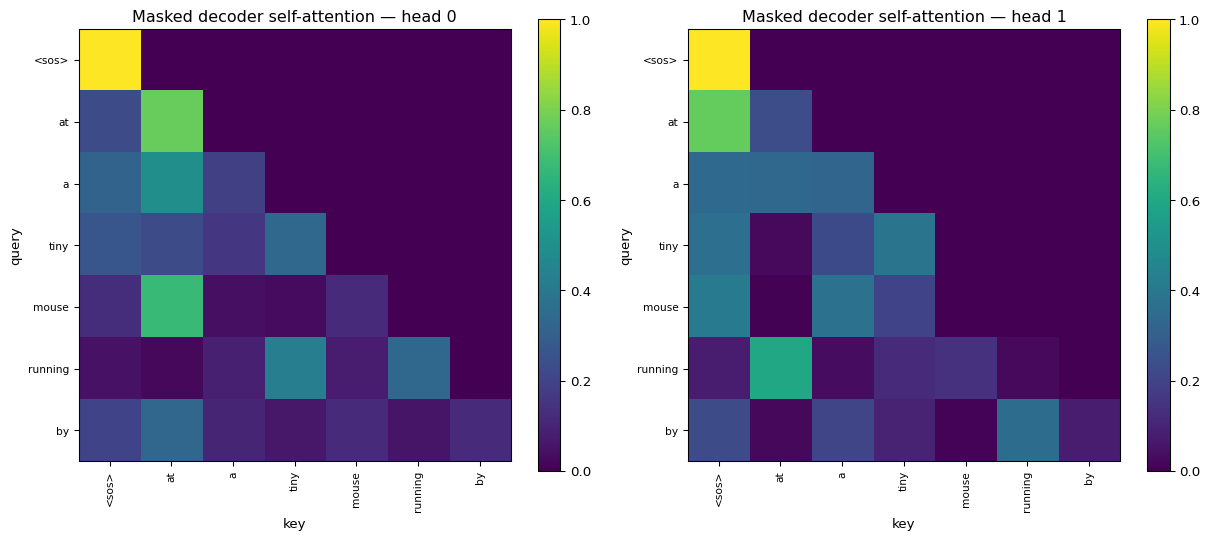
- Row 0 (
<sos>) attends only to itself → weight exactly 1.0, all others 0. - Row $t$ has exactly $t+1$ non-zero entries.
- The weight matrix is lower-triangular.
Causal mask (7 x 7), True = blocked:
[[0 1 1 1 1 1 1]
 [0 0 1 1 1 1 1]
 [0 0 0 1 1 1 1]
 [0 0 0 0 1 1 1]
 [0 0 0 0 0 1 1]
 [0 0 0 0 0 0 1]
 [0 0 0 0 0 0 0]]

Allowed positions per row: [1 2 3 4 5 6 7]
[decoder masked self-attn] x_q (7, 8) , x_kv (7, 8)
  Q,K,V per head: (2, 7, 4), (2, 7, 4), (2, 7, 4)
  scores/weights: (2, 7, 7)   concat: (7, 8)   out: (7, 8)

--- Head 0: scores BEFORE masking (Q K^T / sqrt(d_k)) ---
[[ 0.5   0.56  0.12  1.41  0.44  0.59  0.41]
 [ 0.97  2.16 -0.63 -0.04  0.29 -1.32  0.03]
 [ 0.03  0.47 -0.49  0.88  0.46  0.09 -0.04]
 [ 1.22  1.08  0.69  1.45  0.28  0.57  0.83]
 [ 0.55  2.19 -0.59 -1.    0.48 -1.91 -0.17]
 [-0.05 -0.91  0.52  2.1   0.36  1.87  0.51]
 [ 0.26  0.75 -0.42 -0.87 -0.22 -1.02 -0.24]]

--- Head 0: scores AFTER masking ---
masked_scores =   (blocked entries shown as -inf)
        <sos> |   +0.503      -inf      -inf      -inf      -inf      -inf      -inf
           at |   +0.970    +2.161      -inf      -inf      -inf      -inf      -inf
            a |   +0.031    +0.475    -0.491      -inf      -inf      -inf      -inf
         tiny |   +1.220    +1.080    +0.690    +1.452      -inf      -inf      -inf
        mouse |   +0.552    +2.191    -0.586    -1.000    +0.484      -inf      -inf
      running |   -0.052    -0.905    +0.523    +2.104    +0.365    +1.867      -inf
           by |   +0.258    +0.751    -0.416    -0.868    -0.224    -1.020    -0.236

--- Head 0: attention weights after softmax ---
A =   (blocked entries are exactly 0)
        <sos> |   1.0000         0         0         0         0         0         0
           at |   0.2330    0.7670         0         0         0         0         0
            a |   0.3172    0.4946    0.1882         0         0         0         0
         tiny |   0.2687    0.2338    0.1582    0.3392         0         0         0
        mouse |   0.1313    0.6761    0.0421    0.0278    0.1227         0         0
      running |   0.0496    0.0211    0.0881    0.4282    0.0752    0.3378         0
           by |   0.2009    0.3289    0.1024    0.0652    0.1240    0.0560    0.1226

Row sums (must all be 1): [1. 1. 1. 1. 1. 1. 1.]
Row 0 = [1. 0. 0. 0. 0. 0. 0.]   <- '<sos>' can only see itself
Strictly lower-triangular structure: True
Row 2, unmasked scores over positions 0..2: [ 0.031  0.475 -0.491]
exp(s - max)                                : [0.641 1.    0.381]
/ sum = 2.0220                              : [0.317 0.495 0.188]

From the weights matrix (first 3 entries): [0.317 0.495 0.188]
match: True
remaining entries are exactly zero: True
The black upper triangle is the mask: no token attends to its future.
Masked Self-Attention Matrices
The same seven steps as the encoder, with both operands and the full result matrix printed at each one. Two things differ: every shape is 7 instead of 9, and step 4 applies the causal mask between the scores and the softmax.
STEP 1 : project X_dec to Q (K and V are identical in form)
==============================================================================
==============================================================================
  X_dec (7, 8)   @   Wq (8, 8)   =   Q_full (7, 8)
  shape rule: (7 x 8) @ (8 x 8) -> (7 x 8)   inner dim 8 cancels
  K uses Wk, V uses Wv - same shapes, same arithmetic
==============================================================================

X_dec =
        <sos> |   +1.382    +1.649    -0.167    +1.147    +1.207    +0.183    +0.369    +0.607
           at |   +2.015    +0.910    -0.007    +1.443    -1.561    -0.127    -1.193    +1.143
            a |   +0.129    +0.666    -1.151    +0.565    +0.054    +1.111    -0.177    +1.396
         tiny |   +0.449    -0.174    +1.156    +0.372    -0.137    +1.282    -0.246    +2.607
        mouse |   -0.320    +0.537    +1.339    -0.564    -2.514    +1.934    -1.363    +0.775
      running |   -1.805    -0.301    +0.001    +1.237    +2.399    +0.283    -0.412    +0.937
           by |   -0.123    +1.984    +0.740    -0.511    -0.352    +1.130    -0.449    +0.781

Wq =
     +0.420    -0.169    +0.197    -0.036    -0.369    +0.125    -0.538    -0.106
     +0.057    -0.078    +0.305    +0.402    +0.332    -0.565    -0.375    +0.045
     +0.533    +0.410    +0.420    -0.241    -0.086    -0.036    -0.420    -0.574
     +0.547    -0.318    -0.318    -0.510    +0.525    +0.098    +0.205    +0.504
     -0.189    +0.149    -0.565    -0.384    +0.406    +0.327    -0.183    -0.151
     +0.041    -0.612    -0.317    -0.357    -0.306    +0.375    -0.270    -0.378
     +0.005    +0.448    -0.317    -0.516    -0.176    +0.303    +0.062    +0.388
     +0.563    +0.358    +0.127    -0.008    -0.563    +0.593    -0.143    -0.426

Q_full =
        <sos> |   +1.335    -0.345    -0.441    -0.656    +0.681    +0.293    -1.390    +0.235
           at |   +2.610    -1.152    +1.655    +0.810    -0.711    -0.363    -1.044    -0.108
            a |   +0.609    -0.977    -0.584    -0.086    -0.503    +0.945    -0.240    -0.129
         tiny |   +2.543    +0.313    +0.482    -0.855    -2.001    +2.057    -1.293    -2.201
        mouse |   +1.285    -1.150    +2.180    +1.163    -1.923    -0.497    -0.963    -2.205
      running |   -0.014    +0.271    -2.035    -1.504    +1.646    +1.387    +0.663    -0.226
           by |   +0.726    -0.334    +1.135    +0.840    -0.477    -0.576    -1.472    -1.461

  worked element  Q_full[0,0]  =  row 0 of X_dec  .  column 0 of Wq
      row  0 of X_dec = [ 1.382  1.649 -0.167  1.147  1.206  0.183  0.369  0.607]
      col  0 of Wq = [ 0.419  0.057  0.532  0.547 -0.189  0.041  0.005  0.563]
      (+1.3822)*(+0.4195) + (+1.6487)*(+0.0571) + (-0.1671)*(+0.5325) + (+1.1467)*(+0.5473) +
      (+1.2065)*(-0.1891) + (+0.1831)*(+0.0411) + (+0.3687)*(+0.0052) + (+0.6067)*(+0.5629)
      = +1.335453   |  from array: +1.335453   |  MATCH: True

K_full = X_dec @ Wk -> (7, 8)
V_full = X_dec @ Wv -> (7, 8)
STEP 2 : split the 8 columns into 2 heads of 4
==============================================================================
Q_full (7, 8)  ->  reshape(7, 2, 4)  ->  transpose  ->  (2, 7, 4)

head 0 takes columns 0..3, head 1 takes columns 4..7

Q head 0 (7, 4):
[[ 1.335 -0.345 -0.441 -0.656]
 [ 2.61  -1.152  1.655  0.81 ]
 [ 0.609 -0.977 -0.584 -0.086]
 [ 2.543  0.313  0.482 -0.855]
 [ 1.285 -1.15   2.18   1.163]
 [-0.014  0.271 -2.035 -1.504]
 [ 0.726 -0.334  1.135  0.84 ]]

Q head 1 (7, 4):
[[ 0.681  0.293 -1.39   0.235]
 [-0.711 -0.363 -1.044 -0.108]
 [-0.503  0.945 -0.24  -0.129]
 [-2.001  2.057 -1.293 -2.201]
 [-1.923 -0.497 -0.963 -2.205]
 [ 1.646  1.387  0.663 -0.226]
 [-0.477 -0.576 -1.472 -1.461]]

matches the column slices of Q_full: True
STEP 3 : scores = Q0 @ K0^T, THEN divide by sqrt(d_k)
==============================================================================
==============================================================================
  Q_head0 (7, 4)   @   K_head0^T (4, 7)   =   raw_scores (7, 7)
  shape rule: (7 x 4) @ (4 x 7) -> (7 x 7)   inner dim 4 cancels
  (7,4) @ (4,7) -> (7,7): 7 queries x 7 keys
==============================================================================

Q_head0 =
        <sos> |   +1.335    -0.345    -0.441    -0.656
           at |   +2.610    -1.152    +1.655    +0.810
            a |   +0.609    -0.977    -0.584    -0.086
         tiny |   +2.543    +0.313    +0.482    -0.855
        mouse |   +1.285    -1.150    +2.180    +1.163
      running |   -0.014    +0.271    -2.035    -1.504
           by |   +0.726    -0.334    +1.135    +0.840

K_head0^T =
     +0.669    +0.249    -0.194    +0.637    -0.471    +0.225    +0.134
     +0.121    -1.721    +0.590    -0.852    -1.635    +0.651    +0.002
     +0.471    +1.726    +0.724    -0.595    +0.982    -1.013    +0.458
     -0.553    -1.444    -1.567    -2.151    -2.104    -0.996    -1.296

raw_scores =
        <sos> |   +1.007    +1.113    +0.246    +2.818    +0.882    +1.175    +0.826
           at |   +1.939    +4.322    -1.256    -0.083    +0.577    -2.646    +0.055
            a |   +0.061    +0.950    -0.982    +1.752    +0.917    +0.178    -0.077
         tiny |   +2.439    +2.161    +1.380    +2.905    +0.562    +1.139    +1.669
        mouse |   +1.104    +4.382    -1.172    -2.001    +0.969    -3.825    -0.340
      running |   -0.104    -1.811    +1.046    +4.208    +0.729    +3.734    +1.017
           by |   +0.516    +1.502    -0.832    -1.736    -0.449    -2.041    -0.473

  worked element  raw_scores[0,0]  =  row 0 of Q_head0  .  column 0 of K_head0^T
      row  0 of Q_head0 = [ 1.335 -0.345 -0.441 -0.656]
      col  0 of K_head0^T = [ 0.669  0.121  0.471 -0.552]
      (+1.3355)*(+0.6694) + (-0.3451)*(+0.1215) + (-0.4407)*(+0.4709) + (-0.6556)*(-0.5525)
      = +1.006698   |  from array: +1.006698   |  MATCH: True

then divide every entry by sqrt(d_k) = sqrt(4) = 2:

        <sos> |   +0.503    +0.557    +0.123    +1.409    +0.441    +0.588    +0.413
           at |   +0.970    +2.161    -0.628    -0.042    +0.288    -1.323    +0.027
            a |   +0.031    +0.475    -0.491    +0.876    +0.458    +0.089    -0.039
         tiny |   +1.220    +1.080    +0.690    +1.452    +0.281    +0.569    +0.835
        mouse |   +0.552    +2.191    -0.586    -1.000    +0.484    -1.913    -0.170
      running |   -0.052    -0.905    +0.523    +2.104    +0.365    +1.867    +0.508
           by |   +0.258    +0.751    -0.416    -0.868    -0.224    -1.020    -0.236

>>> still a full (7, 7) matrix - nothing is blocked yet.
STEP 4 : apply the causal mask, BEFORE the softmax
==============================================================================
Scaled scores + M.  Entries above the diagonal are set to -inf,
so exp(-inf) = 0 and a future token can carry no weight.

masked_scores =   (blocked entries shown as -inf)
        <sos> |   +0.503      -inf      -inf      -inf      -inf      -inf      -inf
           at |   +0.970    +2.161      -inf      -inf      -inf      -inf      -inf
            a |   +0.031    +0.475    -0.491      -inf      -inf      -inf      -inf
         tiny |   +1.220    +1.080    +0.690    +1.452      -inf      -inf      -inf
        mouse |   +0.552    +2.191    -0.586    -1.000    +0.484      -inf      -inf
      running |   -0.052    -0.905    +0.523    +2.104    +0.365    +1.867      -inf
           by |   +0.258    +0.751    -0.416    -0.868    -0.224    -1.020    -0.236

(-1e9 is used in code as a stand-in for -inf: exp(-1e9) underflows to
 exactly 0.0 in float64, while avoiding the 0 * inf = NaN edge case.)


After the softmax those blocked entries become hard zeros:

A = softmax(masked_scores) =   (blocked entries are exactly 0)
        <sos> |   1.0000         0         0         0         0         0         0
           at |   0.2330    0.7670         0         0         0         0         0
            a |   0.3172    0.4946    0.1882         0         0         0         0
         tiny |   0.2687    0.2338    0.1582    0.3392         0         0         0
        mouse |   0.1313    0.6761    0.0421    0.0278    0.1227         0         0
      running |   0.0496    0.0211    0.0881    0.4282    0.0752    0.3378         0
           by |   0.2009    0.3289    0.1024    0.0652    0.1240    0.0560    0.1226

   upper triangle is exactly 0 : True
   every row still sums to 1   : [1. 1. 1. 1. 1. 1. 1.]
   non-zero entries per row    : [1 2 3 4 5 6 7]  <- row t has t+1
STEP 5 : weights @ V, the masked weighted sum
==============================================================================
==============================================================================
  A (masked weights) (7, 7)   @   V_head0 (7, 4)   =   head0_out (7, 4)
  shape rule: (7 x 7) @ (7 x 4) -> (7 x 4)   inner dim 7 cancels
  (7,7)@(7,4) -> (7,4). Zero weights mean those V rows contribute nothing
==============================================================================

A (masked weights) =
        <sos> |   +1.000    +0.000    +0.000    +0.000    +0.000    +0.000    +0.000
           at |   +0.233    +0.767    +0.000    +0.000    +0.000    +0.000    +0.000
            a |   +0.317    +0.495    +0.188    +0.000    +0.000    +0.000    +0.000
         tiny |   +0.269    +0.234    +0.158    +0.339    +0.000    +0.000    +0.000
        mouse |   +0.131    +0.676    +0.042    +0.028    +0.123    +0.000    +0.000
      running |   +0.050    +0.021    +0.088    +0.428    +0.075    +0.338    +0.000
           by |   +0.201    +0.329    +0.102    +0.065    +0.124    +0.056    +0.123

V_head0 =
     +0.597    -0.274    +1.040    -1.039
     +1.296    +0.654    +1.575    -2.918
     +0.529    -0.749    +1.454    +0.569
     +1.053    -0.130    +2.242    +0.536
     +1.675    +1.939    +0.404    -1.420
     -0.656    -1.042    -0.113    +2.285
     +1.490    +0.772    -0.180    -0.791

head0_out =
        <sos> |   +0.597    -0.274    +1.040    -1.039
           at |   +1.133    +0.438    +1.451    -2.480
            a |   +0.930    +0.096    +1.383    -1.666
         tiny |   +0.904    -0.083    +1.639    -0.690
        mouse |   +1.212    +0.609    +1.375    -2.245
      running |   +0.459    -0.328    +1.165    +0.832
           by |   +1.023    +0.352    +1.044    -1.221

  worked element  head0_out[0,0]  =  row 0 of A (masked weights)  .  column 0 of V_head0
      row  0 of A (masked weights) = [1. 0. 0. 0. 0. 0. 0.]
      col  0 of V_head0 = [ 0.597  1.296  0.529  1.053  1.675 -0.656  1.49 ]
      (+1.0000)*(+0.5966) + (+0.0000)*(+1.2962) + (+0.0000)*(+0.5293) + (+0.0000)*(+1.0534) +
      (+0.0000)*(+1.6746) + (+0.0000)*(-0.6561) + (+0.0000)*(+1.4896)
      = +0.596564   |  from array: +0.596564   |  MATCH: True

>>> row 0 has a single non-zero weight (1.0 on itself), so its output
>>> equals V row 0 exactly: True
STEPS 6 and 7 : concatenate the heads, then project with W_O
==============================================================================
dec_head0 (7, 4)   +   dec_head1 (7, 4)   side by side   ->   concat (7, 8)

     token |      ---- head 0 (dims 0-3) ----       |      ---- head 1 (dims 4-7) ----
--------------------------------------------------------------------------------------------
     <sos> |   +0.597    -0.274    +1.040    -1.039 |   -1.693    +0.565    +0.092    -1.168
        at |   +1.133    +0.438    +1.451    -2.480 |   -1.629    +0.983    -0.221    -0.983
         a |   +0.930    +0.096    +1.383    -1.666 |   -1.266    +0.861    -0.252    -0.567
      tiny |   +0.904    -0.083    +1.639    -0.690 |   -1.002    +0.785    +0.393    -1.023
     mouse |   +1.212    +0.609    +1.375    -2.245 |   -1.065    +0.435    +0.340    -0.832
   running |   +0.459    -0.328    +1.165    +0.832 |   -1.040    +1.642    -0.355    -0.613
        by |   +1.023    +0.352    +1.044    -1.221 |   -0.754    +0.231    +0.862    -0.728

==============================================================================
  concat (7, 8)   @   W_O (8, 8)   =   dec_attn_out (7, 8)
  shape rule: (7 x 8) @ (8 x 8) -> (7 x 8)   inner dim 8 cancels
  W_O is what MIXES the two heads - this is the sub-layer's final output
==============================================================================

concat =
        <sos> |   +0.597    -0.274    +1.040    -1.039    -1.693    +0.565    +0.092    -1.168
           at |   +1.133    +0.438    +1.451    -2.480    -1.629    +0.983    -0.221    -0.983
            a |   +0.930    +0.096    +1.383    -1.666    -1.266    +0.861    -0.252    -0.567
         tiny |   +0.904    -0.083    +1.639    -0.690    -1.002    +0.785    +0.393    -1.023
        mouse |   +1.212    +0.609    +1.375    -2.245    -1.065    +0.435    +0.340    -0.832
      running |   +0.459    -0.328    +1.165    +0.832    -1.040    +1.642    -0.355    -0.613
           by |   +1.023    +0.352    +1.044    -1.221    -0.754    +0.231    +0.862    -0.728

W_O =
     -0.227    +0.099    +0.282    -0.109    +0.158    +0.244    +0.259    -0.549
     +0.441    -0.051    -0.291    -0.316    -0.021    +0.474    -0.149    +0.306
     -0.494    -0.029    +0.602    +0.331    -0.355    +0.002    -0.326    -0.111
     +0.343    +0.332    -0.333    +0.517    +0.113    -0.147    +0.002    +0.129
     +0.073    -0.017    +0.006    -0.396    +0.383    +0.051    -0.452    +0.326
     +0.530    +0.548    -0.160    -0.446    +0.023    -0.474    +0.532    -0.388
     -0.303    -0.114    -0.143    +0.361    -0.054    -0.403    -0.285    +0.011
     -0.432    +0.137    +0.081    +0.263    +0.536    +0.505    +0.546    -0.313

dec_attn_out =
        <sos> |   -0.474    -0.135    +1.012    -0.026    -1.654    -0.811    +0.254    -1.065
           at |   -0.739    -0.320    +1.676    -1.196    -1.742    -0.106    +0.533    -1.575
            a |   -0.739    -0.063    +1.466    -0.658    -1.290    -0.138    +0.563    -1.420
         tiny |   -0.623    +0.079    +1.225    +0.033    -1.450    -0.813    -0.091    -1.099
        mouse |   -1.048    -0.594    +1.548    -0.898    -1.425    +0.099    -0.070    -1.172
      running |   +0.627    +1.178    +0.381    +0.259    -0.911    -1.163    +0.898    -1.162
           by |   -0.891    -0.412    +0.997    -0.193    -1.074    -0.265    -0.311    -0.824

  worked element  dec_attn_out[0,0]  =  row 0 of concat  .  column 0 of W_O
      row  0 of concat = [ 0.597 -0.274  1.04  -1.038 -1.694  0.565  0.092 -1.168]
      col  0 of W_O = [-0.227  0.441 -0.494  0.343  0.073  0.53  -0.303 -0.432]
      (+0.5966)*(-0.2273) + (-0.2739)*(+0.4406) + (+1.0401)*(-0.4938) + (-1.0385)*(+0.3430) +
      (-1.6935)*(+0.0734) + (+0.5651)*(+0.5296) + (+0.0917)*(-0.3028) + (-1.1684)*(-0.4318)
      = -0.474334   |  from array: -0.474334   |  MATCH: True
Decoder Add & Norm (1)
$$Y_1 = \mathrm{LayerNorm}\big(X_{dec} + \mathrm{MaskedMultiHead}(X_{dec})\big)$$
==============================================================================
  residual = X_dec + attn_out      all three are (7, 8) — element-wise, no mixing
==============================================================================

     <sos> |
            X_dec:   +1.382    +1.649    -0.167    +1.147    +1.207    +0.183    +0.369    +0.607
         attn_out:   -0.474    -0.135    +1.012    -0.026    -1.654    -0.811    +0.254    -1.065
         residual:   +0.908    +1.514    +0.845    +1.120    -0.447    -0.628    +0.623    -0.458

        at |
            X_dec:   +2.015    +0.910    -0.007    +1.443    -1.561    -0.127    -1.193    +1.143
         attn_out:   -0.739    -0.320    +1.676    -1.196    -1.742    -0.106    +0.533    -1.575
         residual:   +1.276    +0.590    +1.669    +0.247    -3.303    -0.232    -0.660    -0.432

         a |
            X_dec:   +0.129    +0.666    -1.151    +0.565    +0.054    +1.111    -0.177    +1.396
         attn_out:   -0.739    -0.063    +1.466    -0.658    -1.290    -0.138    +0.563    -1.420
         residual:   -0.609    +0.603    +0.315    -0.093    -1.236    +0.973    +0.386    -0.024

      tiny |
            X_dec:   +0.449    -0.174    +1.156    +0.372    -0.137    +1.282    -0.246    +2.607
         attn_out:   -0.623    +0.079    +1.225    +0.033    -1.450    -0.813    -0.091    -1.099
         residual:   -0.175    -0.096    +2.381    +0.406    -1.587    +0.469    -0.337    +1.509

     mouse |
            X_dec:   -0.320    +0.537    +1.339    -0.564    -2.514    +1.934    -1.363    +0.775
         attn_out:   -1.048    -0.594    +1.548    -0.898    -1.425    +0.099    -0.070    -1.172
         residual:   -1.368    -0.057    +2.887    -1.462    -3.939    +2.033    -1.433    -0.396

   running |
            X_dec:   -1.805    -0.301    +0.001    +1.237    +2.399    +0.283    -0.412    +0.937
         attn_out:   +0.627    +1.178    +0.381    +0.259    -0.911    -1.163    +0.898    -1.162
         residual:   -1.178    +0.877    +0.382    +1.497    +1.489    -0.880    +0.487    -0.225

        by |
            X_dec:   -0.123    +1.984    +0.740    -0.511    -0.352    +1.130    -0.449    +0.781
         attn_out:   -0.891    -0.412    +0.997    -0.193    -1.074    -0.265    -0.311    -0.824
         residual:   -1.014    +1.572    +1.737    -0.704    -1.426    +0.865    -0.760    -0.043

  check element [0,0]: +1.382159 + -0.474334 = +0.907825   MATCH: True


then LayerNorm, row by row -> Y1 (shape (7, 8)):

        <sos> |   +0.613    +1.398    +0.531    +0.889    -1.142    -1.377    +0.244    -1.156
           at |   +0.967    +0.487    +1.242    +0.247    -2.239    -0.089    -0.388    -0.229
            a |   -0.987    +0.858    +0.420    -0.201    -1.941    +1.421    +0.527    -0.097
         tiny |   -0.440    -0.370    +1.826    +0.075    -1.692    +0.131    -0.584    +1.053
        mouse |   -0.447    +0.204    +1.665    -0.494    -1.724    +1.241    -0.480    +0.035
      running |   -1.579    +0.607    +0.081    +1.266    +1.258    -1.261    +0.192    -0.565
           by |   -0.916    +1.356    +1.501    -0.644    -1.277    +0.735    -0.693    -0.063

mean=+0.0000, per-row std=[1. 1. 1. 1. 1. 1. 1.]
13. Decoder: Cross-Attention
This is the one place where the encoder and the decoder communicate, and the shapes stop being square:
$$Q = Y_1 W^Q \quad \text{from the \textbf{decoder}} \qquad K = H W^K, \;\; V = H W^V \quad \text{from the \textbf{encoder output } } H$$
| comes from | shape | |
|---|---|---|
| $Q$ | decoder, $Y_1$ | $(7, 8) \rightarrow$ per head $(2, 7, 4)$ |
| $K$, $V$ | encoder output $H$ | $(9, 8) \rightarrow$ per head $(2, 9, 4)$ |
| scores $QK^\top$ | $(2, \mathbf{7}, \mathbf{9})$ | |
| output | $(7, 8)$ |
Read the $7 \times 9$ score matrix as: for each of the 7 decoder positions, how much attention is paid to each of the 9 prefix words. Each row sums to 1 across the 9 prefix tokens. This is the conditioning on $x$ in $P(y_t \mid y_{<t}, x)$ — without this sub-layer the decoder would be a plain language model that had never seen the prefix.
Two things to be careful about:
- No causal mask here. The decoder is allowed to look at the entire prefix at every step. The prefix is given, not generated, so there is no future to hide. The causal constraint lives only in the decoder's self-attention.
- $K$ and $V$ are computed once and reused at every generation step — only $Q$ changes, because only the decoder side grows. This is why encoder–decoder models cache the encoder output.
[cross-attention] x_q (7, 8) , x_kv (9, 8)
  Q,K,V per head: (2, 7, 4), (2, 9, 4), (2, 9, 4)
  scores/weights: (2, 7, 9)   concat: (7, 8)   out: (7, 8)

Q comes from the DECODER : (7, 8)  -> per head (2, 7, 4)
K,V come from the ENCODER: (9, 8)  -> per head (2, 9, 4)
Score matrix is rectangular: (2, 7, 9)  (heads, n_tgt, n_src)

--- Head 0: cross-attention weights (7 decoder x 9 prefix) ---
[[0.144 0.088 0.091 0.091 0.068 0.018 0.002 0.448 0.05 ]
 [0.005 0.004 0.429 0.338 0.004 0.    0.002 0.005 0.212]
 [0.034 0.039 0.222 0.204 0.044 0.029 0.184 0.019 0.225]
 [0.004 0.006 0.387 0.279 0.007 0.001 0.041 0.004 0.271]
 [0.004 0.004 0.362 0.289 0.005 0.001 0.036 0.001 0.298]
 [0.069 0.074 0.001 0.001 0.07  0.43  0.009 0.345 0.001]
 [0.035 0.029 0.269 0.255 0.037 0.015 0.077 0.011 0.272]]

Each row sums to 1 over the 9 prefix tokens: True
Decoder position 3 ('tiny') attends most to prefix tokens:
   'sat' (pos 2): 0.3868
   'on' (pos 3): 0.2788
   'looking' (pos 8): 0.2714

(With untrained weights this is arbitrary — a trained model would concentrate on the prefix words that actually constrain the next token.)
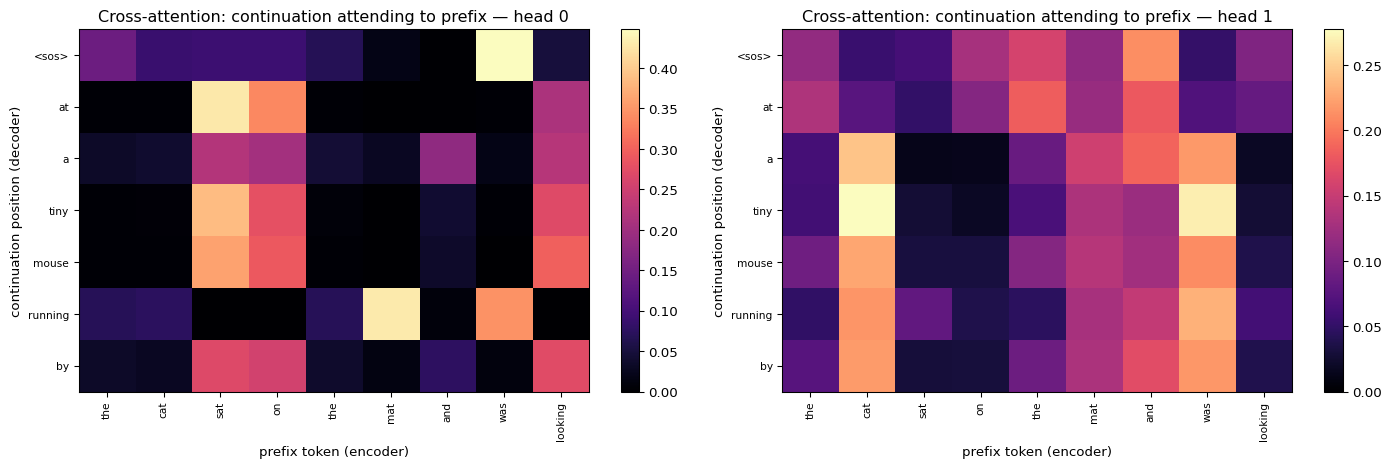
Cross-Attention Matrices
Here the two stacks meet, and the operands come from different places. This is the clearest place to see why shapes work out:
| operation | shapes | result |
|---|---|---|
| $Q$ from decoder $Y_1$ | $(7,8) @ (8,8)$ | $(7,8) \to$ head $(7,4)$ |
| $K$ from encoder $H$ | $(9,8) @ (8,8)$ | $(9,8) \to$ head $(9,4)$ |
| $Q_0 K_0^\top$ | $(7,4) @ (4,9)$ | $(\mathbf{7},\mathbf{9})$ |
| $A V_0$ | $(7,9) @ (9,4)$ | $(\mathbf{7},4)$ |
The output has 7 rows (one per decoder position) and 4 columns per head — the 9 prefix positions appear only as the summed-over dimension. The decoder gets back exactly its own shape, having absorbed information from a sequence of a different length.
Q source = dec_norm1        (7, 8)   (decoder)
K,V source = encoder_output (9, 8)   (encoder)

==============================================================================
  Q_dec_head0 (7, 4)   @   K_enc_head0^T (4, 9)   =   raw_scores (7, 9)
  shape rule: (7 x 4) @ (4 x 9) -> (7 x 9)   inner dim 4 cancels
  rows indexed by DECODER positions, columns by PREFIX positions
==============================================================================

Q_dec_head0 =
        <sos> |   -1.283    +0.863    -0.584    +2.871
           at |   +0.054    -0.599    +1.694    +2.945
            a |   +0.547    -0.652    +0.976    -0.296
         tiny |   +1.658    -0.365    +1.646    +1.304
        mouse |   +1.061    -1.398    +1.859    +0.975
      running |   -0.135    +1.784    -2.773    -0.212
           by |   +0.329    -1.214    +0.509    +0.816

K_enc_head0^T =
     -1.745    -1.226    +0.050    -0.148    -0.856    -0.898    +1.177    -1.513    +0.188
     -0.360    -0.008    -1.309    -1.395    -0.341    -0.161    -1.431    +1.839    -1.672
     -0.470    -0.308    +2.101    +1.958    -0.500    -1.599    +0.232    -0.248    +1.714
     -0.051    -0.234    +1.244    +1.151    -0.186    -1.401    -1.305    +0.230    +0.913

raw_scores =
        <sos> |   +2.059    +1.076    +1.152    +1.148    +0.563    -2.075    -6.626    +4.335    -0.063
           at |   -0.823    -1.272    +8.009    +7.532    -1.236    -6.786    -2.530    -0.925    +6.602
            a |   -1.164    -0.897    +2.564    +2.399    -0.679    -1.533    +2.188    -2.337    +2.596
         tiny |   -3.602    -2.843    +5.643    +4.988    -2.360    -5.890    +1.153    -3.289    +4.935
        mouse |   -2.271    -2.091    +7.002    +6.555    -1.541    -5.066    +2.408    -4.413    +6.614
      running |   +0.907    +1.056    -8.431    -8.142    +0.932    +4.565    -3.078    +4.125    -7.955
           by |   -0.418    -0.741    +3.691    +3.581    -0.273    -2.057    +1.178    -2.669    +3.709

  worked element  raw_scores[0,0]  =  row 0 of Q_dec_head0  .  column 0 of K_enc_head0^T
      row  0 of Q_dec_head0 = [-1.283  0.863 -0.584  2.871]
      col  0 of K_enc_head0^T = [-1.745 -0.36  -0.47  -0.051]
      (-1.2834)*(-1.7453) + (+0.8625)*(-0.3597) + (-0.5840)*(-0.4697) + (+2.8708)*(-0.0505)
      = +2.058955   |  from array: +2.058955   |  MATCH: True

column labels are the prefix tokens: ['the', 'cat', 'sat', 'on', 'the', 'mat', 'and', 'was', 'looking']
==============================================================================
  A (7x9) (7, 9)   @   V_enc_head0 (9x4) (9, 4)   =   head0_out (7x4) (7, 4)
  shape rule: (7 x 9) @ (9 x 4) -> (7 x 4)   inner dim 9 cancels
  the 9 PREFIX positions cancel — output keeps the decoder's 7 rows
==============================================================================

A (7x9) =
        <sos> |   +0.144    +0.088    +0.091    +0.091    +0.068    +0.018    +0.002    +0.448    +0.050
           at |   +0.005    +0.004    +0.429    +0.338    +0.004    +0.000    +0.002    +0.005    +0.212
            a |   +0.034    +0.039    +0.222    +0.204    +0.044    +0.029    +0.184    +0.019    +0.225
         tiny |   +0.004    +0.006    +0.387    +0.279    +0.007    +0.001    +0.041    +0.004    +0.271
        mouse |   +0.004    +0.004    +0.362    +0.289    +0.005    +0.001    +0.036    +0.001    +0.298
      running |   +0.069    +0.074    +0.001    +0.001    +0.070    +0.430    +0.009    +0.345    +0.001
           by |   +0.035    +0.029    +0.269    +0.255    +0.037    +0.015    +0.077    +0.011    +0.272

V_enc_head0 (9x4) =
     +0.972    -0.975    +0.443    +0.039
     +0.085    -1.478    +1.483    -0.670
     -0.539    -0.849    -0.472    +0.348
     +0.392    -0.988    -0.585    +0.547
     +2.163    -1.204    +0.166    +0.024
     +0.894    +0.418    -0.328    -0.174
     +1.643    -0.586    -0.894    -0.251
     +0.186    +1.391    +1.781    -0.570
     -1.243    -0.802    -1.008    +0.702

head0_out (7x4) =
        <sos> |   +0.322    +0.071    +0.850    -0.194
           at |   -0.343    -0.879    -0.598    +0.477
            a |   +0.143    -0.784    -0.510    +0.261
         tiny |   -0.348    -0.859    -0.637    +0.461
        mouse |   -0.376    -0.867    -0.663    +0.481
      running |   +0.688    +0.391    +0.616    -0.318
           by |   -0.125    -0.843    -0.539    +0.378

  worked element  head0_out (7x4)[0,0]  =  row 0 of A (7x9)  .  column 0 of V_enc_head0 (9x4)
      row  0 of A (7x9) = [0.144 0.088 0.091 0.091 0.068 0.018 0.002 0.448 0.05 ]
      col  0 of V_enc_head0 (9x4) = [ 0.972  0.085 -0.539  0.392  2.163  0.894  1.643  0.186 -1.243]
      (+0.1437)*(+0.9724) + (+0.0879)*(+0.0852) + (+0.0913)*(-0.5387) + (+0.0911)*(+0.3924) +
      (+0.0680)*(+2.1627) + (+0.0182)*(+0.8942) + (+0.0019)*(+1.6430) + (+0.4483)*(+0.1859) +
      (+0.0497)*(-1.2427)
      = +0.321661   |  from array: +0.321661   |  MATCH: True

>>> (7,9) @ (9,4) = (7,4).  Encoder length 9 vanishes into the sum.
>>> This is how a decoder of length 7 reads a source of length 9.
Decoder Add & Norm (2)
$$Y_2 = \mathrm{LayerNorm}\big(Y_1 + \mathrm{CrossAttention}(Y_1, H)\big)$$
Note the residual adds $Y_1$ — the decoder stream — not the encoder output. The encoder information enters only through the attention output. This keeps the decoder's own representation as the backbone.
Decoder Add&Norm 2 (shape (7, 8)):
[[ 0.764  1.392  0.269  0.846 -1.436 -0.636  0.269 -1.467]
 [ 1.128  0.09   1.533  0.505 -1.823 -0.364 -0.328 -0.741]
 [-1.147  0.963  0.417 -0.026 -1.832  1.408  0.438 -0.221]
 [-0.447 -0.56   2.124  0.323 -1.345 -0.258 -0.62   0.783]
 [-0.493 -0.006  2.077 -0.293 -1.413  0.988 -0.514 -0.345]
 [-1.54   1.181 -0.292  1.414  0.74  -0.902  0.25  -0.851]
 [-0.974  1.342  1.715 -0.487 -0.987  0.564 -0.8   -0.373]]
14. Decoder: Feed-Forward Network
Identical in form to the encoder FFN, with its own weights:
$$\mathrm{FFN}(x) = \max(0, xW_1 + b_1)W_2 + b_2, \qquad \text{decoder\_output} = \mathrm{LayerNorm}\big(Y_2 + \mathrm{FFN}(Y_2)\big)$$
(7, 8) -> W1 -> (7, 32) -> ReLU -> W2 -> (7, 8)
(49.6% of hidden units zeroed by ReLU)

DECODER OUTPUT (shape (7, 8)):
[[ 0.427  1.034  0.123  1.27  -0.264 -0.185 -0.171 -2.233]
 [ 0.851 -0.119  1.272  1.394 -0.955 -0.262 -0.678 -1.503]
 [-1.206  0.158  0.225  0.322 -0.799  2.268 -0.245 -0.722]
 [-0.107 -1.762  1.586  0.781 -0.874  0.396 -0.657  0.636]
 [-0.541 -0.844  1.685  0.095 -0.302  1.61  -0.936 -0.766]
 [-1.514  0.464 -0.833  1.901  0.461  0.283  0.168 -0.93 ]
 [-0.707  0.527  1.426 -0.643  0.119  1.46  -1.444 -0.738]]

mean = +0.0000, std = 1.0000
Magnitudes stay O(1) through the whole network — contrast with ~80 000 before.
15. Output Projection
The decoder produced 7 vectors of dimension 8. To predict tokens they must be projected onto the vocabulary:
$$\text{logits} = \text{decoder\_output} \cdot W_{out} + b_{out}, \qquad W_{out} \in \mathbb{R}^{d_{model} \times V} = \mathbb{R}^{8 \times 500}$$
$$(7 \times 8) \cdot (8 \times 500) = (7 \times 500)$$
Row $t$, column $v$ of the result is the unnormalized score ("logit") that token $v$ is the correct continuation at position $t$.
Weight tying. The paper shares this matrix with the embedding table: $W_{out} = E^\top$. Two reasons —
- Parameter economy: $V \times d_{model} = 4000$ parameters saved here, hundreds of millions in a real model.
- Interpretation: the logit becomes a dot product between the decoder's output vector and the embedding of each candidate token, $\text{logit}_{t,v} = \langle \text{decoder\_output}_t,\; E_v \rangle$. So the model is literally asking "which token's embedding does my prediction vector point at most?" — a nearest-neighbour search in embedding space, measured by inner product.
This is why keeping the random IDs in [50, 500) is fine: the projection covers all 500 vocabulary slots, and the handful that correspond to real words simply have meaningful embeddings while the rest are unused noise.
decoder_output (7, 8) @ W_out (8, 500) = logits (7, 500)

Logits for the last position (t = 6), first 12 vocabulary entries:
[-0.721 -0.798 -0.249 -0.334  0.354  3.275 -0.734  0.531 -0.554  0.007  0.205 -0.104]

range over the whole matrix: [-4.153, 3.611]

Hand check  logit[t=6, v=2 ('<eos>')] = <decoder_output[6], E[2]>
  = (-0.707)(0.010) + (0.527)(0.452) + (1.426)(0.068) + (-0.643)(0.016) + (0.119)(-0.481) + (1.460)(0.264) + (-1.444)(0.228) + (-0.738)(0.765)
  = -0.249453
  from logits matrix: -0.249453   match: True
Output Projection Matrix
==============================================================================
  decoder_output (7,8) (7, 8)   @   W_out = E^T (8,500) (8, 500)   =   logits (7,500) (7, 500)
  shape rule: (7 x 8) @ (8 x 500) -> (7 x 500)   inner dim 8 cancels
  8 collapses, 500 opens up: one score per vocabulary entry per position
==============================================================================

decoder_output (7,8) =
        <sos> |   +0.427    +1.034    +0.123    +1.270    -0.264    -0.185    -0.171    -2.233
           at |   +0.851    -0.119    +1.272    +1.394    -0.955    -0.262    -0.678    -1.503
            a |   -1.206    +0.158    +0.225    +0.322    -0.799    +2.268    -0.245    -0.722
         tiny |   -0.107    -1.762    +1.586    +0.781    -0.874    +0.396    -0.657    +0.636
        mouse |   -0.541    -0.844    +1.685    +0.095    -0.302    +1.610    -0.936    -0.766
      running |   -1.514    +0.464    -0.833    +1.901    +0.461    +0.283    +0.168    -0.930
           by |   -0.707    +0.527    +1.426    -0.643    +0.119    +1.460    -1.444    -0.738

W_out = E^T (8,500) =   [showing first 10 of 500 columns]
     +0.206    +0.489    +0.010    -0.109    -0.158    -0.198    +0.156    +0.230    -0.085    +0.201
     -0.127    +0.229    +0.452    +0.077    +0.069    +0.133    -0.178    -0.035    +0.124    +0.158
     +0.209    -0.059    +0.068    +0.088    +0.380    +0.553    -0.361    +0.653    -0.442    +0.227
     +0.392    +0.052    +0.016    +0.558    -0.363    -0.023    +0.250    -0.378    +0.510    +0.470
     +0.290    +0.427    -0.481    -0.034    +0.047    -0.196    +0.086    -0.539    -0.029    +0.069
     +0.179    -0.289    +0.264    +0.099    -0.248    +0.665    -0.199    -0.245    +0.395    +0.251
     +0.377    +0.130    +0.228    +0.215    +0.423    -0.512    -0.453    -0.016    +0.121    -0.032
     +0.413    -0.139    +0.765    +0.066    -0.539    -0.777    +0.308    +0.086    +0.161    +0.509

logits (7,500) =   [showing first 10 of 500 columns]
        <sos> |   -0.617    +0.734    -1.168    +0.559    +0.753    +1.844    -0.441    -0.340    +0.239    -0.322
           at |   -0.198    +0.175    -0.851    +0.549    +0.378    +2.016    -0.144    +0.964    -0.340    +0.221
            a |   -0.312    -1.477    +0.454    +0.493    -0.144    +2.729    -0.849    -0.440    +0.960    +0.137
         tiny |   +0.672    -1.171    +0.183    +0.420    -0.545    +0.923    +0.258    +1.217    -0.308    +0.810
        mouse |   -0.084    -1.162    -0.501    +0.112    +0.236    +3.130    -0.678    +0.687    -0.348    +0.207
      running |   +0.063    -0.220    -0.650    +1.175    -0.212    +0.591    +0.079    -2.028    +1.494    +0.097
           by |   -0.721    -0.798    -0.249    -0.334    +0.354    +3.275    -0.734    +0.531    -0.554    +0.007

  worked element  logits (7,500)[0,0]  =  row 0 of decoder_output (7,8)  .  column 0 of W_out = E^T (8,500)
      row  0 of decoder_output (7,8) = [ 0.427  1.034  0.123  1.27  -0.264 -0.185 -0.171 -2.233]
      col  0 of W_out = E^T (8,500) = [ 0.206 -0.127  0.209  0.392  0.29   0.179  0.377  0.413]
      (+0.4266)*(+0.2064) + (+1.0344)*(-0.1270) + (+0.1228)*(+0.2088) + (+1.2699)*(+0.3920) +
      (-0.2637)*(+0.2901) + (-0.1854)*(+0.1793) + (-0.1713)*(+0.3771) + (-2.2332)*(+0.4134)
      = -0.617476   |  from array: -0.617476   |  MATCH: True

>>> the only step where the width EXPANDS: 8 -> 500.
>>> 7 * 8 * 500 = 28,000 multiply-adds, more than the rest of the decoder combined.

>>> then softmax turns each of the 7 rows into a distribution over 500 tokens.
16. Softmax: Next-Token Distribution
$$P(y_t = v \mid y_{<t},\, x) = \frac{\exp(\text{logit}_{t,v})}{\sum_{v'=1}^{V} \exp(\text{logit}_{t,v'})}$$
Each of the 7 rows becomes a probability distribution over all 500 tokens, summing to 1. This is the autoregressive factorization made concrete: row $t$ is one factor of the product $\prod_t P(y_t \mid y_{<t}, x)$.
The prediction of the next token is the last row. Position $t = 6$ has seen the prefix (through cross-attention) plus <sos> at a tiny mouse running by — the complete continuation so far — so its distribution answers "what comes after by?" (the correct answer being <eos>, since the sentence ends there).
Rows $0 \dots 5$ are predictions too — they are what the loss is computed on during training — but only the last one is used when generating.
probs shape (7, 500), every row sums to 1: True

Prefix  (encoder): 'the cat sat on the mat and was looking'
Context (decoder): '<sos> at a tiny mouse running by'
Question: what token comes next?

rank    id  token            logit   probability
--------------------------------------------------
   1     5  <unused_5>      3.2750      0.033622
   2   342  <unused_342>    2.9872      0.025214
   3   190  <unused_190>    2.7904      0.020711
   4   487  <unused_487>    2.5049      0.015566
   5   208  <unused_208>    2.4846      0.015253

PREDICTED NEXT TOKEN: id 5 -> '<unused_5>'
True next token     : id 2 -> '<eos>'

Probability assigned to the true token: 0.000991
Uniform baseline (1/V)                : 0.002000

With random weights the prediction is essentially chance — as expected. The arithmetic is correct; the model is simply untrained.
max probability = 0.03362 at id 5
entropy = 5.6914 nats (maximum possible = log(500) = 6.2146)
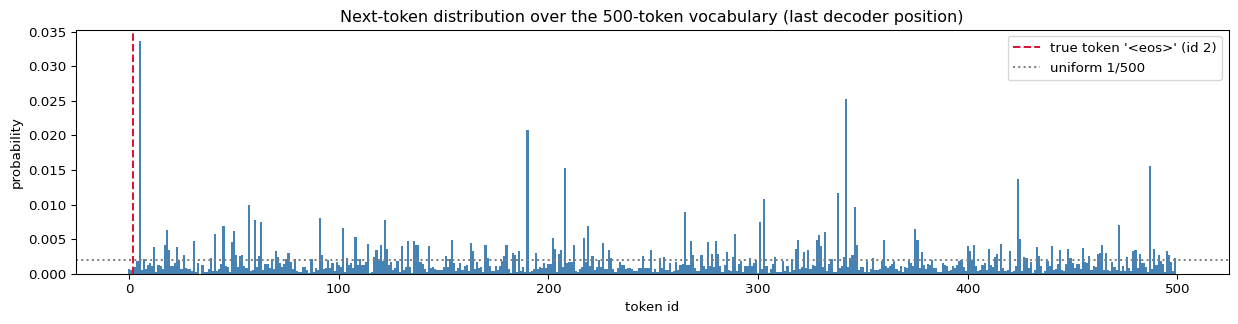
17. Decoding Strategies
Turning the distribution into a token is a separate decision, not part of the model.
Greedy — take the mode: $$\hat{v} = \arg\max_v P(v)$$ Deterministic, but tends to produce repetitive text.
Temperature $T$ — rescale the logits before the softmax: $$P_T(v) = \frac{\exp(\text{logit}_v / T)}{\sum_{v'} \exp(\text{logit}_{v'} / T)}$$ * $T \to 0$: distribution collapses onto the argmax (greedy). * $T = 1$: unchanged. * $T > 1$: flatter, more random.
Temperature is a monotone transformation of the logits, so it never changes the ranking — only how sharply the mass concentrates. Entropy is the quantity to watch.
Top-$k$ — keep the $k$ highest logits, set the rest to $-\infty$, renormalize, sample. This truncates the long tail of 495 implausible tokens that collectively can still hold non-trivial probability mass.
T   entropy (nats)    max prob   argmax id
------------------------------------------------
   0.1           0.2585     0.93886           5
   0.5           4.0472     0.19117           5
   1.0           5.6914     0.03362           5
   2.0           6.0906     0.00931           5
   5.0           6.1952     0.00381           5

The argmax is identical for every T — temperature reshapes, never reorders.

Top-5 renormalized distribution:
   id   5 '<unused>' : 0.033622  ->  0.3046
   id 342 '<unused>' : 0.025214  ->  0.2285
   id 190 '<unused>' : 0.020711  ->  0.1877
   id 487 '<unused>' : 0.015566  ->  0.1410
   id 208 '<unused>' : 0.015253  ->  0.1382
   (the other 495 tokens: probability exactly 0)

8 samples from the top-5 distribution: [208 487 342   5   5 487   5 342]
18. Cross-Entropy Loss
Prediction and training are two sides of the same forward pass. The loss at position $t$ is the negative log-probability the model assigned to the correct token:
$$\mathcal{L}_t = -\log P_t(\text{label}_t), \qquad \mathcal{L} = \frac{1}{n_{tgt}} \sum_{t=0}^{n_{tgt}-1} \mathcal{L}_t$$
Two reference values are useful for sanity-checking any implementation:
- An untrained model should score $\mathcal{L} \approx \log V = \log 500 \approx 6.21$, i.e. chance level. In practice it lands slightly above $\log V$: the random distribution is not uniform, so it is confidently wrong on some positions, and $-\log p$ punishes that asymmetrically. Anything in the range $6$–$8$ here is normal; a value near $0$ would mean the labels are leaking into the input.
- Perplexity $= e^{\mathcal{L}}$ is the effective number of tokens the model is choosing between. At initialization it should be $\approx V$.
If a fresh implementation starts far from $\log V$, something is wrong (usually a mask leak or a label misalignment). All 7 positions contribute — this is why teacher forcing is efficient: one forward pass yields 7 training signals, one per factor of the autoregressive product.
t  input        label          P(label)    -log P
----------------------------------------------------
  0  <sos>        at             0.002379    6.0412
  1  at           a              0.000329    8.0187
  2  a            tiny           0.001004    6.9041
  3  tiny         mouse          0.001992    6.2188
  4  mouse        running        0.000786    7.1490
  5  running      by             0.000530    7.5420
  6  by           <eos>          0.000991    6.9170
----------------------------------------------------
Mean cross-entropy loss : 6.9701
log(V) = log(500)       : 6.2146   <- untrained reference
Perplexity  exp(loss)   : 1064.3  (vs V = 500)

The loss is at chance level (slightly above log V, as expected for a random
non-uniform distribution). Training would drive it toward 0; backpropagation
is out of scope for this notebook.
19. Autoregressive Generation
Everything above computed all 7 positions at once, using the true continuation as decoder input (teacher forcing). At inference time the true continuation does not exist, so the decoder must be run repeatedly, feeding back its own predictions. This is the loop that the word "autoregressive" actually names:
H = Encoder(prefix)                 # computed ONCE
y = [<sos>]
repeat:
    logits = Decoder(y, H)          # full re-run over the prefix of y
    next   = argmax(softmax(logits[-1]))
    y.append(next)
until next == <eos> or len(y) > max_len
Three points that are easy to miss:
- The encoder runs once. $H$, and therefore cross-attention's $K$ and $V$, never change. Only the decoder is re-executed. Every generated token is conditioned on the same 9-token prefix.
- Step $t$ costs a full decoder pass over $t{+}1$ positions. Positions $0 \dots t-1$ recompute identical values, because the causal mask guarantees they cannot depend on the newly appended token. Real implementations exploit this with a KV cache, storing $K$ and $V$ per position; the naive loop below recomputes them so the mechanism stays visible.
- The causal mask is still required even though nothing to the right exists yet — it is what makes point 2 true, and it keeps training and inference behaviour identical.
The two functions below wrap the exact same weights and operations used above.
encoder_forward matches encoder_output : True
decoder_forward matches logits         : True
PREFIX GIVEN TO ENCODER: the cat sat on the mat and was looking

step  context length  predicted          id         P   entropy
------------------------------------------------------------------
   0               1  <unused_479>      479   0.02287    5.7252
   1               2  <unused_479>      479   0.03229    5.6743
   2               3  <unused_314>      314   0.03234    5.6773
   3               4  <unused_314>      314   0.03286    5.6893
   4               5  <unused_314>      314   0.03137    5.6932
   5               6  <unused_314>      314   0.03170    5.6736
   6               7  <unused_314>      314   0.03167    5.6559
   7               8  <unused_314>      314   0.03266    5.6519

GENERATED: <sos> <unused_479> <unused_479> <unused_314> <unused_314> <unused_314> <unused_314> <unused_314> <unused_314>
TRUE CONTINUATION: <sos> at a tiny mouse running by <eos>

The output is gibberish because the weights are random. What the loop demonstrates is the mechanism: encoder once, decoder per step, each step conditioned on all tokens generated so far.
T=0.7  ->  <sos> <42> <130> <375> <233> <21> <179> <194> <71>
T=1.0  ->  <sos> <43> <102> <388> <253> <45> <197> <206> <72>
T=1.5  ->  <sos> <43> <110> <394> looking <46> <205> <243> <84>

Greedy is deterministic; sampling varies with T and the seed. The forward pass is identical in all cases.
20. Summary
| Stage | Operation | Output shape |
|---|---|---|
| Prefix tokens | split | 9 |
| Prefix IDs | vocabulary lookup | $(9,)$ |
| Prefix embeddings | $E[\text{ids}] \cdot \sqrt{d_{model}}$ | $(9, 8)$ |
| $+$ positional encoding | $X_{enc}$ | $(9, 8)$ |
| Encoder self-attn (no mask) | $Q,K,V$ per head | $(2, 9, 4)$ |
| scores / weights | $(2, 9, 9)$ | |
| concat $\cdot W^O$ | $(9, 8)$ | |
| Add & Norm | $(9, 8)$ | |
| Encoder FFN | $8 \to 32 \to 8$ | $(9, 8)$ |
| Add & Norm | encoder output $H$ | $(9, 8)$ |
| Decoder input | <sos> + continuation, shifted |
$(7,)$ |
| $+$ positional encoding | $X_{dec}$ | $(7, 8)$ |
| Masked self-attn (causal) | scores / weights | $(2, 7, 7)$ |
| Add & Norm | $(7, 8)$ | |
| Cross-attn | $Q$ from decoder, $K,V$ from $H$ | scores $(2, 7, 9)$ |
| Add & Norm | $(7, 8)$ | |
| Decoder FFN | $8 \to 32 \to 8$ | $(7, 8)$ |
| Add & Norm | decoder output | $(7, 8)$ |
| Output projection | $\cdot\, W_{out} = E^\top$ | $(7, 500)$ |
| Softmax | per row over vocabulary | $(7, 500)$ |
| Next token | argmax of the last row | scalar |
Where Autoregression Happens
| Requirement | Enforced by | Section |
|---|---|---|
| $y_t$ predicted from $y_{<t}$ only | shift right (<sos> prepended) |
11 |
| no attention to the future | causal mask on decoder self-attention | 12 |
| conditioning on the prefix $x$ | cross-attention, $Q$ decoder / $K,V$ encoder | 13 |
| one factor $P(y_t \mid y_{<t}, x)$ per row | softmax over the vocabulary | 16 |
| generation = repeated conditioning | the loop, decoder re-run per step | 19 |
Note that the encoder is deliberately not autoregressive: it is bidirectional over the prefix, because the prefix is given input rather than generated output.
Parameter Count
| Component | Count |
|---|---|
| Embedding table $E$ (tied with $W_{out}$) | $500 \times 8 = 4000$ |
| Encoder self-attention ($W^Q, W^K, W^V, W^O$) | $4 \times 64 = 256$ |
| Encoder FFN | $8{\cdot}32 + 32 + 32{\cdot}8 + 8 = 552$ |
| Decoder self-attention | 256 |
| Cross-attention | 256 |
| Decoder FFN | 552 |
| LayerNorm ($\gamma, \beta$) $\times 5$ | $5 \times 16 = 80$ |
| Total | ≈ 5952 |
What's Left Out
- Backpropagation. Every weight here is random and stays random; the loss is computed but never minimized.
- Stacking. The paper uses $N = 6$ encoder and 6 decoder blocks. The block above is one of them; stacking means feeding
encoder_outputinto an identical block with fresh weights. - Dropout, learning-rate warmup, label smoothing — training details, not forward-pass mechanics.
- Padding masks and batching. With a single unpadded sequence, no
<pad>mask is needed; a real batch requires masking padded key positions in both self- and cross-attention. - KV caching during generation, as noted in section 19.
---
Appendix: Every Number, By Hand
Everything above showed matrices. This appendix takes one token and follows it through every single arithmetic operation of the network, writing out each multiply-and-add explicitly, and checking each result against the arrays computed earlier.
Two traces:
- Trace A — encoder token 1,
"cat", from embedding lookup toencoder_output[1]. - Trace B — decoder position 6,
"by", from embedding lookup to the final probability of the next token.
Every line printed below is verified with np.isclose against the corresponding entry of the matrices computed in the main body. If a line says MATCH: True, the hand calculation and the vectorized code agree exactly.
Helpers defined. Every step below prints its terms, its result, and a match check.
Trace A: Encoder Token 'cat'
A.1 Embedding Lookup and Scaling
$$\text{emb} = E[\,\text{id}\,] \cdot \sqrt{d_{model}} = E[\,\text{id}\,] \cdot 2.828427$$
Component by component.
Token 'cat' at position 1, vocabulary id = 168

 dim        E[168]     x sqrt(8)         = emb
------------------------------------------------
   0     -0.242053      2.828427     -0.684630
   1      0.279528      2.828427      0.790626
   2     -0.696537      2.828427     -1.970104
   3      0.315581      2.828427      0.892597
   4     -0.428214      2.828427     -1.211172
   5      0.258364      2.828427      0.730764
   6      0.005046      2.828427      0.014273
   7     -0.337269      2.828427     -0.953939

matches src_emb[1]: True
A.2 Positional Encoding
$$X_{enc}[1, d] = \text{emb}[d] + PE[1, d]$$
with, for even $d = 2i$: $PE[1, 2i] = \sin(1 \cdot \omega_i)$ and for odd $d = 2i+1$: $PE[1, 2i+1] = \cos(1 \cdot \omega_i)$, where $\omega_i = 10000^{-2i/8}$.
dim    i    fn       omega_i     PE[1,d]         emb    X_enc[1,d]
--------------------------------------------------------------------
   0    0   sin      1.000000    0.841471   -0.684630      0.156841
   1    0   cos      1.000000    0.540302    0.790626      1.330928
   2    1   sin      0.100000    0.099833   -1.970104     -1.870270
   3    1   cos      0.100000    0.995004    0.892597      1.887602
   4    2   sin      0.010000    0.010000   -1.211172     -1.201172
   5    2   cos      0.010000    0.999950    0.730764      1.730714
   6    3   sin      0.001000    0.001000    0.014273      0.015273
   7    3   cos      0.001000    1.000000   -0.953939      0.046060

matches X_enc[1]: True
x = X_enc[1] = [ 0.157  1.331 -1.87   1.888 -1.201  1.731  0.015  0.046]
A.3 Projection to Q, K, V
$$Q[1, c] = \sum_{d=0}^{7} X_{enc}[1, d] \cdot W^Q[d, c]$$
One output component is a sum of 8 products. Below, component $c = 0$ is expanded in full; the remaining 7 are tabulated.
Recall the head split: columns 0–3 of $Q$ become head 0, columns 4–7 become head 1.
Q[1, 0] = x . Wq[:, 0]
      (+0.1568)*(-0.3560) + (+1.3309)*(-0.2957) + (-1.8703)*(+0.3342) + (+1.8876)*(-0.3792) +
      (-1.2012)*(+0.0962) + (+1.7307)*(+0.4493) + (+0.0153)*(-0.4081) + (+0.0461)*(-0.1221)
      = -1.140044   |  from array: -1.140044   |  MATCH: True

All 8 components of Q[1] (full 8-dim, before head split):
  c        Q[1,c]   head
------------------------------
  0     -1.140044   head 0
  1     -1.111687   head 0
  2      0.583413   head 0
  3     -0.526634   head 0
  4     -0.219950   head 1
  5      1.319576   head 1
  6      0.033149   head 1
  7     -0.870463   head 1

head 0 slice = columns 0..3 = [-1.14  -1.112  0.583 -0.527]
matches Qe[0, 1]      = [-1.14  -1.112  0.583 -0.527]   MATCH: True
head 1 slice = columns 4..7 = [-0.22   1.32   0.033 -0.87 ]
matches Qe[1, 1]      = [-0.22   1.32   0.033 -0.87 ]   MATCH: True
A.4 Attention Scores
$$s_j = \frac{q_1 \cdot k_j}{\sqrt{d_k}} = \frac{q_1 \cdot k_j}{2}, \qquad j = 0 \dots 8$$
Nine dot products of 4-dimensional vectors (head 0).
q_1 (head 0) = [-1.14  -1.112  0.583 -0.527]

  j  token             q.k_j    /2 = score         array  match
--------------------------------------------------------------------
  0  the           -0.563007     -0.281504     -0.281504  True
  1  cat           -0.913154     -0.456577     -0.456577  True
  2  sat            0.045592      0.022796      0.022796  True
  3  on             1.131739      0.565869      0.565869  True
  4  the            0.584410      0.292205      0.292205  True
  5  mat           -0.388204     -0.194102     -0.194102  True
  6  and            1.027013      0.513506      0.513506  True
  7  was           -1.268738     -0.634369     -0.634369  True
  8  looking        2.864096      1.432048      1.432048  True

Expansion of j = 8 ('looking'):
      (-1.1400)*(+0.1606) + (-1.1117)*(-1.9641) + (+0.5834)*(+2.4849) + (-0.5266)*(+1.1127)
      = +2.864096, divided by sqrt(4) = 2 -> +1.432048
A.5 Softmax
$$A_{1j} = \frac{e^{s_j - m}}{\sum_{j'} e^{s_{j'} - m}}, \qquad m = \max_j s_j$$
The shift by $m$ is the numerical-stability trick: it cancels in the ratio, since $e^{s_j - m} / \sum e^{s_{j'} - m} = e^{s_j} / \sum e^{s_{j'}}$.
row max m = 1.432048   (at position 8, 'looking')

  j  token             s_j     s_j - m         exp     /Z = A_1j       array
----------------------------------------------------------------------------
  0  the         -0.281504   -1.713551    0.180225      0.059310    0.059310
  1  cat         -0.456577   -1.888625    0.151280      0.049785    0.049785
  2  sat          0.022796   -1.409252    0.244326      0.080405    0.080405
  3  on           0.565869   -0.866179    0.420556      0.138401    0.138401
  4  the          0.292205   -1.139843    0.319869      0.105266    0.105266
  5  mat         -0.194102   -1.626150    0.196685      0.064727    0.064727
  6  and          0.513506   -0.918541    0.399101      0.131340    0.131340
  7  was         -0.634369   -2.066417    0.126639      0.041676    0.041676
  8  looking      1.432048    0.000000    1.000000      0.329090    0.329090
----------------------------------------------------------------------------
denominator Z = 0.1802 + 0.1513 + 0.2443 + 0.4206 + 0.3199 + 0.1967 + 0.3991 + 0.1266 + 1.0000 = 3.038680

sum of weights = 1.0000000000    matches array row: True
A.6 Attention Output
$$\text{head}_0[1] = \sum_{j=0}^{8} A_{1j} \, v_j$$
This is the operation attention actually performs: a convex combination of the 9 value vectors, with the softmax weights as coefficients. Component 0 is expanded term by term.
Component 0:  sum_j A_1j * V[j, 0]
      (+0.0593)*(-1.3749) + (+0.0498)*(-2.8072) + (+0.0804)*(+0.7433) + (+0.1384)*(+1.6414) +
      (+0.1053)*(-1.1323) + (+0.0647)*(-3.0817) + (+0.1313)*(-2.6194) + (+0.0417)*(-2.3888) +
      (+0.3291)*(-1.0528)
      = -1.043069   |  from array: -1.043069   |  MATCH: True

All 4 components of head 0 output for token 1:
   dim 0: -1.043069
   dim 1: -0.544660
   dim 2: -0.127629
   dim 3: -0.076856

head 0 = [-1.043 -0.545 -0.128 -0.077]
head 1 = [1.377 0.827 0.138 0.455]
concat = [-1.043 -0.545 -0.128 -0.077  1.377  0.827  0.138  0.455]
matches concat_e[1]: True

Sanity: weights are non-negative and sum to 1, so every component of the output
lies between min and max of the corresponding V column:
   V[:,0] range = [-3.0817, +1.6414], output[0] = -1.0431
A.7 Output Projection
$$\text{attn\_out}[1, c] = \sum_{d=0}^{7} \text{concat}[1, d] \cdot W^O[d, c]$$
This is the step the old notebook omitted entirely. Without it the two heads are simply glued together and never mixed.
attn_out[1, 0] = concat . Wo[:, 0]
      (-1.0431)*(-0.5044) + (-0.5447)*(-0.0727) + (-0.1276)*(-0.2093) + (-0.0769)*(-0.3685) +
      (+1.3767)*(-0.5410) + (+0.8272)*(+0.2712) + (+0.1382)*(-0.4579) + (+0.4548)*(+0.5742)
      = +0.298177   |  from array: +0.298177   |  MATCH: True

full row: [ 0.298 -0.049 -0.437 -1.226  0.878  0.768 -0.166 -0.353]
array   : [ 0.298 -0.049 -0.437 -1.226  0.878  0.768 -0.166 -0.353]
MATCH   : True
A.8 Residual Addition
$$r = x + \text{attn\_out}$$
dim             x    + attn_out           = r
----------------------------------------------
   0      0.156841      0.298177      0.455018
   1      1.330928     -0.049324      1.281604
   2     -1.870270     -0.436947     -2.307218
   3      1.887602     -1.225554      0.662048
   4     -1.201172      0.877659     -0.323513
   5      1.730714      0.767867      2.498581
   6      0.015273     -0.165709     -0.150436
   7      0.046060     -0.352609     -0.306549

matches enc_res1[1]: True
A.9 Layer Normalization
$$\mu = \frac{1}{8}\sum_{d} r_d, \qquad \sigma^2 = \frac{1}{8}\sum_{d} (r_d - \mu)^2, \qquad \mathrm{LN}(r)_d = \gamma_d \frac{r_d - \mu}{\sqrt{\sigma^2 + 10^{-5}}} + \beta_d$$
With $\gamma = \mathbf{1}$, $\beta = \mathbf{0}$ this is plain standardization of the 8 numbers of this one token.
mu  = (+0.4550 + +1.2816 + -2.3072 + +0.6620 + -0.3235 + +2.4986 + -0.1504 + -0.3065) / 8
    = +1.809535 / 8 = +0.226192

var = ((+0.2288)^2 + (+1.0554)^2 + (-2.5334)^2 + (+0.4359)^2 + (-0.5497)^2 + (+2.2724)^2 + (-0.3766)^2 + (-0.5327)^2) / 8
    = +13.665984 / 8 = 1.708248
denominator sqrt(var + 1e-5) = 1.307003

 dim           r_d      r_d - mu         / den         array
------------------------------------------------------------
   0      0.455018      0.228826      0.175077      0.175077
   1      1.281604      1.055412      0.807505      0.807505
   2     -2.307218     -2.533410     -1.938334     -1.938334
   3      0.662048      0.435856      0.333477      0.333477
   4     -0.323513     -0.549705     -0.420584     -0.420584
   5      2.498581      2.272390      1.738626      1.738626
   6     -0.150436     -0.376628     -0.288162     -0.288162
   7     -0.306549     -0.532741     -0.407605     -0.407605

MATCH: True
check: mean of result = +2.78e-17, std = 0.999997
A.10 Feed-Forward Network
$$z_u = \sum_{d=0}^{7} \text{LN}[1,d]\, W_1[d,u] + b_{1,u}, \qquad a_u = \max(0, z_u), \qquad \text{ffn}_c = \sum_{u=0}^{31} a_u W_2[u,c] + b_{2,c}$$
The first layer produces 32 hidden units from 8 inputs; two of them are expanded below (one that survives ReLU, one that is killed). The second layer contracts 32 back to 8 — that sum has 32 terms.
hidden unit u = 8  (survives)
      (+0.1751)*(+0.3476) + (+0.8075)*(+0.3610) + (-1.9383)*(-0.3681) + (+0.3335)*(+0.1975) +
      (-0.4206)*(-0.0357) + (+1.7386)*(-0.0116) + (-0.2882)*(-0.2019) + (-0.4076)*(-0.0986)
      + b1[8] = +0.0000
      z_8 = +1.224936   ->   ReLU -> a_8 = +1.224936
      array: pre-ReLU +1.224936, post +1.224936  MATCH: True

hidden unit u = 24  (killed by ReLU)
      (+0.1751)*(+0.0218) + (+0.8075)*(-0.3468) + (-1.9383)*(+0.3620) + (+0.3335)*(-0.3270) +
      (-0.4206)*(-0.2873) + (+1.7386)*(-0.3211) + (-0.2882)*(-0.1196) + (-0.4076)*(-0.0938)
      + b1[24] = +0.0000
      z_24 = -1.451721   ->   ReLU -> a_24 = +0.000000
      array: pre-ReLU -1.451721, post +0.000000  MATCH: True

ReLU killed 15 of 32 units for this token.

Second layer, output component 0 = sum over 32 hidden units:
      (only the 17 non-zero units contribute; the rest add 0)
      (+0.7532)*(-0.2086) + (+0.2872)*(-0.2626) + (+0.8079)*(-0.1647) + (+0.0870)*(+0.3867) +
      (+1.2249)*(-0.0544) + (+0.6054)*(+0.2524) + (+0.0026)*(-0.0177) + (+0.7401)*(+0.3343) +
      (+0.4529)*(-0.2638) + (+0.4463)*(+0.0024) + (+1.1784)*(-0.2271) + (+0.4412)*(-0.0650) +
      (+0.6174)*(+0.0893) + (+1.2025)*(-0.0751) + (+0.1314)*(+0.1340) + (+0.4955)*(+0.1958) +
      (+0.3005)*(+0.1570)
      + b2[0] = +0.0000
      = -0.286386   |  from array: -0.286386   |  MATCH: True
A.11 Final Residual + Norm
$$H[1] = \mathrm{LayerNorm}\big(\text{LN}[1] + \text{ffn}[1]\big)$$
End of Trace A: this row is what cross-attention will later read as a key and a value.
dim          LN1        + ffn         = r2       -> LN2        array
--------------------------------------------------------------------------
   0     0.175077    -0.286386    -0.111309     0.268271     0.268271
   1     0.807505    -0.415618     0.391887     0.905322     0.905322
   2    -1.938334     0.453973    -1.484362    -1.470026    -1.470026
   3     0.333477    -1.062228    -0.728750    -0.513415    -0.513415
   4    -0.420584     0.248086    -0.172498     0.190806     0.190806
   5     1.738626    -1.019688     0.718937     1.319370     1.319370
   6    -0.288162     0.599531     0.311369     0.803385     0.803385
   7    -0.407605    -1.103366    -1.510971    -1.503713    -1.503713

mu = -0.323212, var = 0.623907
MATCH encoder_output[1]: True

=== TRACE A COMPLETE: 'cat' -> [ 0.268  0.905 -1.47  -0.513  0.191  1.319  0.803 -1.504] ===
Trace B: Decoder Position 6 ('by')
This is the position whose output becomes the actual prediction. It carries the whole autoregressive condition: <sos> at a tiny mouse running by on the decoder side, and the 9-token prefix through cross-attention.
B.1 Masked Self-Attention
Position 6 is the last row, so all 7 positions are visible — the mask blocks nothing here. (Compare with position 0, shown afterwards, where 6 of the 7 are blocked.)
Decoder position 6 = 'by'
q (head 0) = [ 0.726 -0.334  1.135  0.84 ]

  j  token        masked?        score         exp      weight       array
----------------------------------------------------------------------------
  0  <sos>             no     0.258070    0.610869    0.200936    0.200936
  1  at                no     0.750942    1.000000    0.328935    0.328935
  2  a                 no    -0.415989    0.311321    0.102404    0.102404
  3  tiny              no    -0.867940    0.198120    0.065169    0.065169
  4  mouse             no    -0.224371    0.377074    0.124033    0.124033
  5  running           no    -1.020254    0.170129    0.055961    0.055961
  6  by                no    -0.236296    0.372604    0.122562    0.122562
----------------------------------------------------------------------------
Z = 3.040119,  weights sum = 1.0000000000,  MATCH: True

Contrast, position 0 ('<sos>'): [1. 0. 0. 0. 0. 0. 0.]
   -> 6 of 7 scores were set to -1e9, exp(-1e9 - max) underflows to exactly 0,
   -> so the single visible position takes the whole mass: weight = 1.0
B.2 Output Projection $W^O$
$$\text{attn\_out}[6, c] = \sum_{d=0}^{7} \text{concat}[6, d] \cdot W^O[d, c]$$
The two heads are concatenated into 8 numbers, then mixed by $W^O$. Without this projection the heads would remain two independent 4-dimensional streams.
head 0 output at position 6 = [ 1.023  0.352  1.044 -1.221]
head 1 output at position 6 = [-0.754  0.231  0.862 -0.728]
concat (8 numbers)           = [ 1.023  0.352  1.044 -1.221 -0.754  0.231  0.862 -0.728]
matches concat_d[6]: True

dec_attn_out[6, 0] = concat . W_O[:, 0]
      (+1.0226)*(-0.2273) + (+0.3517)*(+0.4406) + (+1.0439)*(-0.4938) + (-1.2206)*(+0.3430) +
      (-0.7539)*(+0.0734) + (+0.2307)*(+0.5296) + (+0.8617)*(-0.3028) + (-0.7277)*(-0.4318)
      = -0.891437   |  from array: -0.891437   |  MATCH: True

full row: [-0.891 -0.412  0.997 -0.193 -1.074 -0.265 -0.311 -0.824]
array   : [-0.891 -0.412  0.997 -0.193 -1.074 -0.265 -0.311 -0.824]
MATCH   : True
B.3 Residual + LayerNorm (Add & Norm 1)
$$r = X_{dec}[6] + \text{attn\_out}[6], \qquad Y_1[6] = \mathrm{LayerNorm}(r)$$
Same arithmetic as A.8 and A.9, now on the decoder side.
dim         X_dec    + attn_out           = r
----------------------------------------------
   0     -0.122722     -0.891437     -1.014158
   1      1.983701     -0.411742      1.571959
   2      0.739929      0.997242      1.737171
   3     -0.511390     -0.192861     -0.704251
   4     -0.351859     -1.073738     -1.425598
   5      1.130129     -0.265326      0.864802
   6     -0.448548     -0.311432     -0.759979
   7      0.781329     -0.824303     -0.042975

mu  = (-1.0142 + +1.5720 + +1.7372 + -0.7043 + -1.4256 + +0.8648 + -0.7600 + -0.0430) / 8
    = +0.226970 / 8 = +0.028371
var = 1.295811,   sqrt(var + 1e-5) = 1.138342

 dim      r_d - mu         / den         array
------------------------------------------------
   0     -1.042530     -0.915832     -0.915832
   1      1.543587      1.355997      1.355997
   2      1.708799      1.501131      1.501131
   3     -0.732622     -0.643588     -0.643588
   4     -1.453969     -1.277270     -1.277270
   5      0.836431      0.734780      0.734780
   6     -0.788351     -0.692543     -0.692543
   7     -0.071346     -0.062675     -0.062675

MATCH dec_norm1[6]: True
B.4 Cross-Attention
$$s_j = \frac{q^{cross}_6 \cdot k^{cross}_j}{2}, \qquad j = 0 \dots 8 \;\; (\textbf{prefix positions})$$
Note what changes here: $q$ comes from the decoder, but $j$ now indexes the 9 prefix tokens, because $K$ and $V$ were built from the encoder output $H$. This is the only arithmetic in the whole network that mixes the two stacks.
q_cross (head 0, decoder position 6) = [ 0.329 -1.214  0.509  0.816]
K_cross rows come from H = encoder_output (9 prefix tokens)

  j  prefix token        score         exp      weight       array
------------------------------------------------------------------
  0  the           -0.208753    0.127016    0.034525    0.034525
  1  cat           -0.370644    0.108031    0.029364    0.029364
  2  sat            1.845304    0.990657    0.269274    0.269274
  3  on             1.790264    0.937605    0.254854    0.254854
  4  the           -0.136596    0.136520    0.037108    0.037108
  5  mat           -1.028494    0.055956    0.015210    0.015210
  6  and            0.588864    0.282006    0.076653    0.076653
  7  was           -1.334534    0.041204    0.011200    0.011200
  8  looking        1.854691    1.000000    0.271813    0.271813
------------------------------------------------------------------
MATCH: True,  sum = 1.0000000000

Expansion of the largest score, j = 8 ('looking'):
      (+0.3289)*(+0.1877) + (-1.2142)*(-1.6720) + (+0.5089)*(+1.7143) + (+0.8162)*(+0.9130)
      = +3.709381 / 2 = +1.854691

cross-attention head-0 output = sum_j weight_j * V_j = [-0.125 -0.843 -0.539  0.378]
      component 0: (+0.0345)*(+0.9724) + (+0.0294)*(+0.0852) + (+0.2693)*(-0.5387) + (+0.2549)*(+0.3924) +
      (+0.0371)*(+2.1627) + (+0.0152)*(+0.8942) + (+0.0767)*(+1.6430) + (+0.0112)*(+0.1859) +
      (+0.2718)*(-1.2427)
      = -0.124896   |  from array: -0.124896   |  MATCH: True
B.5 Cross-Attention $W^O$ + Add & Norm 2
$$Y_2[6] = \mathrm{LayerNorm}\big(Y_1[6] + \mathrm{CrossAttention}(Y_1, H)[6]\big)$$
The cross-attention sub-layer also has its own output projection; both heads are mixed before the residual is added.
cross-attention concat at position 6 = [-0.125 -0.843 -0.539  0.378 -0.512  0.096  0.056  0.095]

cross_out[6, 0] = concat . W_O[:, 0]
      (-0.1249)*(-0.0181) + (-0.8432)*(-0.1343) + (-0.5387)*(-0.2618) + (+0.3780)*(-0.2699) +
      (-0.5121)*(+0.0703) + (+0.0958)*(+0.4548) + (+0.0564)*(+0.5068) + (+0.0951)*(+0.3894)
      = +0.227632   |  from array: +0.227632   |  MATCH: True

full row: [ 0.228  0.083  0.281  0.403  0.577 -0.01   0.165 -0.073]
array   : [ 0.228  0.083  0.281  0.403  0.577 -0.01   0.165 -0.073]
MATCH   : True


Add & Norm 2:

 dim           Y1      + cross          = r        -> LN        array
--------------------------------------------------------------------------
   0    -0.915832     0.227632    -0.688200    -0.974226    -0.974226
   1     1.355997     0.082857     1.438854     1.341625     1.341625
   2     1.501131     0.280904     1.782034     1.715267     1.715267
   3    -0.643588     0.402607    -0.240981    -0.487312    -0.487312
   4    -1.277270     0.577426    -0.699844    -0.986904    -0.986904
   5     0.734780    -0.009865     0.724915     0.564317     0.564317
   6    -0.692543     0.164553    -0.527990    -0.799796    -0.799796
   7    -0.062675    -0.073286    -0.135962    -0.372971    -0.372971

mu = +0.206603, var = 0.843587
MATCH dec_norm2[6]: True
B.6 Feed-Forward Network
$$z_u = \sum_{d=0}^{7} Y_2[6,d]\, W_1[d,u] + b_{1,u}, \qquad a_u = \max(0, z_u), \qquad \text{ffn}_c = \sum_{u=0}^{31} a_u W_2[u,c] + b_{2,c}$$
Identical in form to A.10, with the decoder's own weights.
hidden unit u = 8  (survives)
      (-0.9742)*(-0.0613) + (+1.3416)*(+0.2223) + (+1.7153)*(+0.3452) + (-0.4873)*(-0.3863) +
      (-0.9869)*(-0.1973) + (+0.5643)*(+0.0113) + (-0.7998)*(-0.3303) + (-0.3730)*(-0.3614)
      + b1[8] = +0.0000
      z_8 = +1.738386   ->   ReLU -> a_8 = +1.738386
      array: pre-ReLU +1.738386, post +1.738386  MATCH: True

hidden unit u = 27  (killed by ReLU)
      (-0.9742)*(+0.3458) + (+1.3416)*(-0.1154) + (+1.7153)*(-0.3581) + (-0.4873)*(-0.2504) +
      (-0.9869)*(+0.3746) + (+0.5643)*(-0.1724) + (-0.7998)*(+0.1468) + (-0.3730)*(+0.0328)
      + b1[27] = +0.0000
      z_27 = -1.580555   ->   ReLU -> a_27 = +0.000000
      array: pre-ReLU -1.580555, post +0.000000  MATCH: True

ReLU killed 19 of 32 units at this position.

Second layer, output component 0 = sum over 32 hidden units:
      (only the 13 non-zero units contribute; the rest add 0)
      (+0.2118)*(-0.3195) + (+1.0305)*(+0.1828) + (+0.4628)*(-0.1684) + (+1.7384)*(-0.2064) +
      (+0.0673)*(-0.2320) + (+0.0340)*(-0.0034) + (+0.2111)*(-0.3802) + (+0.5934)*(+0.2627) +
      (+0.8853)*(+0.1140) + (+0.3648)*(-0.2992) + (+0.9836)*(+0.2737) + (+0.6189)*(+0.3108) +
      (+0.5985)*(-0.1744)
      + b2[0] = +0.0000
      = +0.092907   |  from array: +0.092907   |  MATCH: True
B.7 Final Residual + Norm $\rightarrow$ decoder_output[6]
$$\text{decoder\_output}[6] = \mathrm{LayerNorm}\big(Y_2[6] + \text{ffn}[6]\big)$$
This 8-vector is the one the output projection turns into 500 logits in B.8.
dim           Y2        + ffn         = r3        -> LN        array
--------------------------------------------------------------------------
   0    -0.974226     0.092907    -0.881320    -0.706660    -0.706660
   1     1.341625    -1.137906     0.203719     0.527177     0.527177
   2     1.715267    -0.721423     0.993844     1.425657     1.425657
   3    -0.487312    -0.338064    -0.825376    -0.643044    -0.643044
   4    -0.986904     0.831840    -0.155063     0.119193     0.119193
   5     0.564317     0.459811     1.024128     1.460093     1.460093
   6    -0.799796    -0.730027    -1.529823    -1.444096    -1.444096
   7    -0.372971    -0.536190    -0.909161    -0.738319    -0.738319

mu = -0.259882, var = 0.773338
MATCH decoder_output[6]: True

>>> the full decoder block is now traced by hand for position 6.
B.8 From Output to Logit
$$\text{logit}_v = \langle \text{decoder\_output}_6,\; E_v \rangle$$
Because $W_{out} = E^\top$ (weight tying), a logit is literally the inner product between the decoder's output vector and the embedding of candidate token $v$. Below: the true token <eos>, the argmax token, and the geometry that separates them.
decoder_output[6] = [-0.707  0.527  1.426 -0.643  0.119  1.46  -1.444 -0.738]   (norm = 2.8284)

--- v = 2 '<eos>'  [TRUE next token] ---
      (-0.7067)*(+0.0102) + (+0.5272)*(+0.4520) + (+1.4257)*(+0.0676) + (-0.6430)*(+0.0164) +
      (+0.1192)*(-0.4808) + (+1.4601)*(+0.2638) + (-1.4441)*(+0.2282) + (-0.7383)*(+0.7648)
      = -0.249453   |  from array: -0.249453   |  MATCH: True
      cosine with decoder output = -0.0823, |E_v| = 1.0710

--- v = 5 '<unused_5>'  [ARGMAX (model's pick)] ---
      (-0.7067)*(-0.1976) + (+0.5272)*(+0.1334) + (+1.4257)*(+0.5535) + (-0.6430)*(-0.0232) +
      (+0.1192)*(-0.1963) + (+1.4601)*(+0.6651) + (-1.4441)*(-0.5120) + (-0.7383)*(-0.7774)
      = +3.274961   |  from array: +3.274961   |  MATCH: True
      cosine with decoder output = +0.8852, |E_v| = 1.3081

The logit is large when the embedding is both well-aligned in direction
and long in magnitude — an inner product, not a pure angle.
B.9 Softmax Over 500 Tokens
$$P(v) = \frac{e^{\ell_v - m}}{\sum_{v'=1}^{500} e^{\ell_{v'} - m}}$$
The denominator is a sum over the entire vocabulary, which is why a large vocabulary makes the output layer the expensive part of a language model. Below, the sum is verified and the top of the ranking is expanded.
max logit m = 3.274961 (token 5)
denominator Z = sum of 500 exponentials = 29.742343

rank     v  token                logit         l-m         exp      /Z = P       array
------------------------------------------------------------------------------------
   1     5  <unused_5>          3.2750      0.0000    1.000000    0.033622    0.033622
   2   342  <unused_342>        2.9872     -0.2878    0.749925    0.025214    0.025214
   3   190  <unused_190>        2.7904     -0.4845    0.615986    0.020711    0.020711
   4   487  <unused_487>        2.5049     -0.7701    0.462966    0.015566    0.015566
   5   208  <unused_208>        2.4846     -0.7904    0.453665    0.015253    0.015253
   6   424  <unused_424>        2.3796     -0.8954    0.408449    0.013733    0.013733
...
 289     2  <eos>              -0.2495     -3.5244    0.029469    0.000991    0.000991   <- TRUE
------------------------------------------------------------------------------------
sum of all 500 probabilities = 1.0000000000
MATCH with probs[6]: True

True token '<eos>' ranks 289 out of 500 — chance-level, as expected from random weights.
B.10 Loss at This Position
$$\mathcal{L}_6 = -\log P(y_6 = \texttt{<eos>}) = -\big(\ell_{\texttt{<eos>}} - m - \log Z\big)$$
The second form is the log-sum-exp identity — it is how the loss is computed in practice, without ever forming the 500 probabilities explicitly.
direct   : -log(P) = -log(0.00099081) = 6.916985
log-sum-exp: -(l_v - m - log Z) = -(-0.249453 - 3.274961 - 3.392572) = 6.916985
identical: True

reference values:
   log(V) = log(500)          = 6.214608   (uniform guess)
   this position              = 6.916985
   perfect prediction (P = 1) = 0.000000

=== TRACE B COMPLETE ===
Every Operation, Counted
For the record, the full forward pass of this block on these two sequences:
| Operation | Where | Multiply-adds |
|---|---|---|
| Encoder $Q,K,V$ projections | $9 \times 8 \times 8 \times 3$ | 1 728 |
| Encoder attention scores | $2 \times 9 \times 9 \times 4$ | 648 |
| Encoder attention $\times V$ | $2 \times 9 \times 9 \times 4$ | 648 |
| Encoder $W^O$ | $9 \times 8 \times 8$ | 576 |
| Encoder FFN | $9 \times (8{\cdot}32 + 32{\cdot}8)$ | 4 608 |
| Decoder self $Q,K,V$ + $W^O$ | $7 \times 8 \times 8 \times 4$ | 1 792 |
| Decoder self attention | $2 \times 7 \times 7 \times 4 \times 2$ | 784 |
| Cross $Q$ (decoder) | $7 \times 8 \times 8$ | 448 |
| Cross $K, V$ (encoder, 9 rows) | $9 \times 8 \times 8 \times 2$ | 1 152 |
| Cross scores + $\times V$ | $2 \times 7 \times 9 \times 4 \times 2$ | 1 008 |
| Cross $W^O$ | $7 \times 8 \times 8$ | 448 |
| Decoder FFN | $7 \times (8{\cdot}32 + 32{\cdot}8)$ | 3 584 |
| Output projection | $7 \times 8 \times 500$ | 28 000 |
Two observations worth carrying forward:
- The output projection dominates — 28 000 of roughly 45 000 multiply-adds, purely because $V \gg d_{model}$. In real models with $V \approx 50\,000$ this layer and its softmax are a major cost, which is why techniques like sampled softmax and tied embeddings exist.
- Attention is not the expensive part here. At $n = 9$ the quadratic term is negligible; the FFN and the output layer dominate. The $O(n^2)$ cost of attention only takes over at long sequence lengths — which is exactly where the various efficient-attention methods aim.