🧠 BERT on EEG
The autoregressive Transformer walkthrough built a model that predicts the next token, and had to hide the future behind a causal mask to do it.
BERT throws that mask away.
Its training task is not "what comes next" but "what is missing": some inputs are blanked out, and the model reconstructs them using context from both sides. That single change — bidirectional instead of causal — is what makes BERT an encoder of meaning rather than a generator of sequences.
Here the inputs are not words but EEG. A raw multi-channel recording is cut into short time patches, each patch is projected into a vector, some patches are masked, and the encoder reconstructs them. This is exactly how EEG foundation models are pre-trained, and it maps onto BERT with one substitution:
| BERT on text | BERT on EEG |
|---|---|
| token → embedding lookup | patch → linear projection |
| predict token ID, cross-entropy | predict the waveform, MSE |
| vocabulary softmax | reconstruction head |
Everything below is computed in NumPy with every matrix printed, and each hand computation is checked against the array it came from.
Display helpers ready: banner, step, check, expand, show_matrix, show_matmul, show_elementwise.
1. The Signal
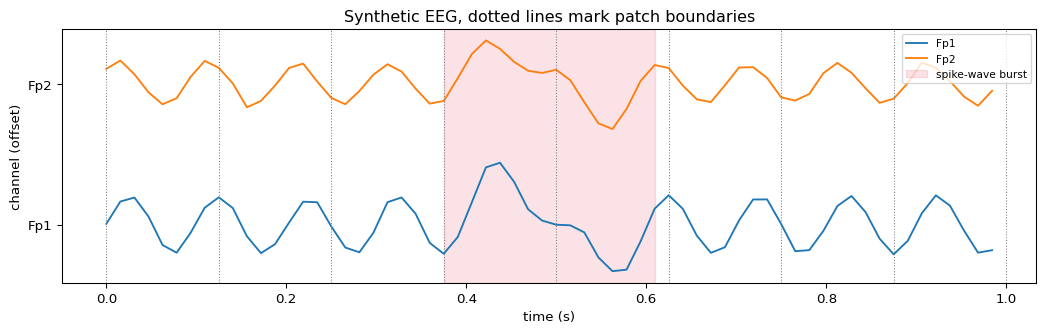
Two channels of synthetic EEG, one second at 64 Hz. Both carry a background alpha rhythm (~10 Hz); a spike-wave burst is injected in the middle, which is the interesting event a model would need to represent.
EEG array shape: (2, 64)  (2 channels x 64 samples)
sampling rate 64 Hz, duration 1.0s, spike burst at samples 24-40

 sample   time(s)        Fp1        Fp2
----------------------------------------
      0    0.0000     0.0248     0.4272
      1    0.0156     0.6583     0.6641
      2    0.0312     0.7715     0.2725
      3    0.0469     0.2322    -0.2394
      4    0.0625    -0.5774    -0.5797
      5    0.0781    -0.7963    -0.4069
    ...
     28    0.4375     1.7602     0.9957
     29    0.4531     1.2208     0.6281
     30    0.4688     0.4369     0.3733
     31    0.4844     0.1165     0.3113
     32    0.5000    -0.0007     0.4013
     33    0.5156    -0.0179     0.1052
----------------------------------------

mean +0.0234, std 0.5996
The dotted lines cut the recording into 8 patches of 8 samples each.
Those patches are this model's 'tokens'.
2. Patching — Turning a Signal into Tokens
A Transformer needs a sequence of vectors. Feeding one time sample per position would give 64 positions carrying almost no information each, and attention cost grows with the square of that number.
So the signal is cut into non-overlapping patches, and each patch is flattened across channels:
$$\text{patch}_p \in \mathbb{R}^{C \times L} \;\longrightarrow\; \mathbb{R}^{C \cdot L}$$
with $C = 2$ channels and $L = 8$ samples, giving vectors of length 16.
8 patches x 16 values  ->  patches.shape = (8, 16)

patch p3 covers samples 24..31 (t = 0.375s to 0.484s)

   Fp1 values: [-0.8272 -0.3474  0.638   1.6286  1.7602  1.2208  0.4369  0.1165]
   Fp2 values: [-0.4854  0.1653  0.8491  1.2341  0.9957  0.6281  0.3733  0.3113]
   flattened          : [-0.8272 -0.3474  0.638   1.6286  1.7602  1.2208  0.4369  0.1165 -0.4854  0.1653  0.8491  1.2341  0.9957  0.6281  0.3733  0.3113]
   MATCH: True

patches (8, 16) =
           p0 |   +0.025    +0.658    +0.771    +0.232    -0.577    -0.796    -0.227    +0.483    +0.427    +0.664    +0.272    -0.239    -0.580    -0.407    +0.200    +0.653
           p1 |   +0.777    +0.472    -0.329    -0.808    -0.554    +0.060    +0.653    +0.637    +0.457    +0.012    -0.664    -0.484    -0.047    +0.454    +0.576    +0.067
           p2 |   -0.051    -0.649    -0.785    -0.227    +0.639    +0.773    +0.310    -0.516    -0.398    -0.578    -0.202    +0.264    +0.557    +0.350    -0.136    -0.560
           p3 |   -0.827    -0.347    +0.638    +1.629    +1.760    +1.221    +0.437    +0.117    -0.485    +0.165    +0.849    +1.234    +0.996    +0.628    +0.373    +0.311
           p4 |   -0.001    -0.018    -0.220    -0.930    -1.321    -1.278    -0.474    +0.454    +0.401    +0.105    -0.524    -1.121    -1.281    -0.712    +0.083    +0.536
           p5 |   +0.837    +0.453    -0.312    -0.800    -0.640    +0.120    +0.716    +0.718    +0.451    -0.046    -0.438    -0.517    -0.038    +0.465    +0.476    +0.165
           p6 |   +0.017    -0.753    -0.723    -0.175    +0.532    +0.815    +0.358    -0.398    -0.384    -0.473    -0.286    +0.305    +0.596    +0.316    -0.124    -0.539
           p7 |   -0.842    -0.460    +0.323    +0.833    +0.542    -0.165    -0.794    -0.725    -0.419    +0.021    +0.603    +0.455    +0.081    -0.359    -0.621    -0.195

row energy (how active each patch is):
   p0:  2.0146  ########
   p1:  2.0391  ########
   p2:  1.9563  #######
   p3:  3.5758  ##############  <- spike burst
   p4:  2.9780  ###########  <- spike burst
   p5:  2.0568  ########
   p6:  1.9134  #######
   p7:  2.1221  ########
3. Patch Embedding
Text BERT looks a token ID up in an embedding table. There is no table here — the input is continuous — so the patch is projected instead:
$$E_p = \text{patch}_p W_e + b_e, \qquad W_e \in \mathbb{R}^{16 \times 8}$$
This is the only structural difference at the input, and it is why the same architecture transfers to signals, images (ViT), and audio.
==============================================================================
  patches (8, 16)   @   W_e (16, 8)   =   E_patch (8, 8)
==============================================================================
  shape rule: (8 x 16) @ (16 x 8) -> (8 x 8)   inner dim 16 cancels
  each 16-value patch becomes an 8-dim vector
==============================================================================

patches (8, 16)   [first 14 of 16 columns] =
           p0 |   +0.025    +0.658    +0.771    +0.232    -0.577    -0.796    -0.227    +0.483    +0.427    +0.664    +0.272    -0.239    -0.580    -0.407
           p1 |   +0.777    +0.472    -0.329    -0.808    -0.554    +0.060    +0.653    +0.637    +0.457    +0.012    -0.664    -0.484    -0.047    +0.454
           p2 |   -0.051    -0.649    -0.785    -0.227    +0.639    +0.773    +0.310    -0.516    -0.398    -0.578    -0.202    +0.264    +0.557    +0.350
           p3 |   -0.827    -0.347    +0.638    +1.629    +1.760    +1.221    +0.437    +0.117    -0.485    +0.165    +0.849    +1.234    +0.996    +0.628
           p4 |   -0.001    -0.018    -0.220    -0.930    -1.321    -1.278    -0.474    +0.454    +0.401    +0.105    -0.524    -1.121    -1.281    -0.712
           p5 |   +0.837    +0.453    -0.312    -0.800    -0.640    +0.120    +0.716    +0.718    +0.451    -0.046    -0.438    -0.517    -0.038    +0.465
           p6 |   +0.017    -0.753    -0.723    -0.175    +0.532    +0.815    +0.358    -0.398    -0.384    -0.473    -0.286    +0.305    +0.596    +0.316
           p7 |   -0.842    -0.460    +0.323    +0.833    +0.542    -0.165    -0.794    -0.725    -0.419    +0.021    +0.603    +0.455    +0.081    -0.359

W_e (16, 8) =
            0 |   -0.459    +0.091    +0.178    -0.483    +0.012    -0.274    +0.145    -0.326
            1 |   +0.191    -0.113    +0.437    -0.362    -0.159    -0.387    +0.425    +0.377
            2 |   -0.242    +0.160    +0.317    +0.055    +0.030    -0.258    -0.407    +0.397
            3 |   +0.400    +0.133    -0.161    -0.151    +0.226    +0.397    +0.387    +0.280
            4 |   +0.142    -0.416    -0.338    +0.399    +0.106    -0.491    -0.399    +0.164
            5 |   -0.495    -0.339    +0.049    +0.192    +0.152    -0.276    +0.212    -0.263
            6 |   -0.175    +0.246    +0.150    +0.349    +0.158    +0.068    -0.406    -0.132
            7 |   -0.235    -0.256    +0.473    -0.107    +0.392    +0.131    +0.295    +0.003
            8 |   +0.077    -0.007    -0.305    +0.222    -0.219    -0.476    +0.145    -0.323
            9 |   +0.440    +0.454    +0.415    -0.130    -0.485    +0.428    -0.072    +0.467
           10 |   +0.464    +0.353    -0.206    -0.115    +0.351    -0.183    -0.331    +0.057
           11 |   +0.436    +0.196    +0.070    -0.403    +0.115    +0.490    -0.360    +0.018
           12 |   +0.377    +0.241    +0.197    +0.202    -0.141    -0.206    +0.309    +0.310
           13 |   +0.367    +0.413    +0.011    +0.002    +0.298    +0.150    +0.202    +0.296
           14 |   +0.390    -0.162    -0.124    -0.406    +0.078    -0.464    -0.034    +0.043
           15 |   -0.213    +0.091    -0.469    -0.463    +0.323    -0.140    -0.373    +0.022

E_patch (8, 8) =
           p0 |   +0.176    +0.479    +0.472    -1.184    -0.219    -0.029    -0.147    +0.664
           p1 |   -1.002    -0.174    +0.819    -0.394    -0.141    -0.775    +0.782    -0.666
           p2 |   -0.085    -0.436    -0.546    +1.148    +0.222    -0.010    -0.008    -0.635
           p3 |   +2.006    +0.302    -0.635    +0.574    +1.563    +0.110    -0.984    +1.579
           p4 |   -1.383    -0.335    +0.029    -0.806    -0.750    +0.168    +0.188    -0.894
           p5 |   -1.094    -0.073    +0.803    -0.436    +0.038    -0.791    +0.736    -0.730
           p6 |   -0.174    -0.367    -0.412    +1.094    +0.215    +0.129    +0.024    -0.648
           p7 |   +1.175    +0.227    -0.810    +0.460    -0.000    +0.853    -0.647    +0.773

  worked element  E_patch[3,0]  =  row 3 of patches  .  column 0 of W_e
      row 3 of patches = [-0.8272 -0.3474  0.638   1.6286  1.7602  1.2208  0.4369  0.1165 -0.4854  0.1653  0.8491  1.2341  0.9957  0.6281  0.3733  0.3113]
      col 0 of W_e = [-0.4592  0.1909 -0.2421  0.4004  0.142  -0.4949 -0.1746 -0.2348  0.0769  0.4405  0.4636  0.4362  0.3774  0.3671  0.39   -0.2135]
      (-0.8272)*(-0.4592) + (-0.3474)*(+0.1909) + (+0.6380)*(-0.2421) + (+1.6286)*(+0.4004) +
      (+1.7602)*(+0.1420) + (+1.2208)*(-0.4949) + (+0.4369)*(-0.1746) + (+0.1165)*(-0.2348) +
      (-0.4854)*(+0.0769) + (+0.1653)*(+0.4405) + (+0.8491)*(+0.4636) + (+1.2341)*(+0.4362) +
      (+0.9957)*(+0.3774) + (+0.6281)*(+0.3671) + (+0.3733)*(+0.3900) + (+0.3113)*(-0.2135)
      = +2.006270   |  from array: +2.006270   |  MATCH: True
The [CLS] token and positional encoding
Two additions, both borrowed unchanged from text BERT:
[CLS] is a learned vector prepended to the sequence. It belongs to no patch, so it
is free to accumulate a summary of the whole recording through attention — which is
what a downstream classifier reads.
Positional encoding restores order. Attention is permutation-invariant: without it, a spike at 0.4s and the same spike at 0.9s would be indistinguishable.
$$Z = \big[\,\texttt{[CLS]};\, E_0;\, \dots;\, E_{7}\,\big] + PE$$
sequence length = 1 ([CLS]) + 8 patches = 9

[CLS] vector = [-0.2529  0.2403 -0.2582  0.0765  0.0161 -0.2304  0.758   0.2241]

==============================================================================
  Z0 = embeddings + PE      all three are (9, 8) - element-wise
==============================================================================

     [CLS] |
       embeddings:   -0.253    +0.240    -0.258    +0.077    +0.016    -0.230    +0.758    +0.224
               PE:   +0.000    +1.000    +0.000    +1.000    +0.000    +1.000    +0.000    +1.000
               Z0:   -0.253    +1.240    -0.258    +1.077    +0.016    +0.770    +0.758    +1.224

        p0 |
       embeddings:   +0.176    +0.479    +0.472    -1.184    -0.219    -0.029    -0.147    +0.664
               PE:   +0.841    +0.540    +0.100    +0.995    +0.010    +1.000    +0.001    +1.000
               Z0:   +1.018    +1.020    +0.572    -0.189    -0.209    +0.971    -0.146    +1.664

        p1 |
       embeddings:   -1.002    -0.174    +0.819    -0.394    -0.141    -0.775    +0.782    -0.666
               PE:   +0.909    -0.416    +0.199    +0.980    +0.020    +1.000    +0.002    +1.000
               Z0:   -0.092    -0.590    +1.018    +0.586    -0.121    +0.225    +0.784    +0.334

        p2 |
       embeddings:   -0.085    -0.436    -0.546    +1.148    +0.222    -0.010    -0.008    -0.635
               PE:   +0.141    -0.990    +0.296    +0.955    +0.030    +1.000    +0.003    +1.000
               Z0:   +0.056    -1.426    -0.251    +2.104    +0.252    +0.990    -0.005    +0.365

        p3 |
       embeddings:   +2.006    +0.302    -0.635    +0.574    +1.563    +0.110    -0.984    +1.579
               PE:   -0.757    -0.654    +0.389    +0.921    +0.040    +0.999    +0.004    +1.000
               Z0:   +1.249    -0.351    -0.245    +1.495    +1.603    +1.109    -0.980    +2.579

        p4 |
       embeddings:   -1.383    -0.335    +0.029    -0.806    -0.750    +0.168    +0.188    -0.894
               PE:   -0.959    +0.284    +0.479    +0.878    +0.050    +0.999    +0.005    +1.000
               Z0:   -2.342    -0.051    +0.508    +0.071    -0.700    +1.166    +0.193    +0.106

        p5 |
       embeddings:   -1.094    -0.073    +0.803    -0.436    +0.038    -0.791    +0.736    -0.730
               PE:   -0.279    +0.960    +0.565    +0.825    +0.060    +0.998    +0.006    +1.000
               Z0:   -1.374    +0.887    +1.368    +0.389    +0.098    +0.207    +0.742    +0.270

        p6 |
       embeddings:   -0.174    -0.367    -0.412    +1.094    +0.215    +0.129    +0.024    -0.648
               PE:   +0.657    +0.754    +0.644    +0.765    +0.070    +0.998    +0.007    +1.000
               Z0:   +0.483    +0.387    +0.232    +1.859    +0.285    +1.126    +0.031    +0.352

        p7 |
       embeddings:   +1.175    +0.227    -0.810    +0.460    -0.000    +0.853    -0.647    +0.773
               PE:   +0.989    -0.146    +0.717    +0.697    +0.080    +0.997    +0.008    +1.000
               Z0:   +2.164    +0.082    -0.093    +1.156    +0.080    +1.849    -0.639    +1.773

  check [0,0]: -0.252898 + +0.000000 = -0.252898   MATCH: True
4. Masking
BERT's training signal comes from hiding part of the input. A fraction of positions is
selected, and the chosen ones are replaced by a single learned [MASK] vector.
Text BERT applies the well-known 80/10/10 rule to each selected position:
- 80% replaced by
[MASK], - 10% replaced by a random token,
- 10% left unchanged.
The reason is a train/inference mismatch: [MASK] never appears when the model is
actually used, so if every selected position were masked the model would only ever learn
to handle that symbol. The 10% "unchanged" slice forces it to keep a good representation
of every position, because it cannot tell which ones it will be scored on.
masking 25% of 8 patches -> 2 positions

[MASK] vector = [-0.716   0.0659 -0.234   0.3014 -0.2802 -0.0406  0.1785  0.3061]

  pos     name   masked       input row (after masking)
--------------------------------------------------------------
    0    [CLS]        -  [-0.253  1.24  -0.258  1.077  0.016  0.77   0.758  1.224]
    1       p0        -  [ 1.018  1.02   0.572 -0.189 -0.209  0.971 -0.146  1.664]
    2       p1        -  [-0.092 -0.59   1.018  0.586 -0.121  0.225  0.784  0.334]
    3       p2        -  [ 0.056 -1.426 -0.251  2.104  0.252  0.99  -0.005  0.365]
    4       p3      YES  [-1.473 -0.588  0.155  1.222 -0.24   0.959  0.183  1.306]
    5       p4        -  [-2.342 -0.051  0.508  0.071 -0.7    1.166  0.193  0.106]
    6       p5        -  [-1.374  0.887  1.368  0.389  0.098  0.207  0.742  0.27 ]
    7       p6        -  [0.483 0.387 0.232 1.859 0.285 1.126 0.031 0.352]
    8       p7      YES  [ 0.273 -0.08   0.483  0.998 -0.2    0.956  0.187  1.306]
--------------------------------------------------------------

masked positions: [4, 8] = ['p3', 'p7']

The true content of those patches is kept aside as the reconstruction
target - the encoder never sees it again until the loss is computed.
targets.shape = (2, 16)  (2 patches x 16 values)
5. Bidirectional Self-Attention
This is the difference that defines BERT.
The autoregressive decoder added a causal mask $M$ before the softmax so position $t$ could not see beyond itself. BERT adds nothing:
$$A = \mathrm{softmax}\!\left(\frac{QK^\top}{\sqrt{d_k}}\right) \qquad\text{(no } +M \text{ term)}$$
Every position attends to every other position, in both directions. A masked patch is reconstructed from the signal before and after it — which is why BERT is useless for generation and excellent for representation.
STEP 1 : project Z to Q, K, V
==============================================================================
==============================================================================
  Z (9, 8)   @   Wq (8, 8)   =   Q_full (9, 8)
==============================================================================
  shape rule: (9 x 8) @ (8 x 8) -> (9 x 8)   inner dim 8 cancels
  K uses Wk, V uses Wv - identical arithmetic
==============================================================================

Z (9, 8) =
        [CLS] |   -0.253    +1.240    -0.258    +1.077    +0.016    +0.770    +0.758    +1.224
           p0 |   +1.018    +1.020    +0.572    -0.189    -0.209    +0.971    -0.146    +1.664
           p1 |   -0.092    -0.590    +1.018    +0.586    -0.121    +0.225    +0.784    +0.334
           p2 |   +0.056    -1.426    -0.251    +2.104    +0.252    +0.990    -0.005    +0.365
           p3 |   -1.473    -0.588    +0.155    +1.222    -0.240    +0.959    +0.183    +1.306
           p4 |   -2.342    -0.051    +0.508    +0.071    -0.700    +1.166    +0.193    +0.106
           p5 |   -1.374    +0.887    +1.368    +0.389    +0.098    +0.207    +0.742    +0.270
           p6 |   +0.483    +0.387    +0.232    +1.859    +0.285    +1.126    +0.031    +0.352
           p7 |   +0.273    -0.080    +0.483    +0.998    -0.200    +0.956    +0.187    +1.306

Wq (8, 8) =
            0 |   -0.319    -0.497    -0.388    +0.532    +0.169    +0.020    +0.192    -0.079
            1 |   +0.282    -0.554    +0.081    -0.418    -0.465    -0.194    -0.500    -0.497
            2 |   -0.231    +0.587    -0.398    -0.591    +0.323    +0.376    -0.188    -0.043
            3 |   +0.183    -0.554    +0.550    +0.474    -0.293    -0.594    +0.531    +0.001
            4 |   +0.048    +0.225    +0.142    +0.544    +0.544    +0.450    +0.167    +0.369
            5 |   +0.217    +0.090    -0.455    +0.381    +0.393    +0.154    +0.392    +0.186
            6 |   -0.359    -0.277    -0.350    -0.150    -0.565    +0.145    -0.200    +0.191
            7 |   -0.140    +0.222    -0.195    -0.293    -0.005    +0.236    -0.186    +0.535

Q_full (9, 8) =
        [CLS] |   +0.411    -1.174    +0.042    -0.161    -1.141    -0.457    -0.123    +0.364
           p0 |   -0.185    -0.180    -1.390    -0.522    +0.280    +0.579    -0.456    +0.353
           p1 |   -0.550    +0.497    -0.553    -0.323    -0.006    +0.320    +0.246    +0.583
           p2 |   +0.202    -0.321    +0.636    +2.178    +0.502    -0.714    +2.251    +1.189
           p3 |   +0.440    +0.745    +0.346    -0.227    -0.147    -0.209    +0.687    +1.226
           p4 |   +0.763    +1.369    +0.024    -1.488    -0.262    +0.029    -0.200    +0.240
           p5 |   +0.188    +0.675    -0.117    -1.785    -0.604    +0.330    -0.860    -0.031
           p6 |   +0.440    -1.112    +0.222    +1.315    +0.011    -0.692    +1.261    +0.270
           p7 |   -0.091    -0.081    -0.539    +0.210    +0.102    +0.003    +0.593    +0.836

  worked element  Q_full[0,0]  =  row 0 of Z  .  column 0 of Wq
      row 0 of Z = [-0.2529  1.2403 -0.2582  1.0765  0.0161  0.7696  0.758   1.2241]
      col 0 of Wq = [-0.3187  0.2817 -0.231   0.1834  0.0482  0.217  -0.3592 -0.1404]
      (-0.2529)*(-0.3187) + (+1.2403)*(+0.2817) + (-0.2582)*(-0.2310) + (+1.0765)*(+0.1834) +
      (+0.0161)*(+0.0482) + (+0.7696)*(+0.2170) + (+0.7580)*(-0.3592) + (+1.2241)*(-0.1404)
      = +0.410802   |  from array: +0.410802   |  MATCH: True

K_full (9, 8), V_full (9, 8)

STEP 2 : split into 2 heads of 4  ->  (2, 9, 4)
STEP 3 : scores = Q K^T / sqrt(d_k)   (head 0)
==============================================================================
==============================================================================
  Q_head0 (9, 4)   @   K_head0^T (4, 9)   =   raw_scores (9, 9)
==============================================================================
  shape rule: (9 x 4) @ (4 x 9) -> (9 x 9)   inner dim 4 cancels
  (9,4) @ (4,9) -> (9,9)
==============================================================================

Q_head0 (9, 4) =
        [CLS] |   +0.411    -1.174    +0.042    -0.161
           p0 |   -0.185    -0.180    -1.390    -0.522
           p1 |   -0.550    +0.497    -0.553    -0.323
           p2 |   +0.202    -0.321    +0.636    +2.178
           p3 |   +0.440    +0.745    +0.346    -0.227
           p4 |   +0.763    +1.369    +0.024    -1.488
           p5 |   +0.188    +0.675    -0.117    -1.785
           p6 |   +0.440    -1.112    +0.222    +1.315
           p7 |   -0.091    -0.081    -0.539    +0.210

K_head0^T (4, 9) =
            0 |   +1.036    -0.694    +0.844    +2.334    +2.509    +2.331    +0.533    +1.051    +1.041
            1 |   +0.552    -0.626    +0.651    +1.874    +1.032    +0.878    +0.211    +1.207    +0.562
            2 |   -0.206    +0.305    +0.055    -0.981    -1.444    -1.927    -0.483    -0.552    -0.334
            3 |   +1.840    +1.519    +0.238    +0.902    +1.260    +0.492    +0.609    +1.622    +1.449

raw_scores (9, 9) =
        [CLS] |   -0.527    +0.217    -0.453    -1.427    -0.443    -0.232    -0.146    -1.270    -0.479
           p0 |   -0.964    -0.975    -0.474    +0.125    +0.701    +1.834    +0.217    -0.490    -0.584
           p1 |   -0.776    -0.588    -0.248    -0.101    -0.476    +0.061    -0.118    -0.196    -0.577
           p2 |   +3.908    +3.563    +0.515    +1.209    +2.001    +0.035    +1.059    +3.006    +2.973
           p3 |   +0.378    -1.010    +0.821    +1.878    +1.087    +0.900    +0.086    +0.803    +0.432
           p4 |   -1.196    -3.638    +1.182    +2.980    +1.417    +2.201    -0.222    +0.028    -0.600
           p5 |   -2.692    -3.300    +0.167    +0.210    -0.910    +0.379    -0.788    -1.817    -1.972
           p6 |   +2.216    +2.456    -0.027    -0.089    +1.292    +0.268    +0.694    +1.130    +1.664
           p7 |   +0.360    +0.269    -0.109    +0.356    +0.733    +0.861    +0.323    +0.446    +0.345

  worked element  raw_scores[0,0]  =  row 0 of Q_head0  .  column 0 of K_head0^T
      row 0 of Q_head0 = [ 0.4108 -1.1735  0.0416 -0.1612]
      col 0 of K_head0^T = [ 1.0363  0.5522 -0.2061  1.8397]
      (+0.4108)*(+1.0363) + (-1.1735)*(+0.5522) + (+0.0416)*(-0.2061) + (-0.1612)*(+1.8397)
      = -0.527471   |  from array: -0.527471   |  MATCH: True


then divide every entry by sqrt(d_k) = 2:

scaled_scores (9, 9) =
        [CLS] |   -0.264    +0.109    -0.227    -0.714    -0.222    -0.116    -0.073    -0.635    -0.239
           p0 |   -0.482    -0.487    -0.237    +0.063    +0.350    +0.917    +0.109    -0.245    -0.292
           p1 |   -0.388    -0.294    -0.124    -0.050    -0.238    +0.031    -0.059    -0.098    -0.288
           p2 |   +1.954    +1.781    +0.258    +0.605    +1.000    +0.017    +0.530    +1.503    +1.486
           p3 |   +0.189    -0.505    +0.411    +0.939    +0.543    +0.450    +0.043    +0.401    +0.216
           p4 |   -0.598    -1.819    +0.591    +1.490    +0.709    +1.100    -0.111    +0.014    -0.300
           p5 |   -1.346    -1.650    +0.083    +0.105    -0.455    +0.190    -0.394    -0.909    -0.986
           p6 |   +1.108    +1.228    -0.013    -0.045    +0.646    +0.134    +0.347    +0.565    +0.832
           p7 |   +0.180    +0.134    -0.054    +0.178    +0.366    +0.430    +0.162    +0.223    +0.173


STEP 4 : softmax - and note what is NOT here
==============================================================================
A = softmax(scores) (9, 9) =
        [CLS] |   0.1081    0.1568    0.1121    0.0689    0.1127    0.1253    0.1307    0.0746    0.1107
           p0 |   0.0640    0.0636    0.0818    0.1103    0.1471    0.2592    0.1155    0.0811    0.0774
           p1 |   0.0884    0.0971    0.1151    0.1239    0.1027    0.1343    0.1228    0.1181    0.0976
           p2 |   0.2316    0.1949    0.0425    0.0601    0.0892    0.0334    0.0557    0.1475    0.1451
           p3 |   0.0933    0.0466    0.1165    0.1975    0.1330    0.1212    0.0806    0.1154    0.0959
           p4 |   0.0376    0.0111    0.1233    0.3031    0.1387    0.2053    0.0611    0.0693    0.0506
           p5 |   0.0438    0.0323    0.1829    0.1869    0.1067    0.2034    0.1135    0.0678    0.0628
           p6 |   0.1791    0.2019    0.0584    0.0566    0.1129    0.0676    0.0837    0.1040    0.1359
           p7 |   0.1081    0.1033    0.0855    0.1079    0.1302    0.1388    0.1061    0.1128    0.1073

row sums (must all be 1): [1. 1. 1. 1. 1. 1. 1. 1. 1.]

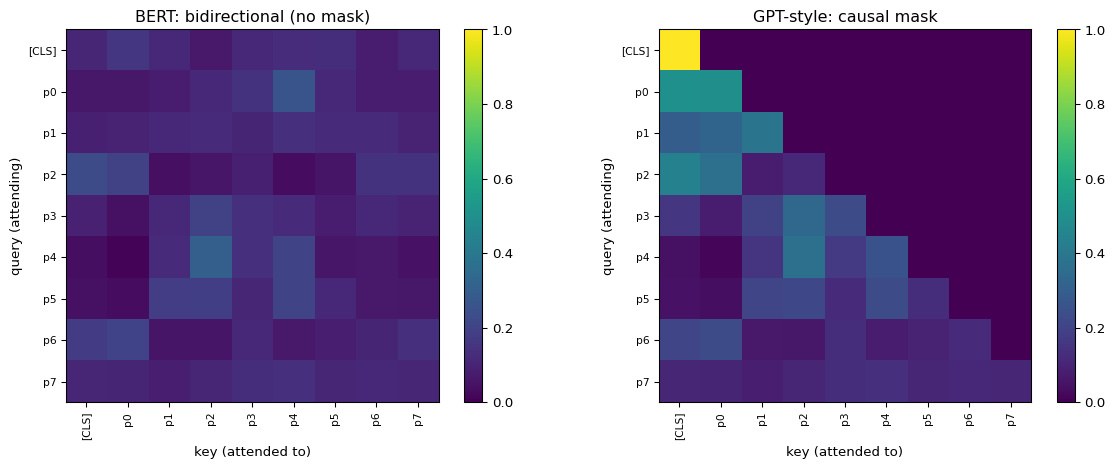
entries ABOVE the diagonal - the 'future' - are all non-zero: True
   smallest such weight = 0.033393

In the autoregressive decoder every one of those was exactly 0.
That is the whole difference between BERT and GPT, visible as a matrix.
Bidirectional vs causal, side by side
The same scores, softmaxed twice: once as BERT does it, once with the causal mask the decoder-style model would apply.
query    BERT: non-zero weights    causal: non-zero weights
--------------------------------------------------------------
  [CLS]                         9                           1
     p0                         9                           2
     p1                         9                           3
     p2                         9                           4
     p3                         9                           5
     p4                         9                           6
     p5                         9                           7
     p6                         9                           8
     p7                         9                           9
--------------------------------------------------------------

Every BERT row uses all 9 positions. The causal rows grow 1, 2, 3, ...
A masked patch in the middle of the recording therefore gets context from
BOTH sides under BERT, and only from the left under a causal model.
One attention weight, by hand
$$A_{ij} = \frac{\exp(s_{ij} - m)}{\sum_{j'} \exp(s_{ij'} - m)}, \qquad s_{ij} = \frac{q_i \cdot k_j}{\sqrt{d_k}}, \qquad m = \max_{j} s_{ij}$$
query = position 4 ('p3', MASKED), key = position 5 ('p4')

q = [ 0.4397  0.7448  0.3462 -0.2267]
k = [ 2.331   0.878  -1.9271  0.492 ]

q . k = (+0.4397)*(+2.3310) + (+0.7448)*(+0.8780) + (+0.3462)*(-1.9271) + (-0.2267)*(+0.4920)
      = +0.900163
/ sqrt(d_k) = +0.900163 / 2 = +0.450082
from the scores matrix: +0.450082   MATCH: True

softmax over row 4, m = max = 0.938971

   j     name         s_ij          s-m         exp          /Z       array
----------------------------------------------------------------------
   0    [CLS]     0.189236    -0.749735    0.472492    0.093338    0.093338
   1       p0    -0.504971    -1.443941    0.235996    0.046619    0.046619
   2       p1     0.410514    -0.528456    0.589514    0.116455    0.116455
   3       p2     0.938971     0.000000    1.000000    0.197544    0.197544
   4       p3     0.543256    -0.395714    0.673199    0.132986    0.132986
   5       p4     0.450082    -0.488889    0.613307    0.121155    0.121155
   6       p5     0.043121    -0.895849    0.408261    0.080649    0.080649
   7       p6     0.401259    -0.537711    0.584083    0.115382    0.115382
   8       p7     0.216020    -0.722951    0.485318    0.095872    0.095872
----------------------------------------------------------------------
Z = 5.062170,  sum of weights = 1.0000000000
MATCH with the array row: True
6. The Encoder Block
Identical in form to the encoder half of the autoregressive Transformer: attention, residual + LayerNorm, feed-forward, residual + LayerNorm. Nothing here is BERT-specific — the only BERT-specific choice was the absent mask.
STEPS 5-7 : weights @ V, concat heads, project with W_O
==============================================================================
==============================================================================
  A_head0 (9, 9)   @   V_head0 (9, 4)   =   head0_out (9, 4)
==============================================================================
  shape rule: (9 x 9) @ (9 x 4) -> (9 x 4)   inner dim 9 cancels
  (9,9) @ (9,4) -> (9,4)
==============================================================================

A_head0 (9, 9) =
        [CLS] |   +0.108    +0.157    +0.112    +0.069    +0.113    +0.125    +0.131    +0.075    +0.111
           p0 |   +0.064    +0.064    +0.082    +0.110    +0.147    +0.259    +0.115    +0.081    +0.077
           p1 |   +0.088    +0.097    +0.115    +0.124    +0.103    +0.134    +0.123    +0.118    +0.098
           p2 |   +0.232    +0.195    +0.042    +0.060    +0.089    +0.033    +0.056    +0.148    +0.145
           p3 |   +0.093    +0.047    +0.116    +0.198    +0.133    +0.121    +0.081    +0.115    +0.096
           p4 |   +0.038    +0.011    +0.123    +0.303    +0.139    +0.205    +0.061    +0.069    +0.051
           p5 |   +0.044    +0.032    +0.183    +0.187    +0.107    +0.203    +0.113    +0.068    +0.063
           p6 |   +0.179    +0.202    +0.058    +0.057    +0.113    +0.068    +0.084    +0.104    +0.136
           p7 |   +0.108    +0.103    +0.085    +0.108    +0.130    +0.139    +0.106    +0.113    +0.107

V_head0 (9, 4) =
            0 |   +0.158    -1.394    -1.264    -0.123
            1 |   +0.197    -0.766    -0.639    -1.657
            2 |   -0.134    -0.605    -0.688    -0.961
            3 |   +1.146    -0.971    -1.650    +0.281
            4 |   +1.222    -1.446    -1.388    -0.736
            5 |   +1.177    -1.143    -0.061    -0.986
            6 |   -0.564    -1.140    -0.446    -0.428
            7 |   +0.398    -1.170    -1.403    +0.329
            8 |   +0.609    -1.065    -1.276    -1.107

head0_out (9, 4) =
        [CLS] |   +0.420    -1.066    -0.896    -0.722
           p0 |   +0.637    -1.112    -0.844    -0.633
           p1 |   +0.480    -1.072    -0.953    -0.578
           p2 |   +0.402    -1.114    -1.088    -0.610
           p3 |   +0.599    -1.088    -1.066    -0.465
           p4 |   +0.774    -1.069    -1.034    -0.420
           p5 |   +0.574    -1.040    -0.897    -0.557
           p6 |   +0.420    -1.097    -1.006    -0.699
           p7 |   +0.522    -1.100    -0.971    -0.596

  worked element  head0_out[0,0]  =  row 0 of A_head0  .  column 0 of V_head0
      row 0 of A_head0 = [0.1081 0.1568 0.1121 0.0689 0.1127 0.1253 0.1307 0.0746 0.1107]
      col 0 of V_head0 = [ 0.1577  0.1974 -0.134   1.1456  1.222   1.1771 -0.564   0.398   0.6086]
      (+0.1081)*(+0.1577) + (+0.1568)*(+0.1974) + (+0.1121)*(-0.1340) + (+0.0689)*(+1.1456) +
      (+0.1127)*(+1.2220) + (+0.1253)*(+1.1771) + (+0.1307)*(-0.5640) + (+0.0746)*(+0.3980) +
      (+0.1107)*(+0.6086)
      = +0.420451   |  from array: +0.420451   |  MATCH: True

==============================================================================
  concat (9, 8)   @   W_O (8, 8)   =   attn_out (9, 8)
==============================================================================
  shape rule: (9 x 8) @ (8 x 8) -> (9 x 8)   inner dim 8 cancels
  W_O mixes the two heads
==============================================================================

concat (9, 8) =
        [CLS] |   +0.420    -1.066    -0.896    -0.722    +0.531    -0.615    +0.610    +0.172
           p0 |   +0.637    -1.112    -0.844    -0.633    +0.649    -0.793    +0.586    -0.061
           p1 |   +0.480    -1.072    -0.953    -0.578    +0.727    -0.733    +0.598    +0.057
           p2 |   +0.402    -1.114    -1.088    -0.610    +1.059    -0.599    +0.614    +0.396
           p3 |   +0.599    -1.088    -1.066    -0.465    +0.874    -0.649    +0.610    +0.267
           p4 |   +0.774    -1.069    -1.034    -0.420    +0.602    -0.704    +0.601    +0.058
           p5 |   +0.574    -1.040    -0.897    -0.557    +0.464    -0.712    +0.586    +0.010
           p6 |   +0.420    -1.097    -1.006    -0.699    +0.816    -0.647    +0.616    +0.202
           p7 |   +0.522    -1.100    -0.971    -0.596    +0.820    -0.692    +0.607    +0.161

W_O (8, 8) =
            0 |   -0.511    +0.461    +0.063    -0.410    -0.109    +0.340    -0.024    +0.594
            1 |   -0.151    +0.306    -0.131    +0.403    +0.085    -0.535    -0.567    -0.448
            2 |   -0.596    -0.520    +0.235    +0.042    +0.306    +0.506    +0.104    +0.277
            3 |   +0.315    -0.150    -0.317    -0.361    -0.304    -0.276    -0.359    +0.463
            4 |   +0.315    -0.555    -0.283    -0.585    -0.002    -0.029    +0.406    -0.235
            5 |   +0.387    +0.573    -0.504    +0.357    +0.110    -0.024    -0.097    +0.349
            6 |   +0.171    +0.374    +0.494    +0.144    +0.588    +0.132    +0.167    +0.067
            7 |   -0.501    +0.277    +0.058    -0.060    +0.503    -0.247    +0.029    +0.242

attn_out (9, 8) =
        [CLS] |   +0.199    +0.071    +0.656    -0.832    +0.186    +0.496    +1.142    -0.111
           p0 |   +0.173    -0.126    +0.691    -1.092    -0.004    +0.652    +1.192    -0.054
           p1 |   +0.321    -0.108    +0.592    -1.066    +0.040    +0.475    +1.172    -0.138
           p2 |   +0.426    -0.090    +0.438    -1.209    +0.207    +0.317    +1.330    -0.167
           p3 |   +0.340    +0.012    +0.474    -1.233    +0.078    +0.379    +1.186    +0.006
           p4 |   +0.240    +0.134    +0.564    -1.161    -0.059    +0.493    +1.046    +0.126
           p5 |   +0.187    +0.052    +0.656    -0.934    +0.015    +0.530    +1.038    -0.015
           p6 |   +0.341    -0.051    +0.566    -1.036    +0.157    +0.436    +1.261    -0.188
           p7 |   +0.303    -0.081    +0.564    -1.133    +0.094    +0.473    +1.230    -0.096

  worked element  attn_out[0,0]  =  row 0 of concat  .  column 0 of W_O
      row 0 of concat = [ 0.4205 -1.0659 -0.896  -0.7223  0.5309 -0.6145  0.61    0.1724]
      col 0 of W_O = [-0.511  -0.151  -0.5956  0.3149  0.3148  0.3875  0.1707 -0.5009]
      (+0.4205)*(-0.5110) + (-1.0659)*(-0.1510) + (-0.8960)*(-0.5956) + (-0.7223)*(+0.3149) +
      (+0.5309)*(+0.3148) + (-0.6145)*(+0.3875) + (+0.6100)*(+0.1707) + (+0.1724)*(-0.5009)
      = +0.199056   |  from array: +0.199056   |  MATCH: True


Add & Norm 1
==============================================================================
==============================================================================
  residual = Z + attn_out      all three are (9, 8) - element-wise
==============================================================================

     [CLS] |
                Z:   -0.253    +1.240    -0.258    +1.077    +0.016    +0.770    +0.758    +1.224
         attn_out:   +0.199    +0.071    +0.656    -0.832    +0.186    +0.496    +1.142    -0.111
         residual:   -0.054    +1.311    +0.397    +0.244    +0.203    +1.266    +1.900    +1.113

        p0 |
                Z:   +1.018    +1.020    +0.572    -0.189    -0.209    +0.971    -0.146    +1.664
         attn_out:   +0.173    -0.126    +0.691    -1.092    -0.004    +0.652    +1.192    -0.054
         residual:   +1.191    +0.894    +1.263    -1.282    -0.213    +1.624    +1.046    +1.609

        p1 |
                Z:   -0.092    -0.590    +1.018    +0.586    -0.121    +0.225    +0.784    +0.334
         attn_out:   +0.321    -0.108    +0.592    -1.066    +0.040    +0.475    +1.172    -0.138
         residual:   +0.228    -0.698    +1.610    -0.480    -0.081    +0.700    +1.956    +0.196

        p2 |
                Z:   +0.056    -1.426    -0.251    +2.104    +0.252    +0.990    -0.005    +0.365
         attn_out:   +0.426    -0.090    +0.438    -1.209    +0.207    +0.317    +1.330    -0.167
         residual:   +0.482    -1.515    +0.187    +0.895    +0.458    +1.307    +1.325    +0.199

        p3 |
                Z:   -1.473    -0.588    +0.155    +1.222    -0.240    +0.959    +0.183    +1.306
         attn_out:   +0.340    +0.012    +0.474    -1.233    +0.078    +0.379    +1.186    +0.006
         residual:   -1.132    -0.575    +0.630    -0.011    -0.162    +1.338    +1.369    +1.312

        p4 |
                Z:   -2.342    -0.051    +0.508    +0.071    -0.700    +1.166    +0.193    +0.106
         attn_out:   +0.240    +0.134    +0.564    -1.161    -0.059    +0.493    +1.046    +0.126
         residual:   -2.102    +0.083    +1.072    -1.090    -0.759    +1.659    +1.239    +0.232

        p5 |
                Z:   -1.374    +0.887    +1.368    +0.389    +0.098    +0.207    +0.742    +0.270
         attn_out:   +0.187    +0.052    +0.656    -0.934    +0.015    +0.530    +1.038    -0.015
         residual:   -1.187    +0.939    +2.024    -0.545    +0.113    +0.737    +1.781    +0.255

        p6 |
                Z:   +0.483    +0.387    +0.232    +1.859    +0.285    +1.126    +0.031    +0.352
         attn_out:   +0.341    -0.051    +0.566    -1.036    +0.157    +0.436    +1.261    -0.188
         residual:   +0.824    +0.335    +0.799    +0.823    +0.442    +1.562    +1.291    +0.163

        p7 |
                Z:   +0.273    -0.080    +0.483    +0.998    -0.200    +0.956    +0.187    +1.306
         attn_out:   +0.303    -0.081    +0.564    -1.133    +0.094    +0.473    +1.230    -0.096
         residual:   +0.576    -0.161    +1.048    -0.135    -0.106    +1.429    +1.417    +1.210

  check [0,0]: -0.252898 + +0.199056 = -0.053842   MATCH: True

Z1 = LayerNorm(residual) (9, 8) =
        [CLS] |   -1.317    +0.795    -0.619    -0.856    -0.920    +0.724    +1.706    +0.487
           p0 |   +0.450    +0.135    +0.526    -2.171    -1.038    +0.908    +0.296    +0.893
           p1 |   -0.227    -1.275    +1.336    -1.028    -0.577    +0.307    +1.728    -0.263
           p2 |   +0.077    -2.292    -0.273    +0.567    +0.049    +1.055    +1.077    -0.259
           p3 |   -1.645    -1.025    +0.316    -0.397    -0.565    +1.103    +1.138    +1.075
           p4 |   -1.775    +0.034    +0.853    -0.937    -0.663    +1.339    +0.992    +0.158
           p5 |   -1.665    +0.415    +1.477    -1.036    -0.393    +0.218    +1.238    -0.254
           p6 |   +0.099    -1.003    +0.042    +0.096    -0.763    +1.766    +1.154    -1.392
           p7 |   -0.126    -1.238    +0.585    -1.199    -1.155    +1.160    +1.142    +0.830

per-row mean ~ 0: [ 0. -0. -0.  0. -0. -0.  0. -0.  0.]
per-row std  ~ 1: [1. 1. 1. 1. 1. 1. 1. 1. 1.]
Feed-forward network:  8 -> 16 -> 8
==============================================================================
==============================================================================
  Z1 (9, 8)   @   W1 (8, 16)   =   pre-ReLU (9, 16)
==============================================================================
  shape rule: (9 x 8) @ (8 x 16) -> (9 x 16)   inner dim 8 cancels
==============================================================================

Z1 (9, 8) =
        [CLS] |   -1.317    +0.795    -0.619    -0.856    -0.920    +0.724    +1.706    +0.487
           p0 |   +0.450    +0.135    +0.526    -2.171    -1.038    +0.908    +0.296    +0.893
           p1 |   -0.227    -1.275    +1.336    -1.028    -0.577    +0.307    +1.728    -0.263
           p2 |   +0.077    -2.292    -0.273    +0.567    +0.049    +1.055    +1.077    -0.259
           p3 |   -1.645    -1.025    +0.316    -0.397    -0.565    +1.103    +1.138    +1.075
           p4 |   -1.775    +0.034    +0.853    -0.937    -0.663    +1.339    +0.992    +0.158
           p5 |   -1.665    +0.415    +1.477    -1.036    -0.393    +0.218    +1.238    -0.254
           p6 |   +0.099    -1.003    +0.042    +0.096    -0.763    +1.766    +1.154    -1.392
           p7 |   -0.126    -1.238    +0.585    -1.199    -1.155    +1.160    +1.142    +0.830

W1 (8, 16)   [first 14 of 16 columns] =
            0 |   +0.296    -0.041    +0.342    +0.269    -0.434    -0.454    +0.121    -0.153    -0.291    +0.080    -0.158    +0.037    -0.040    +0.085
            1 |   -0.320    +0.197    -0.088    +0.374    +0.015    +0.473    +0.102    -0.276    +0.322    -0.155    -0.152    -0.468    +0.049    +0.034
            2 |   -0.371    -0.170    -0.178    -0.408    -0.019    +0.188    +0.012    -0.343    -0.123    -0.497    +0.368    -0.415    +0.097    +0.486
            3 |   -0.264    +0.260    +0.031    +0.221    -0.438    -0.352    -0.367    +0.187    +0.344    +0.250    -0.470    +0.367    -0.146    -0.103
            4 |   -0.318    +0.064    +0.341    -0.411    +0.035    -0.267    -0.157    -0.026    -0.145    +0.149    -0.020    +0.084    +0.237    +0.058
            5 |   -0.121    -0.163    +0.400    +0.108    -0.256    -0.002    -0.170    +0.434    -0.492    -0.275    -0.135    -0.012    +0.351    -0.412
            6 |   +0.342    -0.448    -0.482    +0.197    +0.497    +0.397    +0.076    +0.417    -0.495    +0.475    -0.009    +0.223    +0.321    +0.218
            7 |   +0.339    -0.295    +0.468    +0.211    -0.300    +0.236    +0.030    +0.207    +0.268    -0.413    +0.006    +0.432    -0.179    +0.094

pre-ReLU (9, 16)   [first 14 of 16 columns] =
        [CLS] |   +0.765    -0.993    -1.055    +0.902    +1.454    +2.195    +0.394    +1.185    -0.517    +0.140    +0.170    +0.026    +0.652    -0.231
           p0 |   +1.091    -1.256    +0.265    +0.249    +0.357    +1.327    +0.929    +0.037    -1.104    -1.421    +1.023    -0.709    +0.364    +0.236
           p1 |   +0.764    -1.519    -1.265    -0.755    +1.343    +0.890    +0.397    +0.550    -1.855    +0.017    +1.158    -0.125    +0.799    +0.885
           p2 |   +0.845    -0.835    +0.094    -0.350    +0.034    -1.019    -0.548    +1.673    -1.660    +0.975    -0.184    +1.517    +0.550    -0.485
           p3 |   +0.627    -1.334    -0.337    -0.240    +0.806    +1.315    -0.134    +1.542    -0.763    -0.518    +0.578    +0.799    +0.530    -0.118
           p4 |   -0.165    -1.061    -0.886    -0.374    +1.244    +1.918    +0.100    +0.838    -0.912    -0.865    +0.855    -0.564    +0.895    +0.003
           p5 |   -0.465    -0.912    -1.665    -0.747    +1.777    +2.131    +0.350    +0.008    -0.651    -0.616    +1.197    -1.120    +0.808    +0.832
           p6 |   +0.262    -0.626    -0.643    +0.092    +0.412    -0.216    -0.259    +1.245    -2.027    +0.691    -0.134    +0.062    +0.996    -0.666
           p7 |   +1.356    -1.668    -0.167    -0.001    +0.531    +0.959    +0.401    +1.118    -1.593    -0.699    +0.849    +0.393    +0.528    +0.137

  worked element  pre-ReLU[0,0]  =  row 0 of Z1  .  column 0 of W1
      row 0 of Z1 = [-1.3169  0.7946 -0.6191 -0.8557 -0.9203  0.7243  1.7057  0.4874]
      col 0 of W1 = [ 0.2965 -0.3199 -0.3713 -0.2639 -0.3177 -0.1212  0.3423  0.3386]
      (-1.3169)*(+0.2965) + (+0.7946)*(-0.3199) + (-0.6191)*(-0.3713) + (-0.8557)*(-0.2639) +
      (-0.9203)*(-0.3177) + (+0.7243)*(-0.1212) + (+1.7057)*(+0.3423) + (+0.4874)*(+0.3386)
      = +0.764521   |  from array: +0.764521   |  MATCH: True

ReLU zeroes 61 of 144 hidden activations (42.4%)

==============================================================================
  post-ReLU (9, 16)   @   W2 (16, 8)   =   ffn_out (9, 8)
==============================================================================
  shape rule: (9 x 16) @ (16 x 8) -> (9 x 8)   inner dim 16 cancels
==============================================================================

post-ReLU (9, 16)   [first 14 of 16 columns] =
        [CLS] |   +0.765    +0.000    +0.000    +0.902    +1.454    +2.195    +0.394    +1.185    +0.000    +0.140    +0.170    +0.026    +0.652    +0.000
           p0 |   +1.091    +0.000    +0.265    +0.249    +0.357    +1.327    +0.929    +0.037    +0.000    +0.000    +1.023    +0.000    +0.364    +0.236
           p1 |   +0.764    +0.000    +0.000    +0.000    +1.343    +0.890    +0.397    +0.550    +0.000    +0.017    +1.158    +0.000    +0.799    +0.885
           p2 |   +0.845    +0.000    +0.094    +0.000    +0.034    +0.000    +0.000    +1.673    +0.000    +0.975    +0.000    +1.517    +0.550    +0.000
           p3 |   +0.627    +0.000    +0.000    +0.000    +0.806    +1.315    +0.000    +1.542    +0.000    +0.000    +0.578    +0.799    +0.530    +0.000
           p4 |   +0.000    +0.000    +0.000    +0.000    +1.244    +1.918    +0.100    +0.838    +0.000    +0.000    +0.855    +0.000    +0.895    +0.003
           p5 |   +0.000    +0.000    +0.000    +0.000    +1.777    +2.131    +0.350    +0.008    +0.000    +0.000    +1.197    +0.000    +0.808    +0.832
           p6 |   +0.262    +0.000    +0.000    +0.092    +0.412    +0.000    +0.000    +1.245    +0.000    +0.691    +0.000    +0.062    +0.996    +0.000
           p7 |   +1.356    +0.000    +0.000    +0.000    +0.531    +0.959    +0.401    +1.118    +0.000    +0.000    +0.849    +0.393    +0.528    +0.137

W2 (16, 8) =
            0 |   +0.049    +0.049    -0.298    +0.185    -0.412    -0.361    -0.497    -0.383
            1 |   -0.027    +0.106    +0.294    -0.393    +0.351    +0.246    -0.091    +0.433
            2 |   +0.491    -0.295    -0.121    +0.426    +0.222    -0.452    +0.282    +0.328
            3 |   +0.251    +0.300    +0.325    -0.314    -0.264    +0.134    +0.408    -0.184
            4 |   +0.088    +0.183    -0.048    +0.214    +0.400    +0.124    +0.040    -0.061
            5 |   +0.077    -0.145    -0.109    +0.032    -0.433    -0.271    +0.043    -0.068
            6 |   -0.167    +0.231    +0.194    -0.333    +0.379    -0.005    +0.241    +0.073
            7 |   +0.498    +0.252    +0.207    +0.279    -0.357    -0.295    +0.214    -0.006
            8 |   +0.255    -0.397    +0.036    -0.121    -0.043    +0.104    +0.002    +0.040
            9 |   -0.014    -0.091    +0.272    -0.488    +0.098    +0.066    +0.216    +0.099
           10 |   +0.327    +0.459    -0.157    -0.273    -0.076    -0.212    +0.115    +0.412
           11 |   -0.361    -0.399    -0.244    +0.226    +0.093    -0.398    +0.419    +0.290
           12 |   -0.477    +0.151    +0.271    -0.126    -0.431    -0.423    -0.396    +0.340
           13 |   +0.411    -0.377    -0.264    -0.334    -0.314    +0.337    -0.168    -0.189
           14 |   -0.273    +0.108    -0.121    +0.244    -0.294    +0.288    +0.104    -0.386
           15 |   -0.085    +0.364    +0.423    -0.034    -0.019    +0.418    +0.087    -0.467

ffn_out (9, 8) =
        [CLS] |   +0.690    +0.850    +0.204    +0.362    -1.613    -1.099    +0.340    -0.544
           p0 |   +0.257    +0.679    -0.483    -0.130    -1.123    -0.845    -0.037    -0.267
           p1 |   +0.575    +0.789    -0.489    -0.048    -1.154    -0.568    -0.320    -0.135
           p2 |   -0.033    -0.116    +0.066    +0.587    -1.055    -1.470    +0.644    +0.230
           p3 |   +0.437    +0.476    -0.272    +0.879    -1.452    -1.411    +0.367    +0.004
           p4 |   +0.257    +0.813    -0.081    +0.410    -1.324    -0.901    +0.176    +0.088
           p5 |   +0.423    +0.558    -0.486    -0.210    -0.985    -0.448    +0.003    +0.085
           p6 |   -0.032    +0.579    +0.537    +0.200    -1.001    -0.570    +0.054    -0.031
           p7 |   +0.379    +0.754    -0.453    +0.530    -1.565    -1.278    -0.155    -0.314

  worked element  ffn_out[0,0]  =  row 0 of post-ReLU  .  column 0 of W2
      row 0 of post-ReLU = [0.7645 0.     0.     0.9017 1.4536 2.195  0.3945 1.1848 0.     0.1397 0.1698 0.0264 0.6519 0.     0.4703 0.    ]
      col 0 of W2 = [ 0.0486 -0.0268  0.4909  0.2505  0.0883  0.0775 -0.1672  0.4977  0.2546 -0.0136  0.3268 -0.3609 -0.477   0.4107 -0.2726 -0.0855]
      (+0.7645)*(+0.0486) + (+0.0000)*(-0.0268) + (+0.0000)*(+0.4909) + (+0.9017)*(+0.2505) +
      (+1.4536)*(+0.0883) + (+2.1950)*(+0.0775) + (+0.3945)*(-0.1672) + (+1.1848)*(+0.4977) +
      (+0.0000)*(+0.2546) + (+0.1397)*(-0.0136) + (+0.1698)*(+0.3268) + (+0.0264)*(-0.3609) +
      (+0.6519)*(-0.4770) + (+0.0000)*(+0.4107) + (+0.4703)*(-0.2726) + (+0.0000)*(-0.0855)
      = +0.690151   |  from array: +0.690151   |  MATCH: True


Add & Norm 2  ->  ENCODER OUTPUT H
==============================================================================
H (9, 8) =
        [CLS] |   -0.395    +1.311    -0.236    -0.295    -1.827    -0.205    +1.613    +0.033
           p0 |   +0.806    +0.897    +0.243    -1.745    -1.627    +0.260    +0.427    +0.738
           p1 |   +0.544    -0.334    +1.070    -0.956    -1.646    -0.097    +1.661    -0.242
           p2 |   +0.158    -1.918    -0.054    +1.098    -0.730    -0.230    +1.579    +0.097
           p3 |   -0.998    -0.393    +0.151    +0.555    -1.742    -0.171    +1.495    +1.103
           p4 |   -1.335    +0.845    +0.776    -0.420    -1.766    +0.468    +1.141    +0.292
           p5 |   -1.082    +1.079    +1.095    -1.086    -1.216    -0.095    +1.341    -0.036
           p6 |   +0.097    -0.377    +0.589    +0.317    -1.667    +1.184    +1.195    -1.339
           p7 |   +0.489    -0.210    +0.375    -0.385    -2.335    +0.137    +1.188    +0.740

H.shape = (9, 8)   one contextual vector per position.
Row 0 is the [CLS] summary; rows 1..8 are the contextualised patches.
7. The Reconstruction Head and the Loss
Text BERT ends with a softmax over the vocabulary and a cross-entropy loss. There is no vocabulary for a continuous signal, so the head projects each encoder output back to the patch dimension and the loss is mean squared error:
$$\hat{p}_i = H_i W_r + b_r \in \mathbb{R}^{16}, \qquad \mathcal{L} = \frac{1}{|\mathcal{M}|}\sum_{i \in \mathcal{M}} \big\lVert \hat{p}_i - p_i \big\rVert^2$$
Crucially the sum runs only over the masked positions $\mathcal{M}$. Unmasked positions were handed to the model as input, so reconstructing them would be copying, not learning.
reconstruction head: (8) -> (16) for each of 8 patches
recon.shape = (8, 16)

==============================================================================
  H (patches only) (8, 8)   @   W_r (8, 16)   =   reconstruction (8, 16)
==============================================================================
  shape rule: (8 x 8) @ (8 x 16) -> (8 x 16)   inner dim 8 cancels
==============================================================================

H (patches only) (8, 8) =
           p0 |   +0.806    +0.897    +0.243    -1.745    -1.627    +0.260    +0.427    +0.738
           p1 |   +0.544    -0.334    +1.070    -0.956    -1.646    -0.097    +1.661    -0.242
           p2 |   +0.158    -1.918    -0.054    +1.098    -0.730    -0.230    +1.579    +0.097
           p3 |   -0.998    -0.393    +0.151    +0.555    -1.742    -0.171    +1.495    +1.103
           p4 |   -1.335    +0.845    +0.776    -0.420    -1.766    +0.468    +1.141    +0.292
           p5 |   -1.082    +1.079    +1.095    -1.086    -1.216    -0.095    +1.341    -0.036
           p6 |   +0.097    -0.377    +0.589    +0.317    -1.667    +1.184    +1.195    -1.339
           p7 |   +0.489    -0.210    +0.375    -0.385    -2.335    +0.137    +1.188    +0.740

W_r (8, 16) =
            0 |   +0.413    -0.252    +0.078    -0.334    -0.466    -0.189    +0.280    -0.222    -0.280    -0.287    +0.015    +0.476    -0.041    +0.057    +0.361    +0.035
            1 |   -0.316    -0.200    -0.190    -0.103    -0.073    +0.300    -0.151    -0.032    +0.125    -0.122    +0.337    +0.087    -0.206    +0.214    +0.028    +0.034
            2 |   -0.019    -0.003    +0.265    -0.397    -0.166    -0.424    +0.253    -0.228    +0.397    +0.027    +0.301    +0.479    +0.340    +0.367    -0.092    +0.052
            3 |   -0.246    -0.304    +0.006    +0.095    -0.161    +0.069    +0.387    +0.057    +0.221    +0.305    +0.489    +0.103    +0.307    +0.463    +0.444    -0.359
            4 |   -0.094    -0.176    -0.413    +0.133    +0.236    +0.348    -0.377    +0.376    +0.143    +0.204    +0.411    +0.125    -0.164    +0.325    -0.137    -0.466
            5 |   +0.331    -0.155    +0.274    -0.137    +0.361    -0.280    +0.475    +0.280    -0.386    +0.066    +0.485    -0.029    -0.318    -0.015    +0.012    +0.242
            6 |   +0.199    -0.097    -0.282    +0.145    -0.078    -0.368    +0.401    +0.191    +0.183    +0.323    +0.030    +0.315    -0.002    -0.433    -0.095    -0.003
            7 |   +0.220    -0.393    -0.360    -0.236    -0.234    +0.232    -0.249    +0.133    -0.006    +0.073    +0.338    -0.096    +0.271    -0.078    -0.146    +0.459

reconstruction (8, 16) =
           p0 |   +0.960    +0.061    +0.304    -0.989    -0.697    -0.732    +0.201    -0.722    -0.661    -0.990    -0.745    +0.252    -0.287    -1.255    -0.405    +1.856
           p1 |   +0.944    +0.455    +0.656    -0.571    -0.750    -1.936    +1.404    -0.770    +0.128    -0.203    -1.005    +0.987    +0.349    -1.323    -0.234    +1.034
           p2 |   +0.729    -0.017    +0.127    +0.410    -0.502    -1.254    +1.520    +0.076    +0.210    +0.875    -0.454    +0.399    +0.923    -0.838    +0.430    -0.132
           p3 |   +0.219    -0.086    -0.105    +0.114    -0.468    -0.808    +0.933    -0.039    +0.498    +0.705    -0.212    -0.226    +0.980    -1.126    -0.205    +1.032
           p4 |   -0.118    +0.305    +0.370    -0.191    +0.094    -0.951    +0.805    -0.207    +0.469    +0.232    -0.074    -0.135    +0.233    -0.903    -0.619    +1.240
           p5 |   -0.199    +0.495    +0.107    -0.233    +0.000    -0.911    +0.350    -0.338    +0.742    +0.052    -0.373    +0.269    +0.079    -0.903    -0.900    +0.969
           p6 |   +0.560    +0.473    +1.395    -0.092    +0.087    -2.022    +2.359    -0.372    -0.238    +0.156    -0.320    +0.590    -0.096    -0.685    +0.437    +0.353
           p7 |   +1.019    +0.018    +0.576    -0.660    -0.980    -1.457    +1.352    -0.724    -0.273    -0.252    -0.745    +0.363    +0.570    -1.390    +0.066    +1.625

  worked element  reconstruction[3,0]  =  row 3 of H (patches only)  .  column 0 of W_r
      row 3 of H (patches only) = [-0.9984 -0.393   0.1514  0.555  -1.7423 -0.1711  1.4953  1.1031]
      col 0 of W_r = [ 0.4127 -0.3155 -0.0189 -0.2461 -0.0936  0.3307  0.1988  0.2202]
      (-0.9984)*(+0.4127) + (-0.3930)*(-0.3155) + (+0.1514)*(-0.0189) + (+0.5550)*(-0.2461) +
      (-1.7423)*(-0.0936) + (-0.1711)*(+0.3307) + (+1.4953)*(+0.1988) + (+1.1031)*(+0.2202)
      = +0.219234   |  from array: +0.219234   |  MATCH: True
LOSS - computed on masked patches only

  patch   masked         MSE   counts toward loss?
--------------------------------------------------
     p0        -    0.775568  no  (input, not a target)
     p1        -    0.935136  no  (input, not a target)
     p2        -    0.880113  no  (input, not a target)
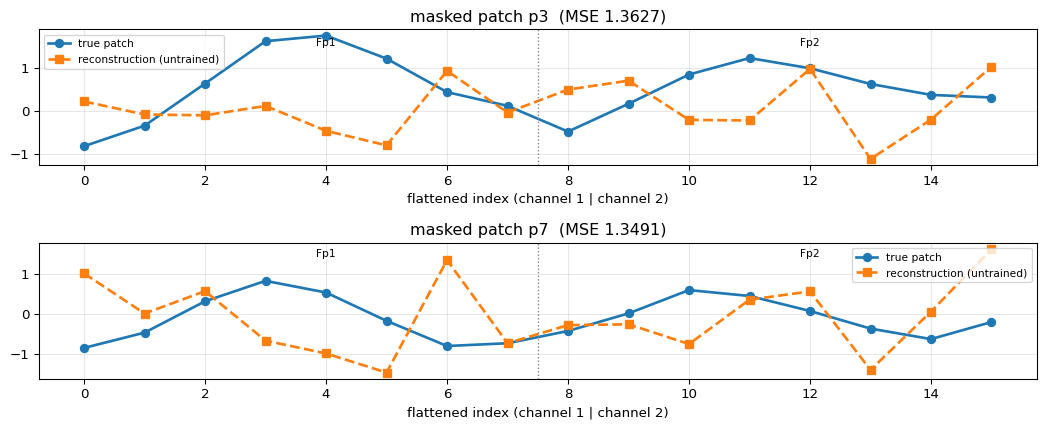
     p3      YES    1.362692                   YES
     p4        -    0.606813  no  (input, not a target)
     p5        -    0.589623  no  (input, not a target)
     p6        -    1.352232  no  (input, not a target)
     p7      YES    1.349081                   YES
--------------------------------------------------

masked patches: ['p3', 'p7']
their MSEs    : [1.3627 1.3491]

loss = mean = (1.362692 + 1.349081) / 2
     = 2.711772 / 2 = 1.355886

worked example, patch p3:
   predicted[:4] = [ 0.2192 -0.0855 -0.1055  0.1145]
   true[:4]      = [-0.8272 -0.3474  0.638   1.6286]
   diff[:4]      = [ 1.0465  0.2619 -0.7435 -1.5141]
   sum of squares over 16 values = 21.803068
   / 16 = 1.362692
   from array   = 1.362692   MATCH: True

baseline (predict the mean of the masked patches): 0.492816
model loss with RANDOM, untrained weights        : 1.355886

The weights here were never trained, so there is nothing to celebrate in
that number. What has been shown is the mechanism, not a result.
With random weights the reconstruction is unrelated to the target - as it
must be. Training is what closes that gap, and the loss above is the signal
that would drive it.
8. What [CLS] Is For
The reconstruction head is thrown away after pre-training. What survives is the encoder,
and the usual way to attach a classifier is through the [CLS] position:
$$\hat{y} = \sigma\big(H_{\texttt{[CLS]}} \, w_c + b_c\big)$$
[CLS] carries no signal of its own, so everything in it arrived through attention from
the patches. That is what makes it a whole-recording summary — useful for "does this
epoch contain a seizure?".
H[CLS] = [-0.3946  1.3115 -0.2359 -0.2945 -1.8269 -0.2055  1.6127  0.0333]

logit = H_CLS . w_c + b_c
      = (-0.3946)*(-0.0796) + (+1.3115)*(+0.4269) + (-0.2359)*(+0.0815) + (-0.2945)*(+0.1528) +
      (-1.8269)*(+0.1913) + (-0.2055)*(+0.0470) + (+1.6127)*(+0.1838) + (+0.0333)*(-0.0418)
      = +0.463005

P(seizure) = sigmoid(+0.463005) = 1 / (1 + exp(-0.463005)) = 0.613727


where [CLS] got its content - its attention row (head 0):

  attends to     weight
------------------------
       [CLS]     0.1081  ######
          p0     0.1568  #########
          p1     0.1121  ######
          p2     0.0689  ####
          p3     0.1127  ######
          p4     0.1253  #######
          p5     0.1307  #######
          p6     0.0746  ####
          p7     0.1107  ######
------------------------
sum = 1.000000

[CLS] began as a fixed learned vector identical for every recording.
Everything that distinguishes one recording's [CLS] from another's came
through these attention weights.
9. Summary
| Stage | Operation | Shape |
|---|---|---|
| Raw EEG | 2 channels x 64 samples | $(2, 64)$ |
| Patching | 8 patches of 8 samples, channels flattened | $(8, 16)$ |
| Patch embedding | $\text{patch}\,W_e + b_e$ | $(8, 8)$ |
Add [CLS] + PE |
prepend and add | $(9, 8)$ |
| Masking | 2 positions → [MASK] vector |
$(9, 8)$ |
| Self-attention | $\mathrm{softmax}(QK^\top/\sqrt{d_k})V$, no mask | $(9, 9)$ weights |
| Encoder output $H$ | attention + FFN, each with Add & Norm | $(9, 8)$ |
| Reconstruction | $H_{1:}W_r + b_r$ | $(8, 16)$ |
| Loss | MSE on masked positions only | scalar |
The one idea: remove the causal mask and the model stops being a generator and becomes an encoder. Prediction of the next item is replaced by reconstruction of a missing one, which is a task that requires understanding context from both directions.
Why this transfers to EEG so directly: BERT never actually required words. It required a sequence of vectors, a way to corrupt some of them, and a loss comparing the reconstruction to the original. Patching supplies the vectors; MSE supplies the loss. The attention mathematics is untouched.
What is deliberately left out: multiple stacked encoder layers (this is one block), learned rather than sinusoidal positional embeddings, the 80/10/10 corruption applied stochastically, GELU instead of ReLU, dropout, next-sentence prediction, and any actual training — every weight here is random.
Compared with the autoregressive Transformer walkthrough:
| Autoregressive (GPT-style) | BERT (this notebook) | |
|---|---|---|
| Mask | causal, upper triangle $= -\infty$ | none |
| Context | left only | both directions |
| Task | predict the next token | reconstruct masked inputs |
| Loss | cross-entropy over vocabulary | MSE over the masked patches |
| Stacks | encoder + decoder | encoder only |
| Good at | generating sequences | representing them |